The Patient
He came to me in his forties with a history that explained everything — a severe motorcycle accident that had left his cervical spine structurally devastated. By the time I saw him, the consequences had progressed well beyond neck complaints. He was losing the ability to write with his right hand. Grip strength was gone. The muscle mass in his right forearm had atrophied. His right hand was withering from the inside out.
This was not a neck pain case. This was progressive neurological deterioration driven by chronic, unresolved cervical subluxation — and the brachial plexus was paying the price.
What the X-Ray Revealed
Lateral cervical X-ray told the full story. The cervical curve had not just flattened — it had reversed. Forward head carriage was severe and measurable. And the degeneration of the vertebral structures was significant: the bones themselves showed the wear of a spine that had been subluxated and mechanically compromised for years following the accident. This wasn't acute injury. This was what happens when trauma-induced subluxation goes uncorrected and the spine adapts around the damage.
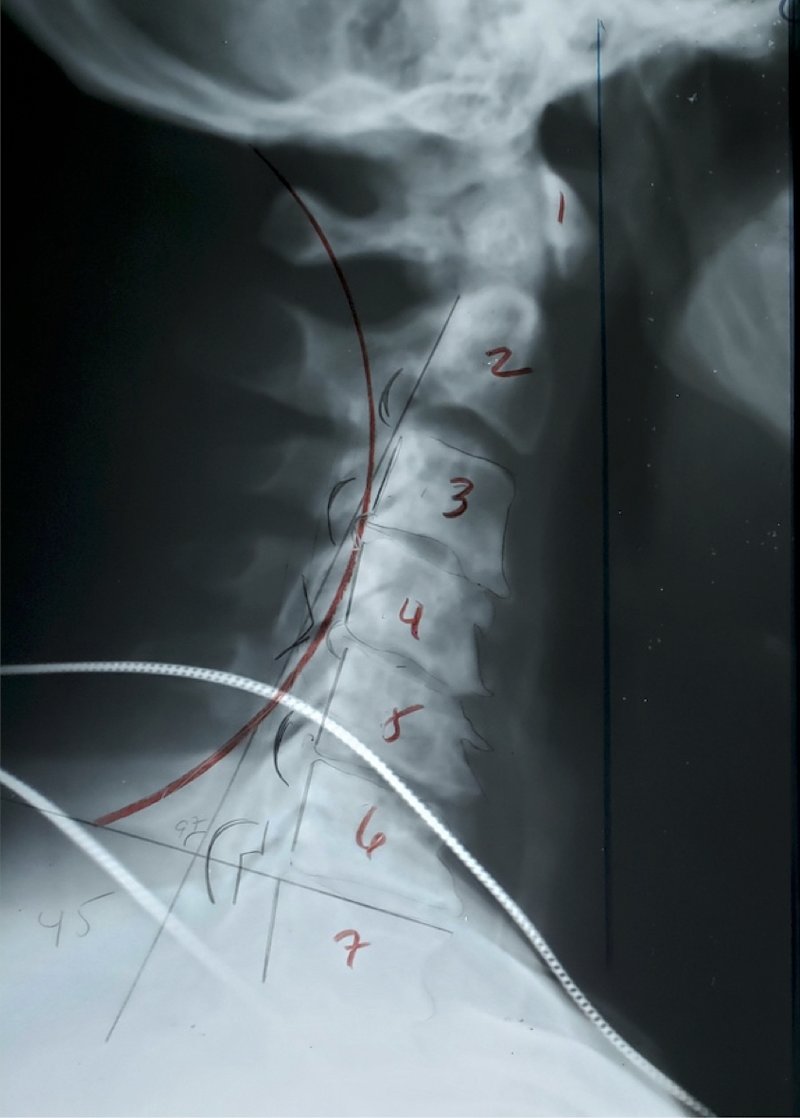
Reversed curve, severe degeneration
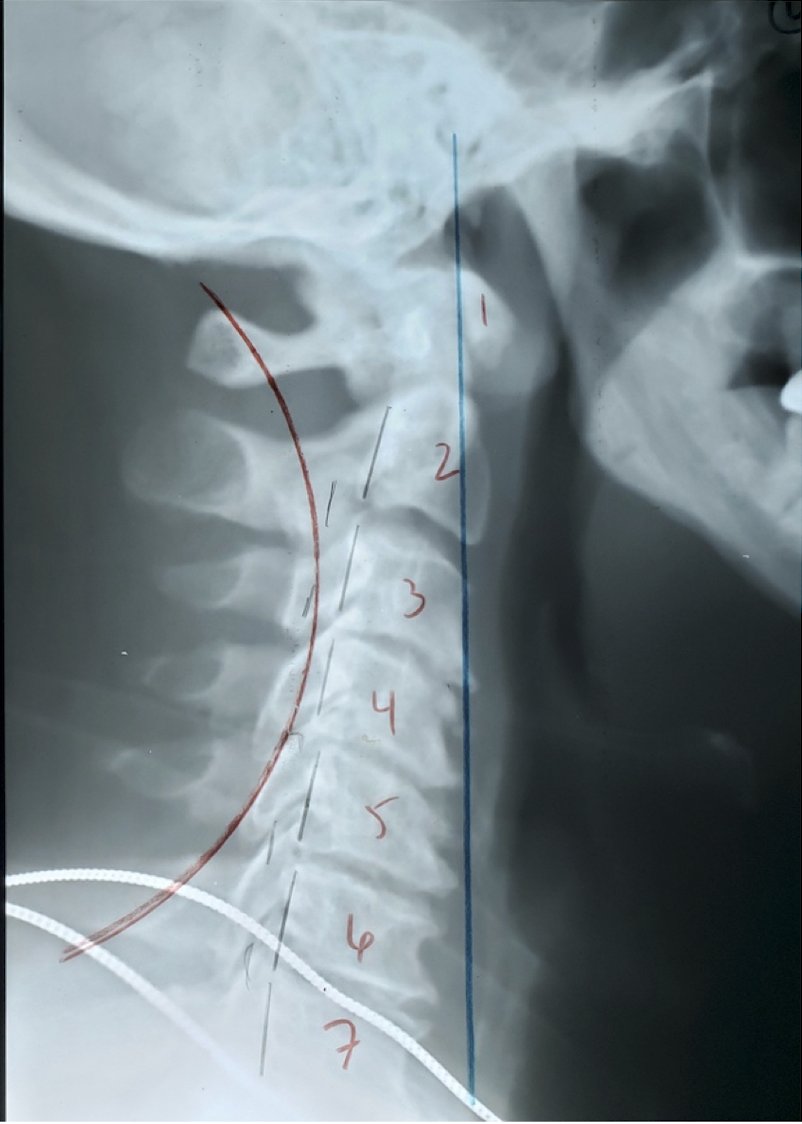
Curve straightened, head carriage improved
Structural Findings — Initial Examination
Cervical curve (lateral): Reversed — kyphotic deformity. Severe forward head carriage.
Vertebral degeneration: Significant — consistent with years of post-traumatic subluxation.
Neurological consequence: Progressive brachial plexus compromise — right-side grip loss, forearm atrophy, fine motor deterioration.
The Brachial Plexus: Where Cervical Subluxation Meets the Upper Extremity
The cervical nerve roots — particularly C6, C7, and C8 — form the core of the brachial plexus, which drives motor and sensory function throughout the shoulder, arm, forearm, and hand. When cervical subluxation compresses those nerve roots chronically, the muscles they supply begin to deteriorate. Grip weakens. Mass is lost. Fine motor tasks become impossible. The hand loses the neural input it needs to function.
This is exactly what was happening in his right arm. The reversed cervical curve and the forward head carriage were creating sustained compression on the nerve roots feeding the brachial plexus on the right side. His hand wasn't failing because of a hand problem. It was failing because the nerve supply originating in his cervical spine had been compromised since the accident.
6 Months of Corrective Care
Over 6 months of specific corrective chiropractic adjustments, we worked to move his cervical curve from reversal toward straightening — reducing the nerve root compression and restoring structural integrity to a spine that had been severely traumatized. The correction on X-ray may not look dramatic to an untrained eye. But context matters here: when you are working with a spine this degenerated, with this degree of post-traumatic structural compromise, moving from a reversed curve to a straightened curve is a profound structural achievement.
Structural Correction — 6-Month Results
Cervical curve: Reversal corrected to straightening. Forward head carriage significantly reduced.
Nerve root decompression: Brachial plexus interference reduced as cervical alignment improved.
He regained all of his grip strength. He was able to write with his right hand again. The forearm atrophy began to reverse as the nerve supply was restored. And he returned to playing golf.
The functional improvement — and the restoration of his quality of life — is exactly why we practice chiropractic this way. The body is capable of reclaiming lost function when the nervous system interference that is blocking it is removed. Maintaining clear nerve system communication is the key.
Why This Pattern Matters
The timeline in this case is the point most people miss: the accident was not recent. Years separated the initial trauma from the progressive hand deterioration that finally brought him in. The cervical subluxation created by that accident did not produce immediate crisis. It produced slow structural degeneration — the reversed curve, the chronic nerve root compression, the gradual loss of brachial plexus function — that accumulated over time until it became undeniable. By the time the hand is atrophying, the process has been running for a long time. The lesson is not that trauma leads to hand weakness. The lesson is that trauma-induced subluxation, left uncorrected, leads there — and that correction is still possible even when the structural damage is significant.
The body's capacity for restoration is not erased by degeneration. It is constrained by interference. When that interference is removed — even in a spine this structurally compromised — Innate Intelligence begins to restore what it was always trying to restore. Moving a reversed cervical curve to straight, reducing the compression on the nerve roots of the brachial plexus, and restoring motor signal to an atrophied forearm is a testament to what the nervous system can accomplish when the structural obstruction is addressed.
What to Look For
Progressive, asymmetric upper extremity weakness — particularly grip loss, forearm atrophy, or declining fine motor function on one side — following a history of cervical trauma is the pattern that belongs on a structural evaluation table, not a neurology referral list alone. The cervical spine is the origin of the brachial plexus. Structural compromise at C6, C7, or C8 produces exactly the hand and forearm dysfunction described in this case. If the cervical structure has never been X-rayed and assessed for subluxation following the original trauma, the source of the deterioration remains unaddressed regardless of what other interventions are applied.
The gap between accident and consequence can be years or decades. That gap creates the impression that the symptoms are unrelated to the original injury. They are not. The subluxation that the accident produced is still there — still compressing, still interfering, still driving the process forward. Have you ever had your spine checked for subluxation?
Progressive Neurological Loss Doesn't Have to Be the End of the Story
If you or someone you know is experiencing grip weakness, arm dysfunction, or progressive loss of upper extremity function — especially following trauma — a structural assessment of the cervical spine may reveal what is driving it. We serve patients across Royal Palm Beach, Wellington, and the greater West Palm Beach area.
Schedule a Structural AssessmentOr call us at (561) 795-3156
To learn more about how cervical subluxation affects neurological function in the upper extremity, visit our cervical subluxation resource page.