The Patient
She was referred to me by an existing practice member — a woman in her sixties who had been suffering from severe sciatica for three years. Three years of pain radiating through the hip and down the leg. Three years of medical intervention that produced no relief. No history of recent injury or trauma. No obvious explanation for why a relatively unremarkable health history had produced such persistent, debilitating lower extremity symptoms.
When I examined her cervical spine, I found the answer — and it had nothing to do with her lumbar spine or her sciatic nerve.
What the X-Ray Revealed
Lateral cervical X-ray showed significant vertebral stagger at C4 through C7. The bones were not stacking in smooth alignment — they were displaced relative to each other, creating direct mechanical pressure on the spinal cord at the cervical level. Moderate spondylosis and degeneration were also present, consistent with long-standing subluxation. The spine was compromised — but the damage was in the neck, not the low back.
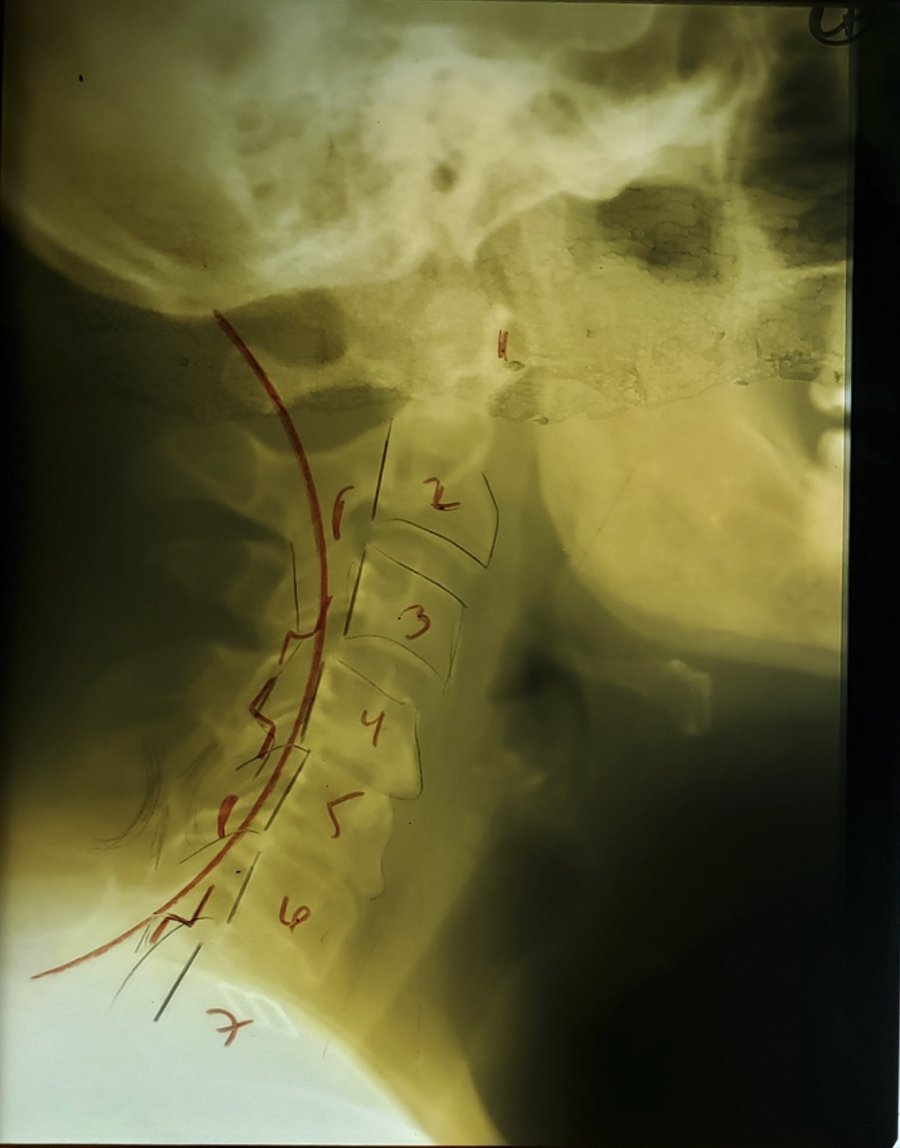
C4–C7 stagger, degeneration
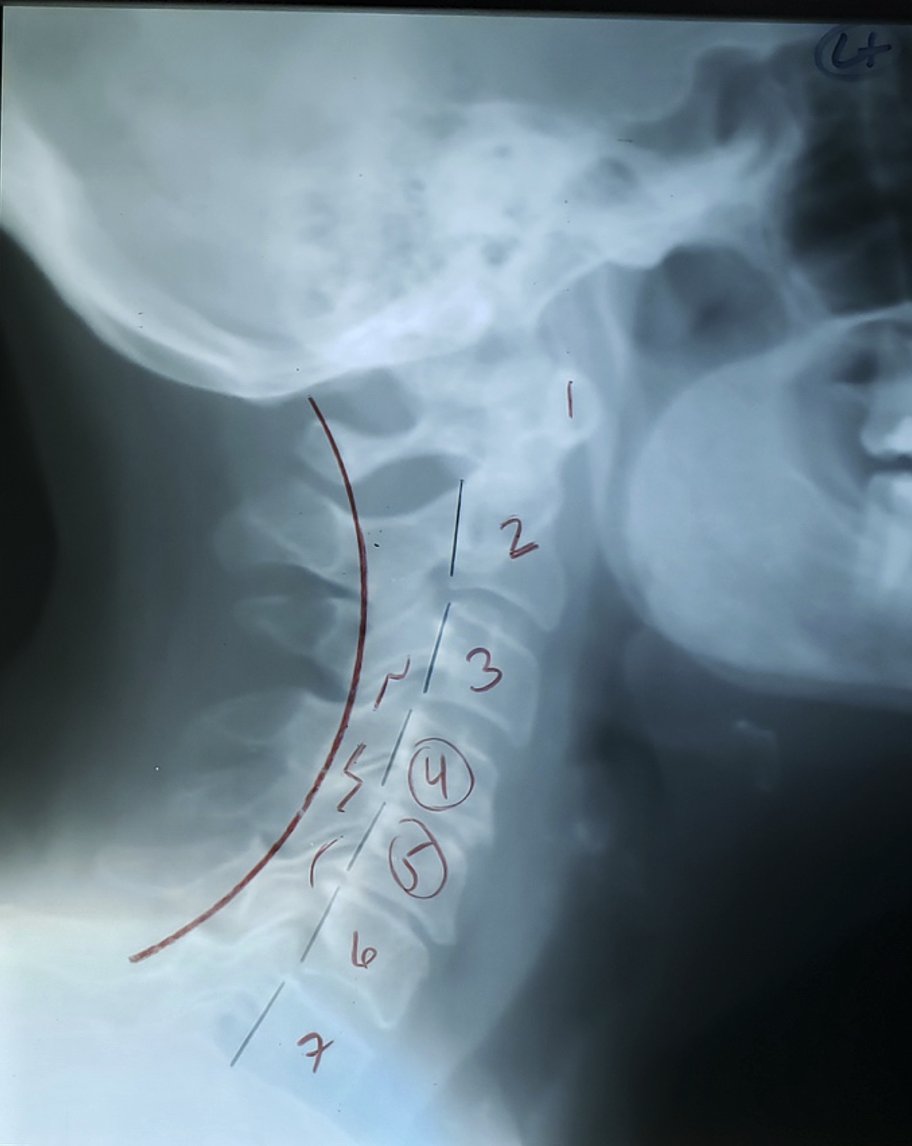
C5–C7 aligned, cord decompressed
Structural Findings — Initial Examination
Cervical (lateral): Vertebral stagger at C4–C7. Bones displaced relative to each other, creating mechanical spinal cord compression.
Degeneration: Moderate spondylosis — consistent with long-standing subluxation.
Lumbar: Not the structural source of her sciatica.
How a Cervical Subluxation Produces Sciatica
This is the question worth understanding — because it reframes everything about how we think about symptoms and their origins.
The spinal cord is a continuous structure running from the brainstem down through the lumbar spine. When vertebral subluxation creates mechanical compression or interference at the cervical cord level — as the stagger at C4–C7 was doing in this case — it doesn't just affect the structures at that level. It disrupts the integrity of nerve signal transmission through the entire cord below it. The lumbar and sacral segments, which give rise to the sciatic nerve, receive degraded or interfered signals from above.
Three years of treatment directed at the lumbar spine and the sciatic nerve pathway produced no resolution because the source was never there. The interference was at C4–C7. Chase the sciatica and you find nothing. Correct the cervical subluxation and the nervous system restores itself.
The Corrective Approach and Results
My approach was to correct the vertebral subluxation in her cervical spine — specifically the stagger pattern at C4 through C7. Through specific corrective adjustments targeting those segments, we progressively restored alignment. Follow-up X-ray showed C5, C6, and C7 properly aligned. C4 retained some displacement, but the overall reduction in spinal cord compression was significant and measurable.
Structural Correction — Post-Care Results
C5, C6, C7: Properly aligned — stagger corrected, spinal cord decompressed.
C4: Improved but retains some displacement — ongoing correction in progress.
Nerve flow: Immense relief of pressure off the spinal cord. Restored nerve transmission.
Her sciatica resolved. Three years of medically unresolved lower extremity pain cleared after correcting a cervical subluxation. Not because we treated her sciatica — because we corrected the structural interference that was disrupting her nervous system, and her body did the rest.
Instead of trying to take away her sciatica, we corrected her subluxation. Her body healed itself.
Why This Pattern Matters
The spinal cord is a single continuous structure. There is no clean anatomical boundary that confines cervical problems to the neck or guarantees that leg symptoms originate in the lumbar spine. The entire cord — from the brainstem through the cervical, thoracic, lumbar, and sacral segments — is a connected transmission pathway. When vertebral subluxation creates compression or interference at any level, it degrades the quality and integrity of nerve signal transmission from that point downward. The lumbar and sacral segments that give rise to the sciatic nerve receive that degraded signal. The leg feels it.
In this case, three years of treatment were directed at exactly the wrong location. Every intervention targeted the leg and the lumbar spine — where the symptom appeared — rather than the cervical spine, where the structural interference was actually located. This is not unusual. It is the predictable result of treating symptoms rather than investigating structural cause. The subluxation at C4 through C7 was producing the sciatica before anyone examined her neck. Correcting it removed the interference. Her Innate Intelligence restored the function that was always within her body's capacity to restore.
This principle has consequences beyond this single case. Every patient with persistent unresolved sciatica who has never had a structural assessment of the cervical spine has not yet received a complete investigation. Lumbar-focused treatment for cervical-source sciatica does not fail because providers are incompetent. It fails because the investigation stopped at the symptom's location and never reached the structural source. A complete spinal evaluation — cervical through lumbar — is the investigation that changes the outcome.
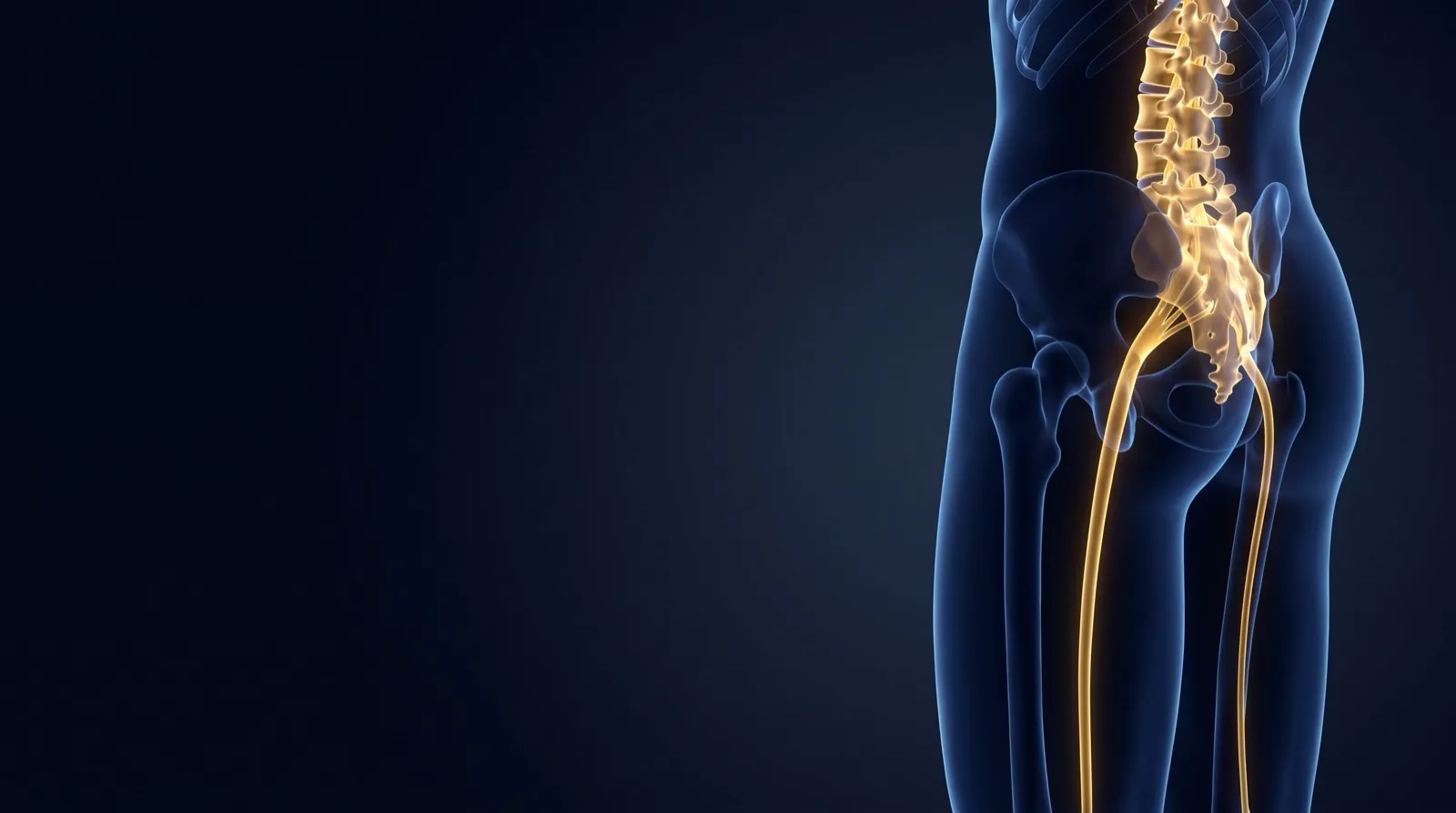
The anatomy of this case is worth understanding directly. The sciatic nerve originates from lumbar and sacral nerve roots — L4, L5, S1, S2, and S3. Those roots emerge from the spinal cord, which is a continuous structure running from the brain stem through the cervical, thoracic, and lumbar spine. When vertebral subluxation at C4 through C7 places mechanical compression on the spinal cord, it degrades the integrity of neural transmission flowing down the entire cord — including through the lumbar and sacral segments where the sciatic nerve originates. The sciatic nerve depends on clear signal transmission the full length of the cord. Compress that transmission at the cervical level and the sciatic nerve expresses it in the leg.
This is also why the correction produced results that three years of lumbar intervention did not. The lumbar treatments targeted the correct nerve — but from the wrong end of the system. The cervical correction addressed the structural interference degrading the entire transmission pathway. Once that interference was removed, the nerve signal was restored from the source. The sciatica resolved not because the leg was treated, but because the nervous system could communicate from brain to body without obstruction. Structural correction of the actual source achieves what symptom management of the wrong location cannot.
What to Look For
Sciatica without a clear lumbar explanation — no disc herniation on imaging, no documented injury, no identifiable lumbar compression — deserves a full structural evaluation of the cervical spine. The same is true when sciatica has been treated through lumbar-focused interventions, including physical therapy, injections, and medication, without lasting resolution. Three years of failed lumbar treatment was the signal in this case. The problem was never in the lumbar spine.
If you have been told your sciatica is idiopathic — without a known cause — the honest answer is that the cause has not been found yet. There is always a structural source. The question is whether the assessment has looked in the right place. A structural X-ray evaluation of the entire spinal column, not just the area of pain, is the only way to locate where the interference actually lives. Your nervous system was designed to function without interference. When it cannot, the source belongs in the structural record — not on a list of symptoms without explanation. Have you ever had your spine checked for subluxation?
The duration of unresolved treatment is itself diagnostic. Three years of failed lumbar intervention — physical therapy, injections, medication cycles — is not evidence that sciatica cannot be resolved. It is evidence that the structural source has not been identified. When appropriate treatment is applied to the wrong location, the symptom persists. That persistence is the body reporting that the interference has not been found. The right response is a broader structural investigation, not more of the same treatment directed at the wrong place.
Has Your Sciatica Been Treated in the Right Place?
If you've been managing sciatica without lasting resolution — especially without a clear lumbar injury or disc finding — the source may be elsewhere in your spine. A full structural assessment examines the entire spinal column, not just where the symptom appears. We serve patients across Royal Palm Beach, Wellington, and the greater West Palm Beach area.
Schedule a Structural AssessmentOr call us at (561) 795-3156
To learn more about how cervical subluxation affects nerve function throughout the body, visit our cervical subluxation resource page.