The Patient
A 31-year-old female currently in her correction plan. No history of physical trauma. That detail matters, because when most people see disc degeneration on an X-ray, they assume it came from an injury. It didn't here. What produced the degeneration was sustained vertebral subluxation — the structural misalignment of spinal vertebrae that places abnormal, chronic mechanical stress on the discs, bones, and nervous system over time.
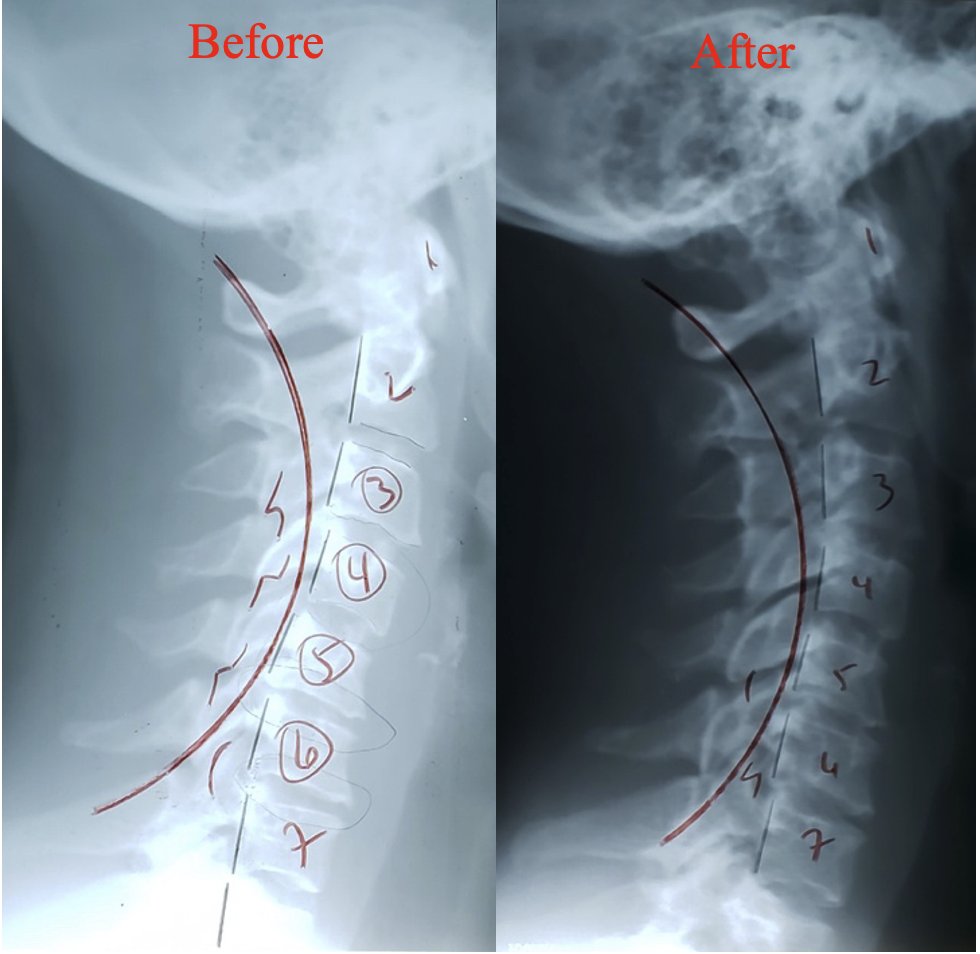
The X-rays told the story clearly: dark spaces between the vertebrae indicating disc thinning, and changes to the bone architecture consistent with long-term structural dysfunction. These are not the findings of acute injury. They are the findings of a spine that has been under uncorrected mechanical stress — subluxation — for years.
What the X-Rays Showed
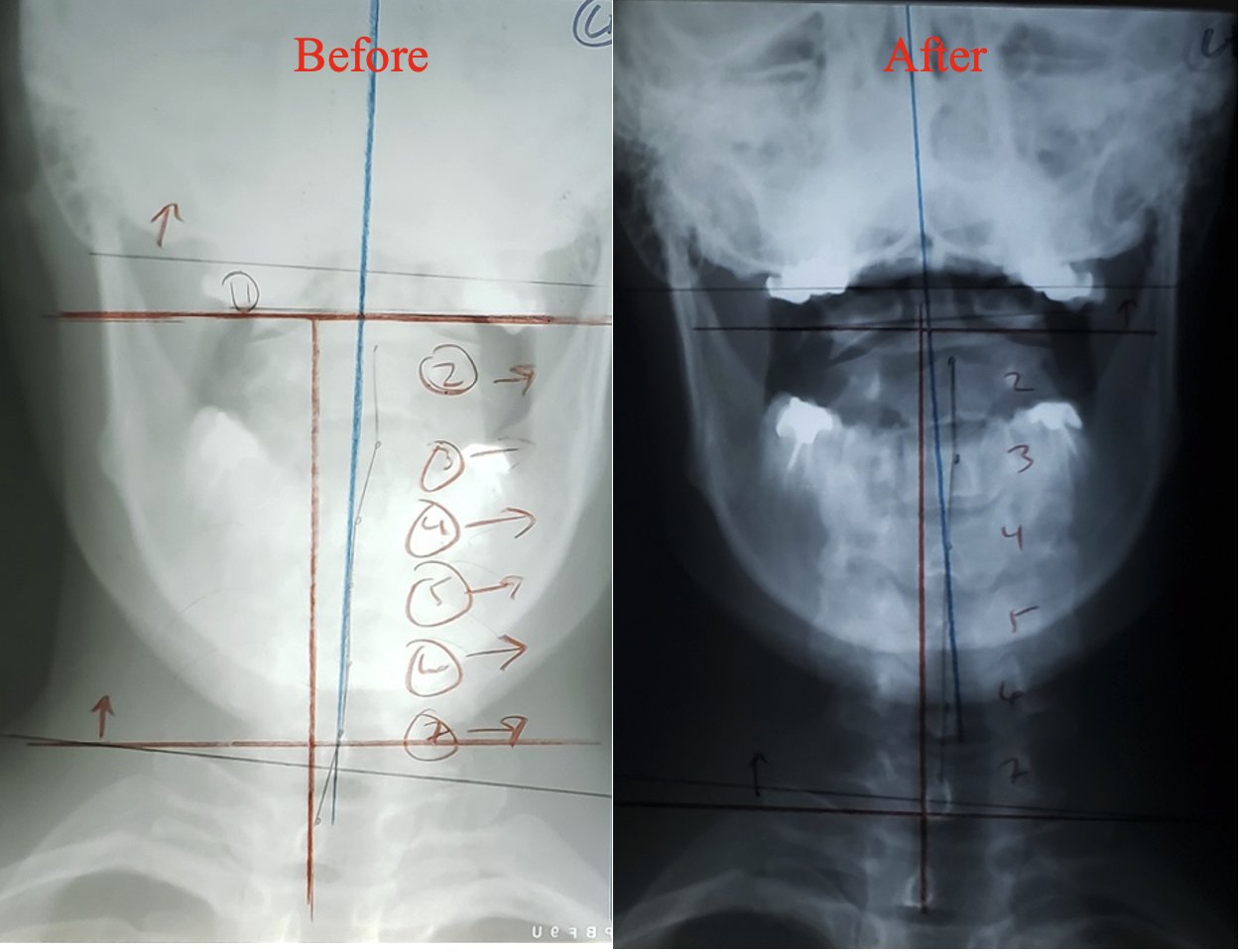
On her initial AP (front-to-back) cervical X-ray, the head tilt was apparent using the vertical reference line. Her skull was displaced laterally off the midline — indicating significant subluxation placing stress on the brain stem. That region of the spinal cord is responsible for coordinating the body's most fundamental automatic functions: heart rate, respiration, circulation, and the neurological signaling that runs the entire body below it.
Three Months of Results
Her original correction plan was designed for six months. Due to outside circumstances, we evaluated structural change at the three-month mark. What we found was meaningful: measurable correction on both AP and lateral cervical X-rays, and significant improvement in how she felt, how she slept, and how she functioned at work.
Those functional improvements are not incidental. They are the direct consequence of removing subluxation-based interference from the nervous system. When the brain can communicate with the body without structural obstruction, the body begins to coordinate its own function the way it was designed to. Sleep improves. Energy improves. Daily performance improves. Not because anything was added — but because the interference was removed.
The results at three months motivated her to continue into a full correction plan. That is the right response. Structural change that begins in three months deepens over six, nine, and twelve months. Stopping early locks in partial correction. Continuing allows the spine to complete its restoration.
Outcomes at the 3-Month Milestone
Measurable structural correction on AP and lateral cervical X-rays.
Visible improvement in head alignment relative to the cervical spine.
Improved sleep quality.
Improved daily energy and work function.
Continued correction plan underway toward the full 6-month goal.
Structure Dictates Function
This case illustrates a principle I return to constantly in practice: structural improvement precedes systemic function improvement. The body does not heal randomly. It heals in response to structural correction. When the vertebrae move back toward their proper position, nerve flow is restored. When nerve flow is restored, the systems the nervous system governs — digestion, circulation, sleep, immune response, cognition — begin to express normal function again.
This patient did not have a dramatic presenting complaint. She had disc degeneration at 31 that most people would have missed entirely, because they were not looking at the structure. That degeneration was a silent signal of subluxation. Correcting it — now, at 31, before it advances — is exactly the right decision. The sooner the structure is corrected, the more restoration is possible and the less degeneration continues to accumulate.
Why This Pattern Matters
Disc degeneration is commonly understood as an aging process or the result of physical injury. Neither assumption holds in this case. A 31-year-old with no trauma history and visible disc thinning on X-ray is presenting with the structural consequence of sustained vertebral subluxation — the chronic mechanical loading of discs and joint surfaces that subluxation imposes over years, silently, before any symptom forces an evaluation. The degeneration visible at 31 did not develop in 31 years of normal use. It developed over however many years the subluxation was present and uncorrected. The spine was aging faster than the patient.
What changes at this point in the trajectory is entirely determined by whether the structural problem is addressed. Subluxation that continues uncorrected produces more degeneration, more nerve compromise, and eventually a structural baseline that is much harder to reverse. Correction that begins at 31 — with meaningful disc tissue and reasonable structural integrity still present — produces significantly better outcomes than correction attempted at 45 or 55 after the same process has run another decade. This is the case for proactive structural evaluation at any age: not because something hurts, but because structure dictates function, and the structure is telling a story before the symptoms do.
What to Look For
Young adults in their twenties and thirties who experience stiffness upon waking, neck tension that never fully resolves, mild but persistent fatigue, or generalized dysfunction that does not respond to rest or exercise are often presenting with the early functional consequences of subluxation-driven disc change. They attribute it to stress, their work environment, or simply "getting older" — which at 31 is already a sign that something structural is robbing them of function they should have.
The absence of a trauma history is not evidence that the spine is healthy. It is evidence that the degeneration came from somewhere other than injury — and subluxation is the most common structural source. A lateral cervical X-ray and structural evaluation is the right first step for anyone in this age range who has never been assessed. Have you ever had your spine checked for subluxation?
Is Your Spine Aging Ahead of Schedule?
Disc degeneration on X-ray does not require a trauma history — it requires uncorrected subluxation. A structural assessment at Rochet Family Chiropractic, serving Royal Palm Beach and the greater West Palm Beach area, will show you exactly what is happening in your spine.
Schedule a Structural AssessmentOr call us at (561) 795-3156
To learn more about how cervical subluxation produces structural damage and systemic dysfunction, visit our cervical subluxation resource page.