
Referred by Someone Who Had Already Seen the Results
This 23-year-old woman was referred by her boyfriend, who had completed a corrective care plan at Rochet Family Chiropractic and was continuing under maintenance care. He had experienced exceptional results and believed that subluxation correction could help her. She arrived seeking care primarily for migraine headaches and severe neck pain — issues she had been managing without a structural explanation.
The intake process revealed what the headaches had not revealed on their own. Her health history showed a digestive system that operated slowly, with stagnation she had accepted as normal. It also showed menstrual cycles that had been severely disruptive for years: heavy flow, severe cramping, irregular timing. She had sought answers for these issues separately, without resolution, because no one had looked at her spine as a possible source of the nerve interference driving them.
What the Examination Found
Clinical Findings — Initial AP Upper Cervical Examination
Patient: 23-year-old female, referred by practice member (boyfriend)
Primary complaint: Migraine headaches, severe neck pain
Health history findings: Slow/stagnant digestion; disruptive menstrual cycles (severe cramping, irregular and heavy flow) for years without identified cause
X-ray type: AP upper cervical
Primary subluxation: Atlas (C1) and head alignment — severely subluxated
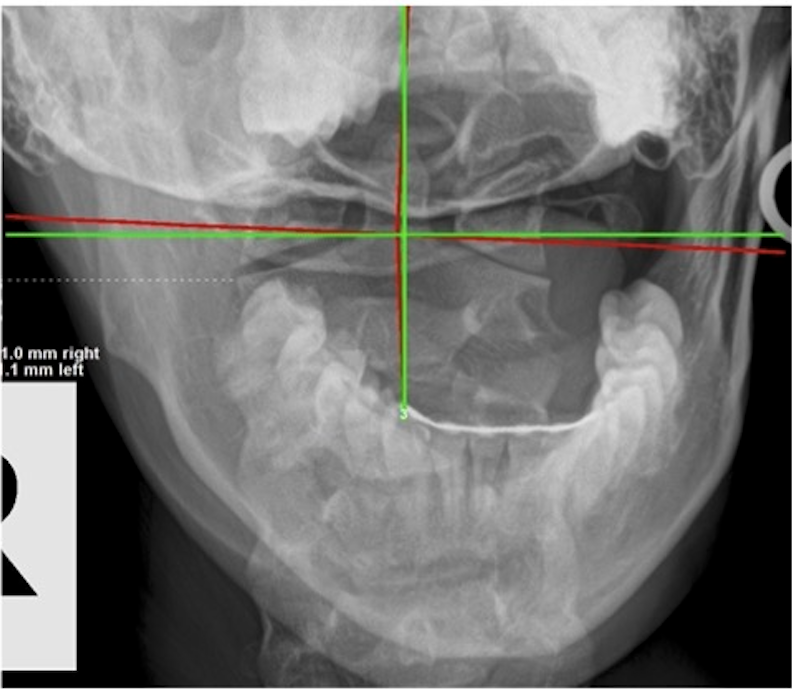
Initial measurements: C1 overhang 0.8mm right / 1.0mm left on AP film
The AP upper cervical X-ray confirmed it clearly. Her Atlas (C1) and the overall alignment of her head were severely subluxated. The Atlas encircles the brainstem — the control center for the autonomic nervous system, which governs digestion, hormonal regulation, vascular tone, and immune response. When the Atlas is displaced from its proper position, the nerve interference created at the brainstem level does not stay local. It travels through every system the brainstem governs. The headaches were the symptom she noticed first. They were not the only consequence.
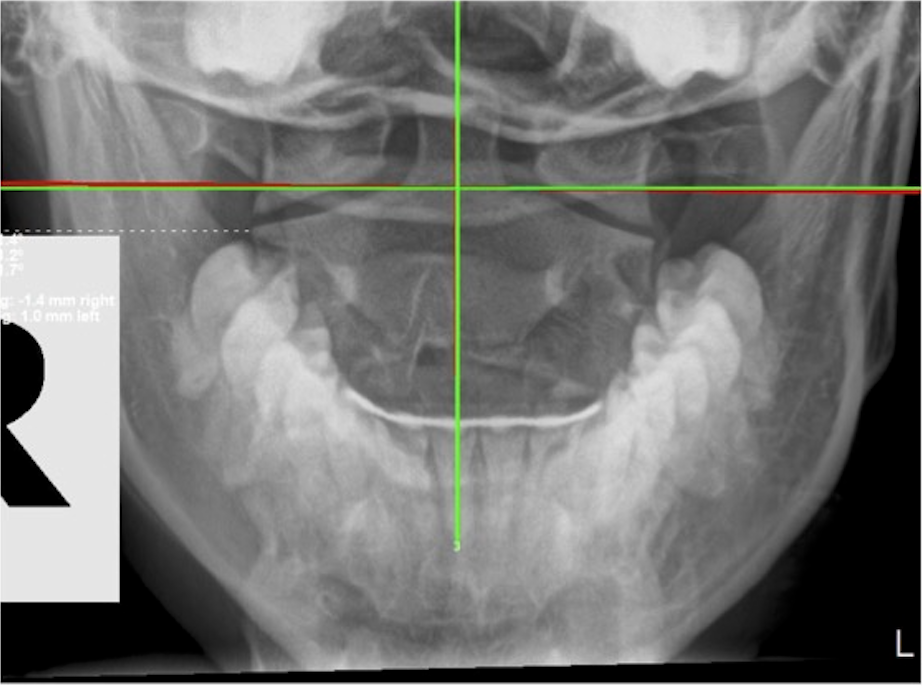
Atlas (C1) AP — Before & After
What Correcting the Atlas Restored
As we progressed through her corrective care plan, the changes followed the structural correction. Her headaches resolved completely. We do not treat headaches — we correct subluxation. The headaches resolved because the nerve interference driving them was removed. Her digestion improved. We do not treat digestive conditions — we correct subluxation. Her digestion improved because the vagal nerve pathway, which governs digestive motility, regained its structural freedom through atlas correction. Her menstrual cycle regulated and the severity of her symptoms decreased. We do not treat reproductive or hormonal conditions — we correct subluxation. The body, designed by God to self-regulate through Innate Intelligence, does the rest.
She said her quality of life improvements were far greater than she had expected coming in. That is nearly always the case when patients present with systemic dysfunction that has been driven by upper cervical subluxation. They come in expecting help with one thing. The body, freed from interference, expresses health across every system it governs. Her health future is far brighter than it was before her corrective care.
Why This Pattern Matters
The migraine-digestion-menstrual case is the one I return to most often when explaining why subluxation-based chiropractic is not musculoskeletal care. She came in for headaches. Her atlas was also interfering with the vagal nerve pathway that drives digestive motility, the autonomic signals governing hormonal regulation, and the vascular mechanisms behind migraine generation — all from a single structural displacement at C1.
The atlas is not simply the top vertebra of the cervical spine. It is the gatekeeper between the brainstem and the rest of the nervous system. The brainstem contains the control centers for every autonomic function the body runs on: heart rate, breathing, digestion, immune response, hormonal signaling, and sleep. When the atlas is displaced, the interference created at that level travels downstream through every system the brainstem governs.
This is why patients with atlas subluxation often present with complaints spanning multiple systems simultaneously — and why physicians addressing each complaint in isolation rarely find answers. The spine is the common thread. Correcting it allows Innate Intelligence to restore function across every channel that was being interfered with.
There is a specific failure mode worth naming: the sequential specialist consultation. A young woman with recurring headaches sees a neurologist. Digestive irregularity sends her to a gastroenterologist. Hormonal irregularity leads to an OBGYN evaluation. Each specialist finds their own system in partial dysfunction and manages it independently. No one asks about the structural relationship between those systems. No one takes a cervical X-ray. The atlas subluxation driving all three presentations remains undetected. This is not a criticism of specialists — it is a structural blind spot that subluxation-based evaluation is specifically positioned to address.
The boyfriend referral in this case is also instructive. He had completed a corrective care plan at Rochet Family Chiropractic. He watched her manage multiple symptoms with no resolution. He recognized that a structural evaluation had never been done and referred her accordingly. That referral was based on direct knowledge of what structural correction produces. The most reliable referrals come from people who have experienced the outcome themselves and can recognize when someone they know has the same underlying pattern.
The sequential specialist path this patient traveled before arriving at a structural evaluation is worth noting for what it reveals about how multi-system presentations are routed in conventional medicine. Each specialist addressed the system within their scope — neurology for the headaches, gastroenterology for the digestion, gynecology for the hormonal disruption. Each was responding appropriately within their specialty. What none of them had training to ask was whether the atlas was structurally displaced and interfering with the brainstem pathways governing all three systems simultaneously. That question belongs to a different discipline entirely, and it was the last one asked.
The speed of recovery in atlas correction cases also follows a pattern that differs from lumbar or thoracic correction. When the brainstem pathway is cleared through C1 and C2 adjustment, the downstream autonomic effects can improve within weeks. The nervous system's capacity to restore regulated function, once the primary interference at the atlas is removed, is often faster than both the patient and the provider expect. The multi-system improvements documented in this case — migraines reduced, digestion normalized, menstrual regularity restored — were not the result of treating those systems directly. They were the result of clearing the one structural source that was disrupting all of them.
What to Look For
Atlas subluxation in young adults frequently presents as a cluster of complaints that individually seem minor or unrelated: recurring headaches starting at the base of the skull; brain fog or difficulty concentrating; digestive irregularity that has been present so long it feels normal; sleep that doesn't feel restorative; hormonal patterns that don't match what bloodwork shows.
If several of these descriptions apply simultaneously, a structural evaluation of the upper cervical spine is worth pursuing. The AP cervical X-ray shows C1 position relative to the skull base and identifies displacement from normal. The atlas is small, and the displacements that create significant brainstem interference are measured in millimeters — which is why the X-ray, not examination alone, is required to see them clearly.
The pattern intensifies over time. A 23-year-old managing migraines, digestive irregularity, and hormonal disruption simultaneously has likely been accumulating atlas subluxation for years — through sports, accidents, postural loading, or trauma that occurred before the symptoms became significant enough to report. Early evaluation changes the trajectory. The longer the atlas remains displaced, the more the brainstem-governed systems adapt around the interference — and the longer the correction process takes to fully restore them. Have you ever had your spine checked for subluxation?
Your Spine Governs Everything. Including What You Think Is Unrelated.
If you have been managing migraines, digestive issues, hormonal irregularities, or other systemic concerns without structural answers, your Atlas may be the missing piece. A thorough examination and AP upper cervical X-ray can show what has been interfering with your nervous system — and what correcting it could restore.
Schedule a Structural EvaluationOr call us at (561) 795-3156
Related: How atlas subluxation presented as low back pain and resolved globally through C1 and C2 correction.