When Desk Work Becomes a Structural Crisis
A 47-year-old computer professional came to me with a constellation of complaints that at first glance seemed unrelated. Numbness and tingling radiating down both arms. Declining grip strength. Headaches that never went away. Low back pain that seemed to come "out of nowhere." His ability to perform fine motor work — the detailed tasks that defined his profession — was becoming increasingly difficult.
But these weren't separate problems. They were all consequences of cervical subluxation actively disrupting his nervous system function.
Like so many in today's workplace — here in Royal Palm Beach and across the West Palm area — his workday was spent in front of a screen. Over months, forward-head posture created progressive vertebral misalignment in his cervical spine. That misalignment didn't sit there passively. It was actively disrupting his nervous system, degrading his ability to work, sleep, and move freely.
His quality of life was deteriorating. Sleep was poor. His ability to be present and productive was compromised. The subluxations weren't just a structural problem — they were limiting his ability to live the way he wanted to live.
What the X-Rays Revealed
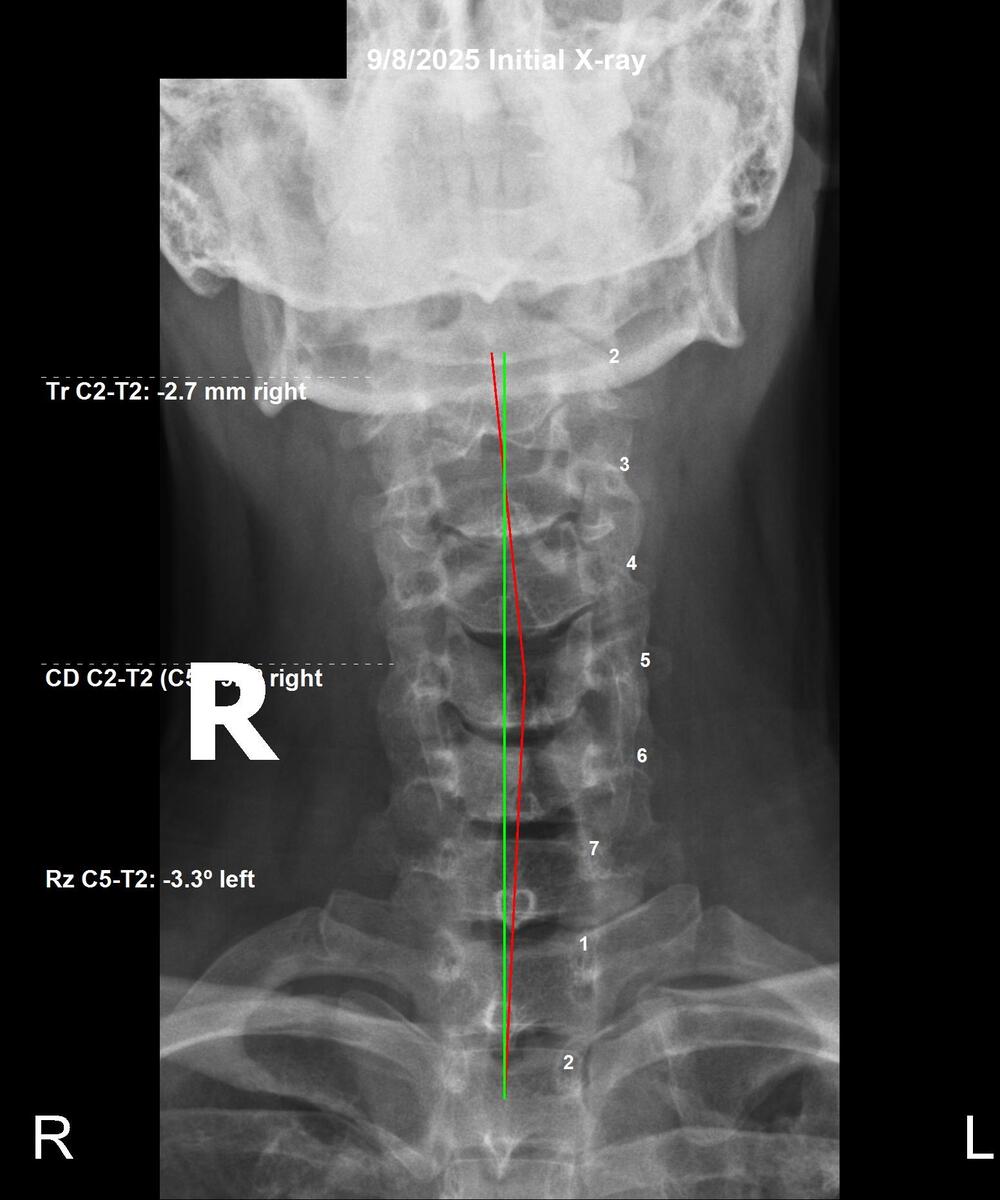
Structural analysis showed something significant. His cervical spine had a severe right head tilt — 2.7mm deviation at C2-T2 — with a rotational component crushing nerve roots. His lumbar AP X-ray revealed a left anterior inferior (AI) sacrum at 2.3 degrees — the sacral base unlevel and tilting forward and down on the left, destabilizing the entire lumbar foundation above it.
This wasn't passive misalignment. The cervical subluxations were compressing nerve roots, creating paresthesias — numbness and tingling — radiating down both arms. His grip strength was declining because the nerve pathways controlling hand and forearm function were being compressed at the source. The headaches were a direct consequence of cervical subluxation disrupting the nerve pathways that control sensation and vascular regulation in the head and neck.
The low back pain had its own structural cause. The AP lumbar revealed a left anterior inferior (AI) sacrum — his sacral base tilted forward and down on the left at 2.3 degrees. An unlevel sacral foundation creates chronic mechanical stress through the entire lumbar spine. The pain wasn't incidental. It was the direct consequence of his pelvis being structurally out of alignment beneath him.
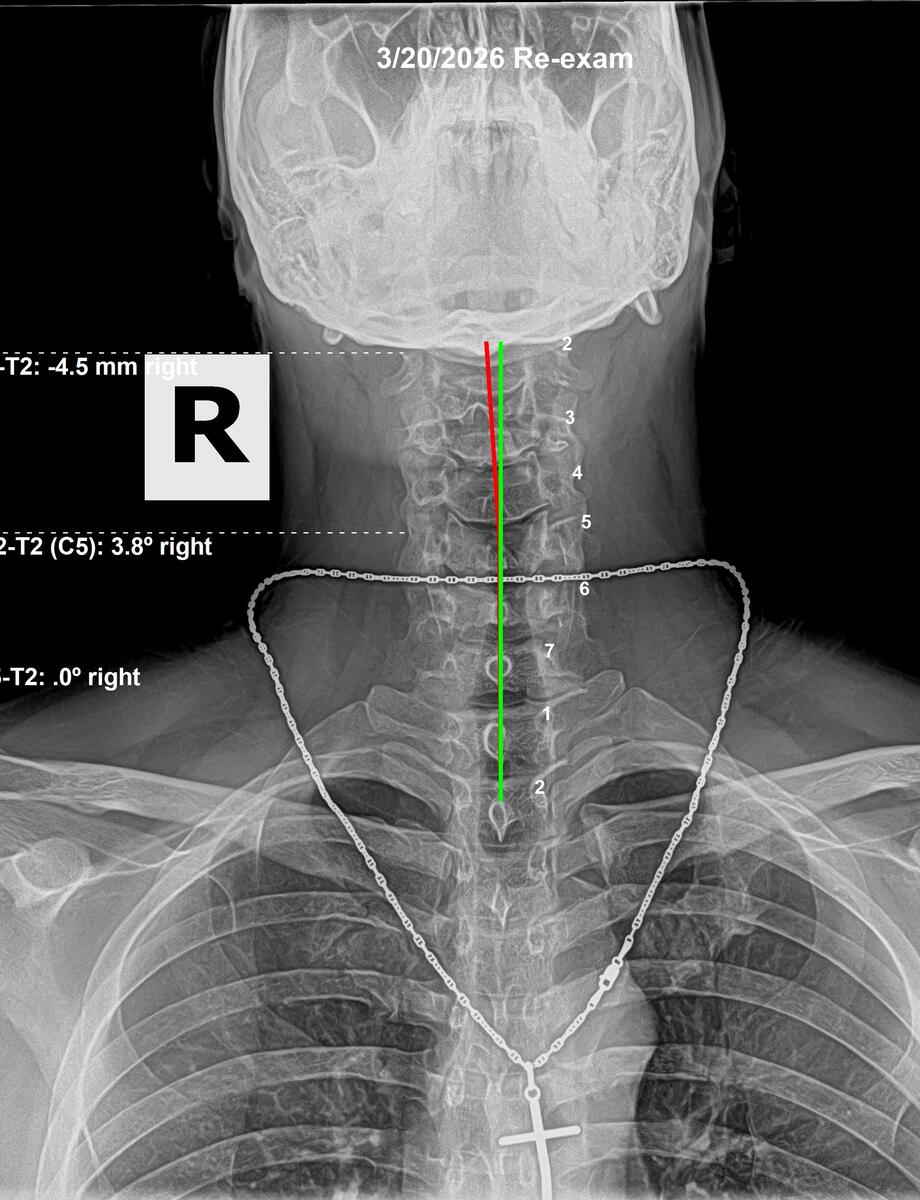
Cervical Spine — Before & After 12 Weeks
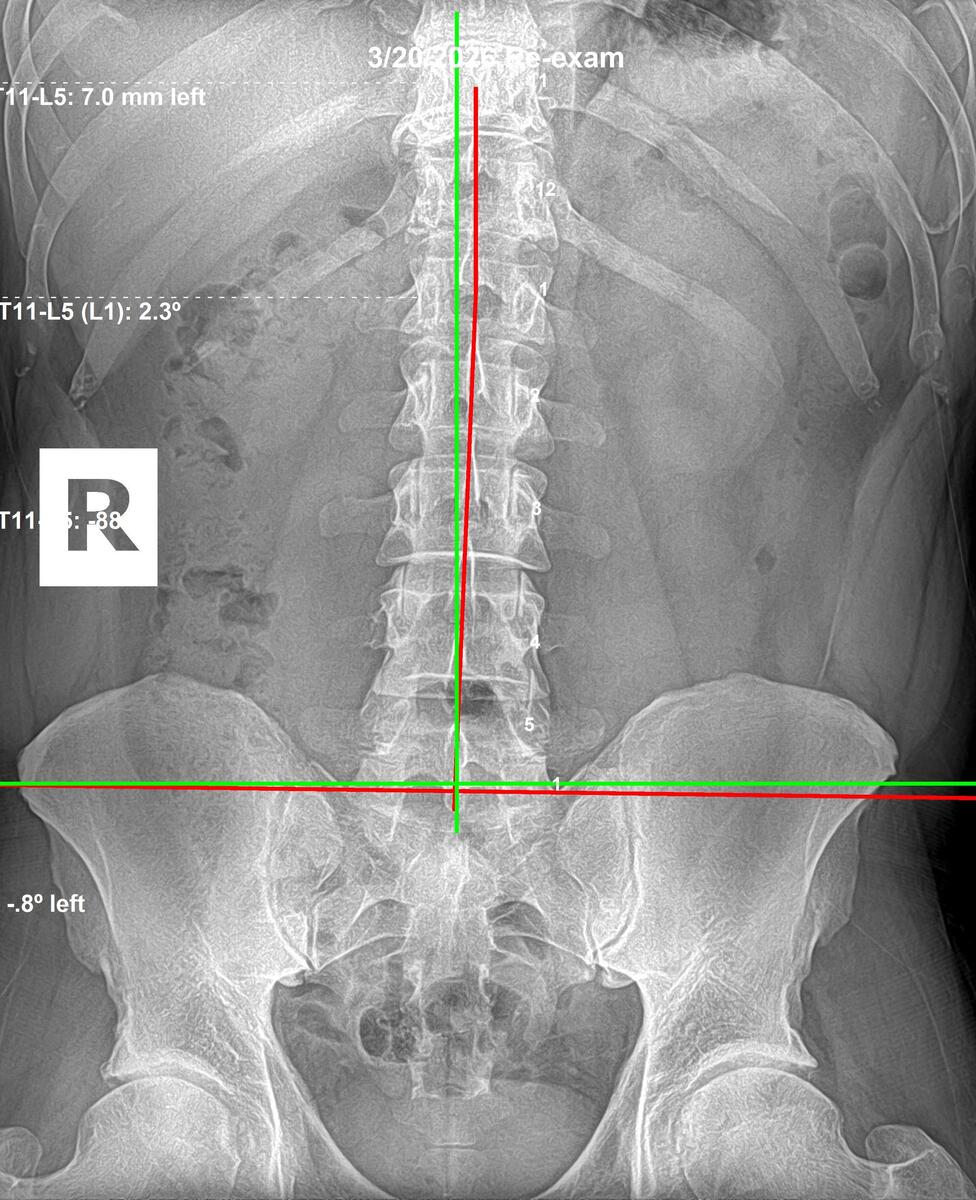
Lumbar Spine — Before & After 12 Weeks
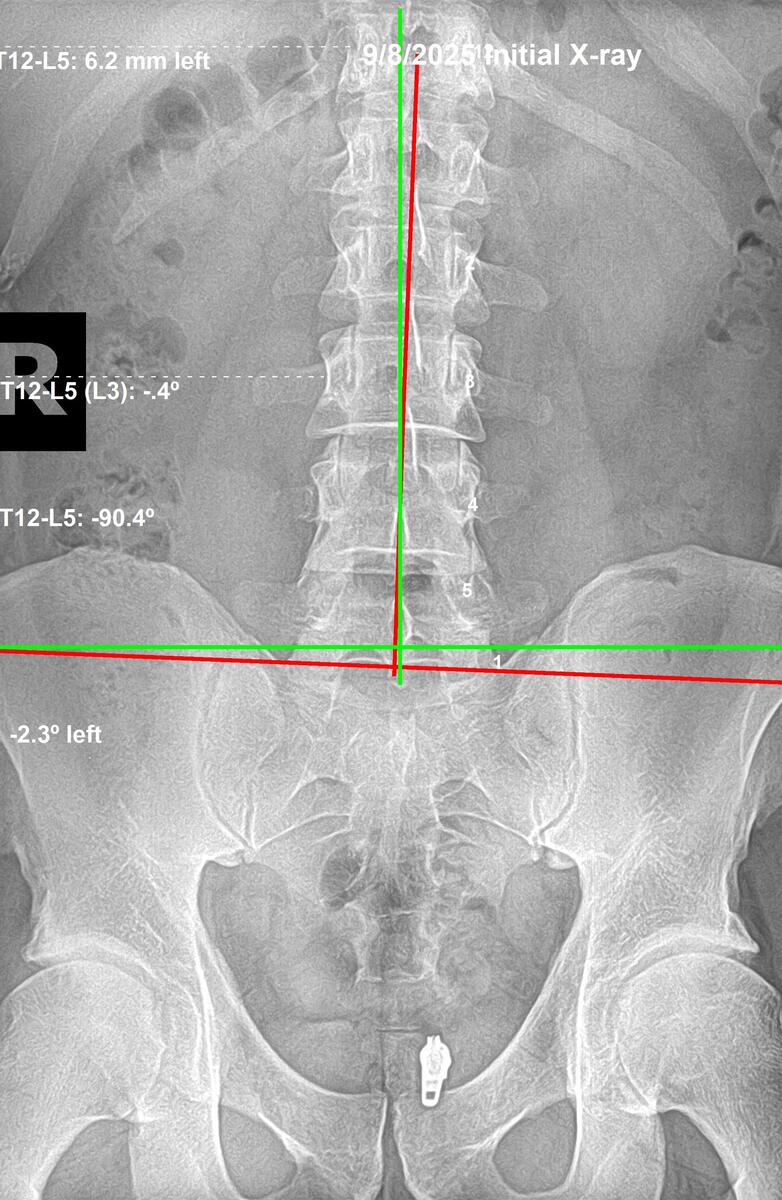
Structural Findings — Initial Examination (Sept 8, 2025)
Cervical: Severe right head tilt (2.7mm deviation at C2-T2). Subluxation with rotational component, crushing nerve roots.
Lumbar (AP): Left anterior inferior (AI) sacrum, 2.3° deviation. Sacral base unlevel, destabilizing lumbar foundation.
The Corrective Approach
My approach was clear: correct the vertebral subluxations and restore his spinal architecture. This required specific adjustments targeting the exact vertebrae involved — C2 in the cervical spine, and the lumbar segments that had lost their natural curve.
This wasn't symptom management. This was structural correction. Over 12 weeks of regular corrective care, his cervical and lumbar vertebrae were progressively realigned through specific adjustments designed to restore proper spinal biomechanics and clear the nervous system interference that was degrading his life.
Structural Correction — 12-Week Interim Results (March 20, 2026)
Cervical: Head tilt corrected from 2.7mm to 0mm. Subluxation at C2 corrected. Cervical vertebrae re-aligned.
Lumbar (AP): Left AI sacrum corrected from 2.3° to 0.8°. Sacral base leveling, lumbar foundation stabilizing.
What Restoration Actually Looks Like
The paresthesias — that constant numbness and tingling in his arms — resolved. His grip strength returned. The fine motor tasks that had become difficult were comfortable again. He could type, perform detailed work, and do his job without nervous system interference disrupting everything.
The headaches disappeared. His sleep quality improved dramatically. Without the constant cervical subluxation and nervous system interference it was creating, his body could finally rest properly.
The low back pain resolved. His ability to work through a full day at his desk returned. He went back to exercising — to moving his body the way he wanted to.
His quality of life was restored. Not because we "treated his numbness" or "relieved his headaches" — we corrected his subluxations, restored his spinal alignment, and allowed his nervous system to function the way it was designed to function. The restoration followed naturally.
Does This Sound Familiar?
If you recognize yourself in this pattern — postural stress from desk work, numbness or tingling, persistent headaches, or function you've accepted as "just how it is" — you don't have to stay there. Structural correction can restore your nervous system function and your quality of life.
Schedule a Structural AssessmentWhy This Matters for Desk Workers in Royal Palm Beach
This case illustrates a principle often lost when care is focused on symptoms: your body's ability to function is directly proportional to the integrity of your spinal structure and the clarity of nerve transmission.
If you spend your day in front of a screen — whether you're in Royal Palm Beach, Wellington, or anywhere in the West Palm Beach corridor — your cervical spine is under constant postural stress. That stress doesn't announce itself with dramatic warning signs. It compounds quietly over months and years. By the time it creates the pattern this patient presented with, the subluxation has been interfering with nervous system function for a long time.
The structural correction he experienced is possible because we didn't try to manage the downstream effects. We identified the cause — vertebral subluxation — corrected it at the source, and allowed his body to restore itself.
The Bigger Picture
This principle applies universally. Cervical subluxation disrupts the nervous system's ability to coordinate function throughout the entire body — not just the neck. Infertility reversed by restoring pelvic and lumbar nerve function. Acid reflux eliminated by correcting thoracic subluxation. Blood pressure improved by restoring brainstem nerve flow. Childhood development optimized through proper spinal alignment from infancy.
There is a law that applies to everyone from newborns to the elderly: your body, and your health, will work better with a clear brain-body connection. That connection depends on spinal integrity. Vertebral subluxation is the interference that breaks it.
If you or someone you know is living with that interference — whether from desk work, an old injury, or years of postural stress — the restoration is possible. It starts with a structural assessment.
Why This Pattern Matters
The desk worker case isn't unusual. Across the Royal Palm Beach and Wellington corridor, the majority of adults who work in an office or professional setting are spending six to nine hours a day in forward-head posture. Over time, that postural load doesn't stay in the muscles — it shifts into the structural architecture of the cervical spine. Discs begin to thin at the front as the head migrates forward. The lower cervical vertebrae (C5, C6, C7) bear disproportionate load. The upper cervical segments shift to compensate. The pattern builds for months before it surfaces as a clinical problem.
What makes this particularly significant is that Innate Intelligence can compensate for a long time. The nervous system adapts. It reroutes. It does everything it can to maintain function under increasing interference. This is why patients arrive with years of accumulated subluxation and say "I felt fine until last month." They weren't fine. Their body was compensating. The capacity to compensate has limits. This case — 2.7mm cervical head tilt, paresthesias into both arms, declining grip strength — is what it looks like when those limits have been reached. The good news is that structural correction is still effective at that stage.
What to Look For
Early subluxation from postural desk work rarely announces itself as neck pain. The first signs are usually quieter: occasional tingling at the fingertips or outer forearm that comes and goes; headaches that start at the base of the skull and migrate forward; a tendency to tilt or rotate the head when driving or sitting; tightness through the upper trapezius that doesn't respond to stretching or massage.
None of these are definitive on their own. But any of them — especially in someone who spends significant time at a screen — is worth a structural evaluation. The X-ray tells the story that symptoms can't. A cervical analysis will show the degree of forward head migration, the head tilt, and the specific levels involved. If subluxation is present, early correction prevents the compensatory cascade that this case ultimately presented with.
Have you ever had your spine checked for subluxation?