The Patient
A woman in her early fifties presenting with generalized pain, stiffness, and mental fog. Her history included significant physical trauma, and her spine reflected it clearly. These were not the structural changes of normal aging — they were the result of years of uncorrected subluxation placing chronic stress on the nervous system.
What the X-Rays Showed
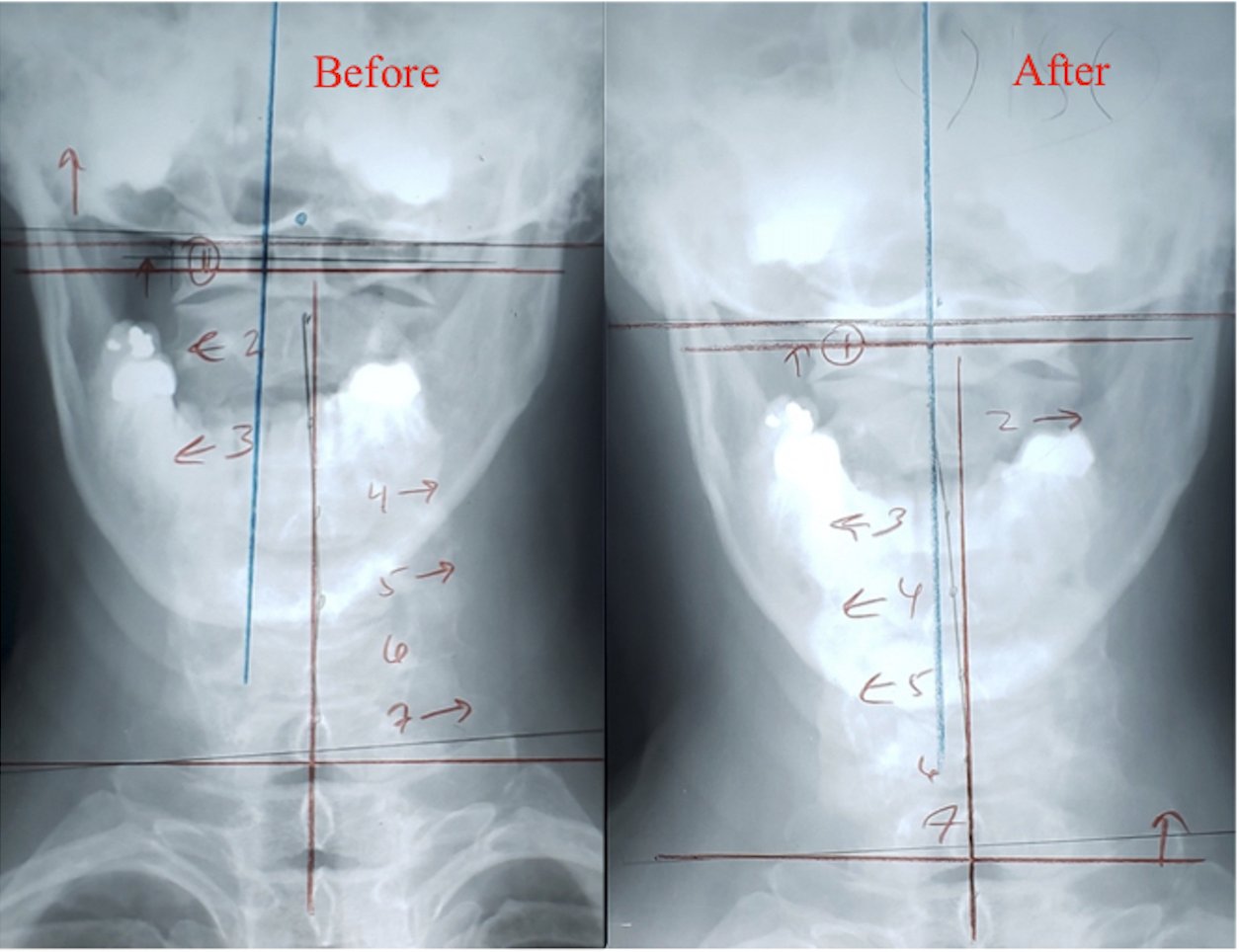
On her initial AP (front-to-back) cervical X-ray, the head tilt was immediately apparent. I use a vertical reference line to evaluate alignment, and her skull was displaced significantly off that midline. That degree of lateral deviation indicates substantial subluxation stress on the brain stem — the region of the spinal cord that coordinates virtually everything the body does automatically: breathing, circulation, immune response, and neurological signaling throughout the extremities and organs.
Why Structural Correction Produces Systemic Change
When the cervical spine subluxates — particularly in the region adjacent to the brain stem — the nerve pathways running from brain to body are compromised. This is not a metaphor or a theory. The brain stem is the physical hub through which all descending and ascending nerve signals must pass. When subluxation places mechanical stress on that structure, the body cannot communicate with itself properly.
In this patient's case, the consequences of that interference were sinus dysfunction, diminished hand and leg function, and cognitive fog. These are not random symptoms. They are predictable expressions of a nervous system that cannot transmit clearly. Correcting the structural subluxation removes the mechanical interference. The nervous system begins to function as designed. And the body restores what was always possible.
Outcomes After Six Months of Corrective Care
Improved sinus function.
Restored hand and leg function.
Significant improvement in mental clarity and focus.
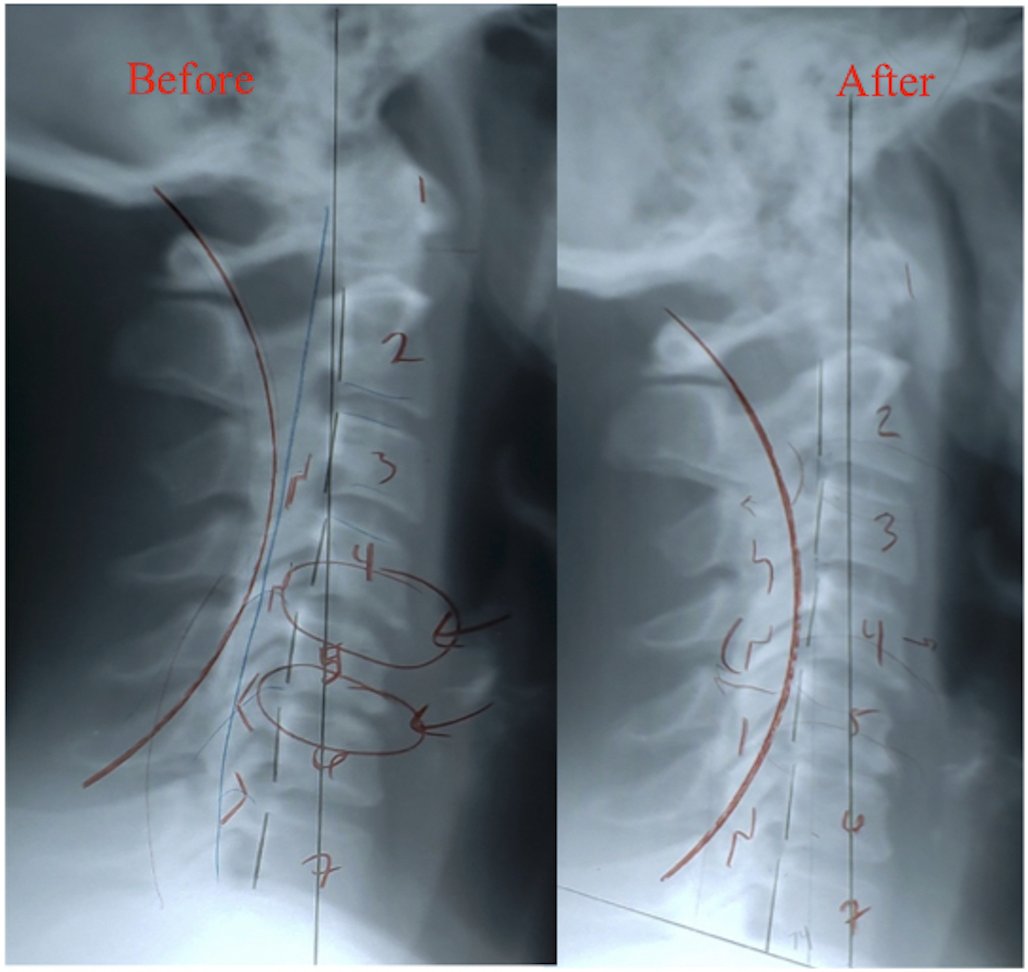
Measurable structural correction on AP and lateral cervical X-rays.
Continued correction plan underway for further restoration.
The Recovery Was Not Linear
Her recovery involved significant retracing events — periods where symptoms intensified or shifted before improving. This is normal in corrective spinal care. The body does not heal in a straight line. It heals by unwinding the layers of dysfunction it accumulated on the way down. That process takes time, and it is not always comfortable.
This patient stayed the course. She came out of every difficult period better and stronger. She is now into a second correction plan, continuing to see structural changes — knowing that those spinal changes produce systemic function changes, which produce better health.
That is the work. That is the goal.
Why This Pattern Matters
The brain stem is not an abstraction. It is a physical structure — the narrowest and most critical passage in the central nervous system, through which all communication between brain and body must travel. It coordinates respiration, circulation, immune signaling, and the nerve pathways that supply the sinuses, upper extremities, and the cognitive processing centers of the brain. When vertebral subluxation places mechanical stress on the brain stem and upper cervical cord — as the lateral head displacement in this case clearly demonstrated — the effects are not contained to the neck. They appear throughout every system those pathways supply.
This is why the symptoms in this case — sinus dysfunction, diminished hand and leg function, cognitive fog — were not three separate conditions. They were one structural problem expressing itself through multiple systems at once. The brain could not communicate clearly with the body. The body adapted within those constraints as long as it could. Correcting the cervical subluxation removed the mechanical interference. Innate Intelligence restored what had been compromised for years — not because those symptoms were treated, but because the nervous system was freed to do what the body was designed to do from the beginning.
What this case also illustrates is the distinction between treating systemic symptoms and removing structural interference. Sinus function, cognitive clarity, and motor coordination in the hands and legs are not directly treated in a subluxation-based chiropractic practice. What is corrected — precisely, specifically, and verifiably on X-ray — is the structural subluxation placing mechanical stress on the pathways those functions depend on. Once that interference is removed, the body coordinates its own restoration. That is not a philosophical position. It is the clinical record of what happened in this case, documented on follow-up X-ray and confirmed in every functional improvement she reported.
Six months of corrective care is not arbitrary. The brain-stem-level subluxation in this case had been accumulating long before the symptoms became undeniable. The correction had to reverse years of structural positioning — not release tension from a tight muscle. That kind of structural correction requires sustained, precise work over time. The non-linear recovery — periods of intensified symptoms followed by clear functional improvement — is not a sign that care is failing. It is the body restoring function through pathways that had been compressed long enough to require gradual neurological reestablishment. It cannot be rushed, and it cannot be achieved through symptom management.
That is also why the follow-up X-ray matters as much as the patient's reported outcomes. The improved skull alignment on the AP cervical view after six months confirmed that the mechanical stress on the brain stem had been structurally reduced. What she reported — restored sinus function, clearer cognition, improved hand and leg coordination — was the nervous system's expression of that structural change. The X-ray and the outcome point to the same place: the cervical subluxation was the source, and its correction produced the restoration.
What to Look For
The pattern worth recognizing is a cluster of symptoms spanning different systems — sinus congestion, hand or extremity numbness, cognitive fog, disrupted sleep, reduced energy — appearing together without a clear unifying diagnosis. Individually, each can be investigated as an isolated problem and treated without resolution. Together, they are a structural signal. The origin is often the brain stem and upper cervical spine, where all of those pathways converge.
Additional indicators: a history of significant physical trauma, even decades old; a visible head tilt in photographs or in the mirror; chronic neck tension so persistent it no longer seems like a symptom. Structural changes accumulate quietly. By the time the symptoms are undeniable, the subluxation has usually been present for years. If this pattern describes you or someone in your family, the answer is not another specialist for each symptom. It is a structural spinal assessment to find where the interference actually lives. Have you ever had your spine checked for subluxation?
There is one more indicator worth recognizing: the normalization of the decline. Brain-stem-level cervical subluxation produces a slow erosion across multiple systems — sinus, cognition, motor function, energy — that happens gradually enough that patients begin to accept it as their baseline. "I've always been like this." "I guess this is just how I am now." When those words describe fatigue, brain fog, sinus pressure, and hand or leg dysfunction together, the structural assessment of the cervical spine has almost certainly never been done. Acceptance of declining function is not a medical diagnosis. It is a missed investigation.
That structural investigation is a full cervical X-ray evaluation — not a range-of-motion assessment, not a neurological screen, and not imaging focused on a single symptomatic level. The complete cervical spine, from the base of the skull through C7, evaluated for subluxation with a trained structural eye. That is what identified the source in this patient's case. That is what made the correction possible. And that is what made the restoration of years of accumulated functional decline achievable within six months of corrective care.
Is Subluxation Interfering with Your Body's Function?
Structural X-rays reveal what symptoms alone cannot show. If you or someone you know is dealing with unexplained systemic dysfunction, a consultation at Rochet Family Chiropractic is the right first step.
Schedule a Consultation in Royal Palm BeachOr call us at (561) 795-3156
To learn more about how cervical subluxation affects nervous system function and whole-body health, visit our cervical subluxation resource page.