He Came in Because His Wife Made Him
A 64-year-old man came to us alongside his wife, who was already under care. She was the primary patient — and after seeing her films, he decided to get checked himself. His history told us what decades of hard physical work tend to leave behind: a spine that had taken a lot of hits over the years. Physical labor, a few traumas, the kind of accumulation that doesn't announce itself with a dramatic injury but shows up quietly on X-ray.
His main complaints? Stiffness and limited mobility. He didn't come in describing a lot of pain. He wasn't a "I can't function" case. He was more of a "this is just how I feel now" case — the guy who's adapted so completely to feeling less-than-great that he stopped noticing how far from normal he'd drifted.
The X-rays told a different story than he expected.
What His Neck Actually Looked Like
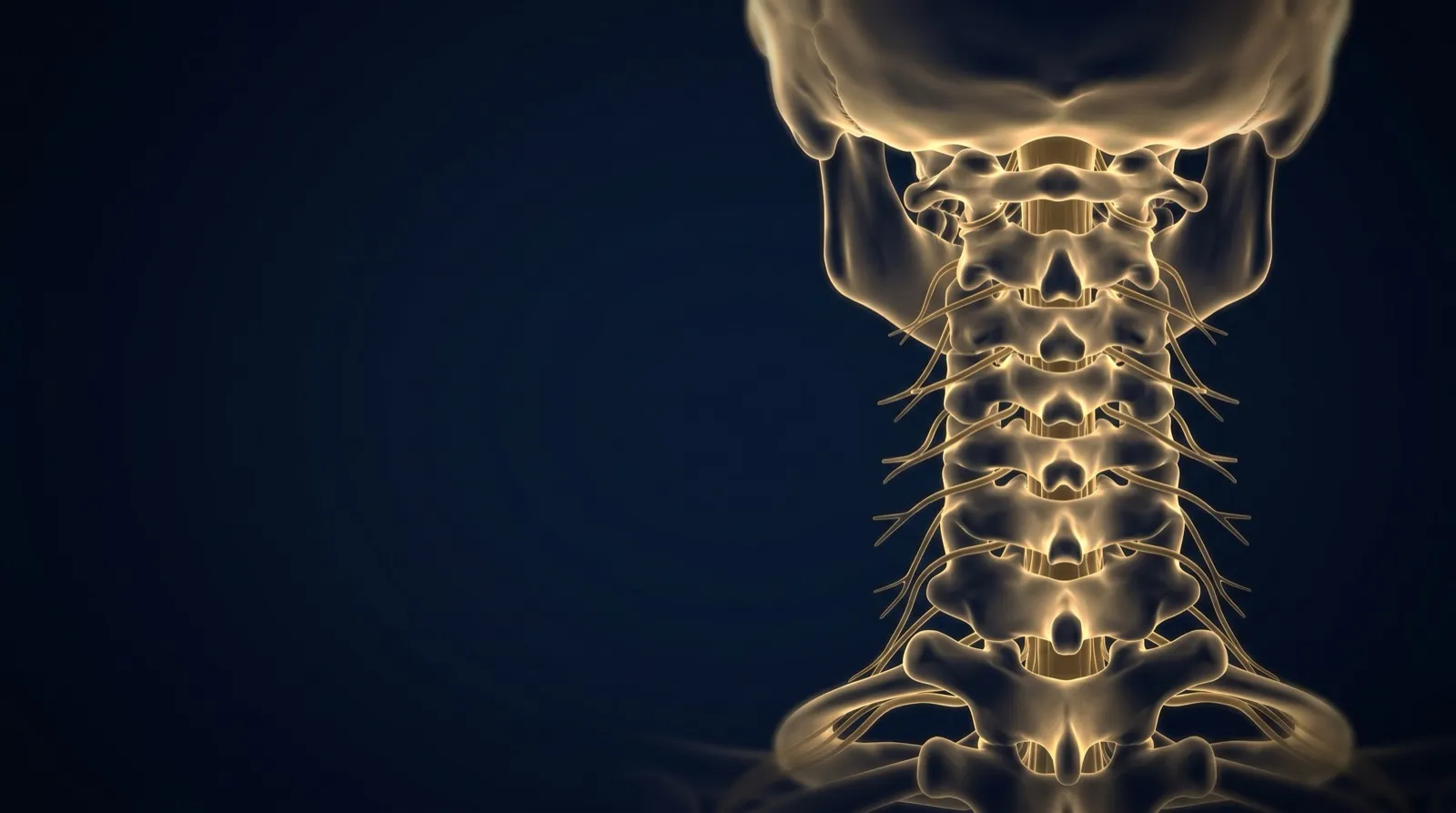
On a lateral cervical X-ray, we measure the natural curve of the neck — the gentle backward "C" shape that healthy cervical spines have. That curve exists for a reason: it distributes the weight of your head evenly, keeps the nerve roots in the proper position, and protects the spinal cord. When it's lost, everything downstream changes.
His curve was 51.4% below normal. Over half of the natural cervical curve — gone. His neck wasn't just stiff. It had been structurally compromised for a long time, putting chronic pressure on the nerve pathways that run from his brain through his spine to the rest of his body. The "just stiffness" he was describing was the least of what was happening.
Cervical Spine Lateral — Before & After
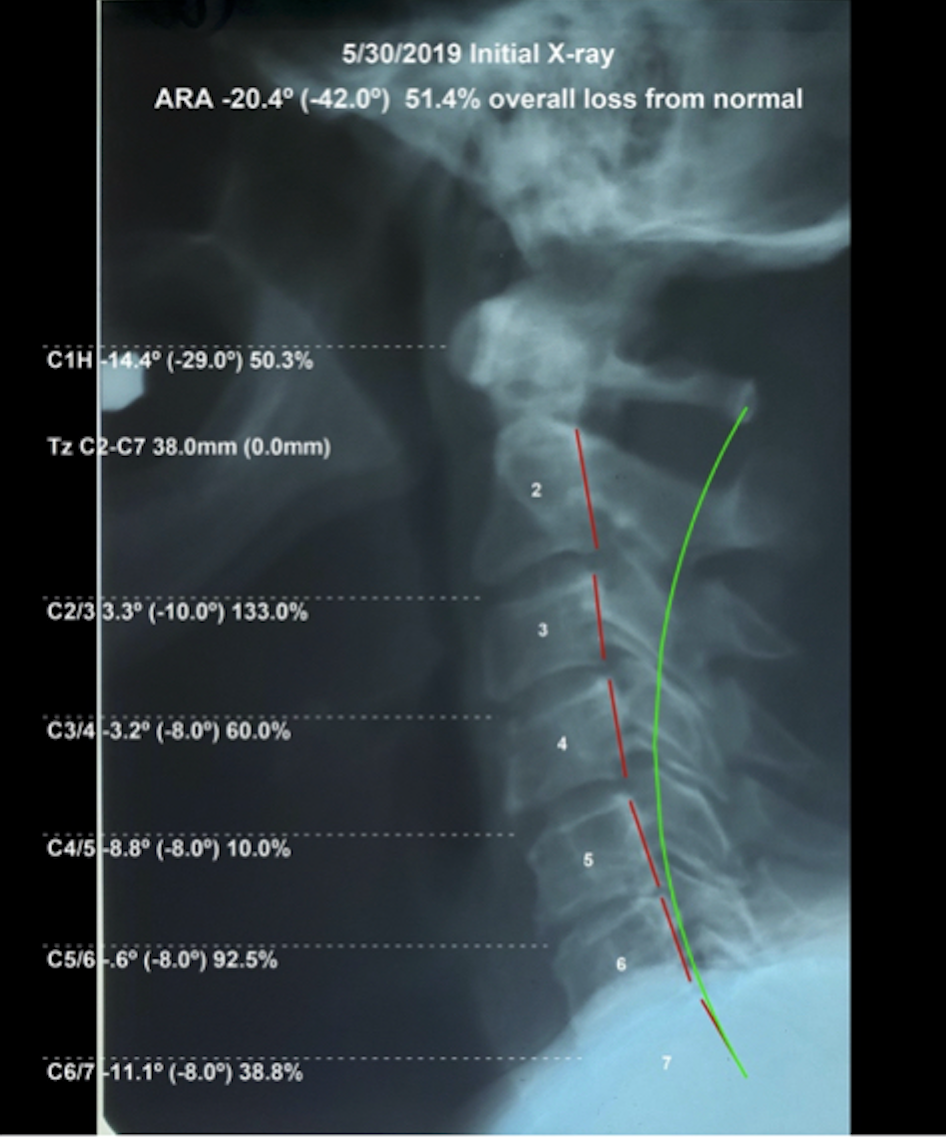
What We Found — Initial X-Ray (May 30, 2019)
Cervical curve (ARA): -20.4° — normal is -42.0°. That's 51.4% overall loss from normal.
What it means: More than half his natural neck curve was gone. The bones were stacked wrong, the nerve pathways were under chronic stress, and it had likely been this way for years.
Six Months of Correction
We put him on a corrective care plan — specific adjustments targeting the vertebrae that had shifted out of position and were holding his neck in the wrong shape. Six months of consistent work.
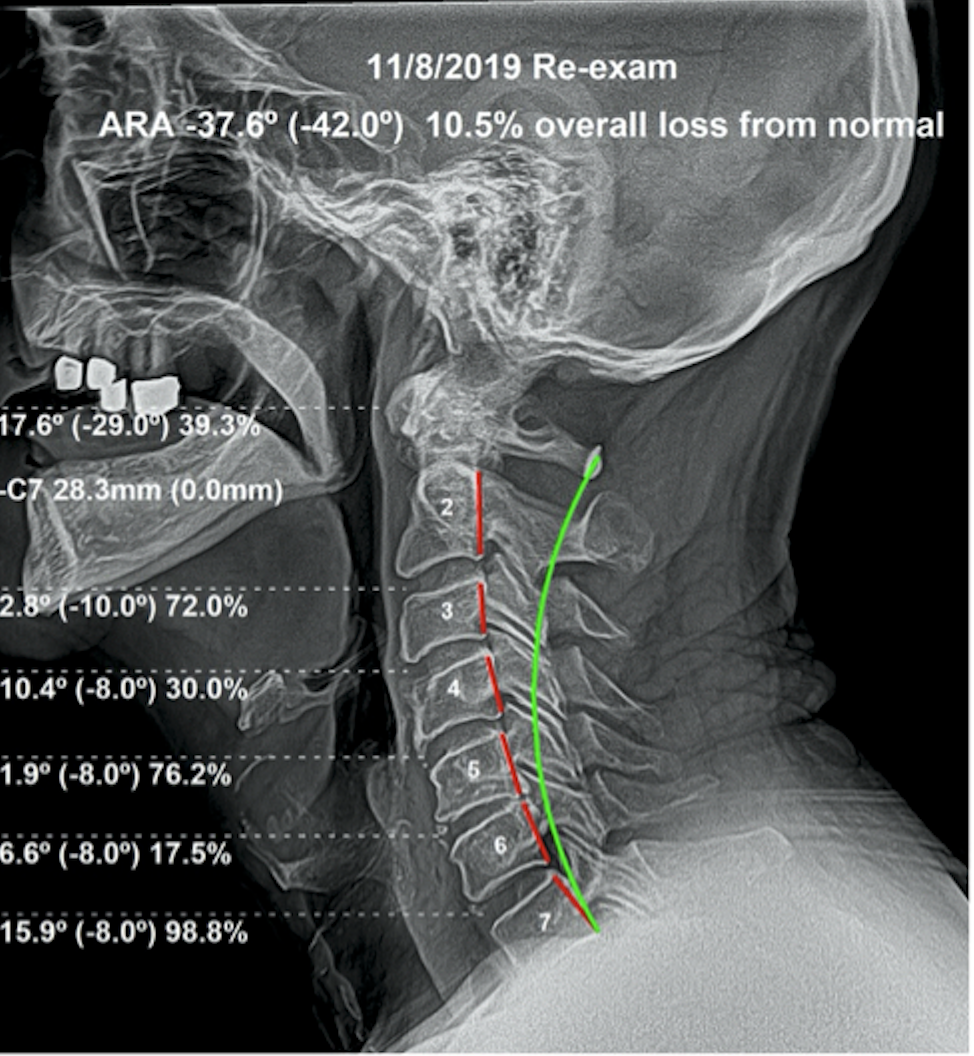
At re-evaluation, his cervical curve had gone from -20.4° to -37.6°. Normal is -42.0°. He went from 51.4% loss to just 10.5% loss — an overall improvement of more than 54%. That's not a small shift. That's the spine fundamentally changing its shape and restoring the structure that protects his nervous system.
Where He Ended Up — Re-evaluation (Nov 8, 2019)
Cervical curve (ARA): -37.6° — from 51.4% loss down to just 10.5% loss from normal.
Overall improvement: More than 54% of cervical curve restored in 6 months.
What Changed Beyond the X-Ray
The structural change showed up on film. But the changes he noticed were in his daily life.
More energy. He wasn't dragging through his days the way he had been. Less stiffness — the constant tightness he'd written off as "just getting older" had significantly improved. Better sleep. He was waking up more rested, which changed how he felt and performed throughout the day.
Mental clarity. This one surprises people, but it shouldn't. The nerve pathways running through the cervical spine don't just control your neck — they connect your brain to everything. When those pathways are compressed and running at reduced capacity, your thinking is affected too. Clear those pathways, and the clarity comes back.
And the one that mattered most to him practically: he could work longer without wearing out. For a man who's spent his life doing physical work, that's not a small thing.
He came in for stiffness. He left with more energy, better sleep, sharper thinking, and a neck that was structurally sound for the first time in years. None of that was the goal of treatment — it was the result of correcting the subluxation that had been interfering with his nervous system.
Feeling Like This Is "Just How You Are Now"?
Stiffness, low energy, not sleeping well, brain fog — these aren't just signs of aging. They're often signs of a nervous system running with interference. Come in and find out what's actually on your X-ray. You might be surprised how much is fixable.
Schedule a Structural AssessmentOr call us at (561) 795-3156
The Part That Matters Most
This man was 64. He had decades of physical work on his spine. He had old traumas he'd long since stopped thinking about. And he came in thinking he was basically fine — just a little stiff.
The X-ray showed otherwise. But more importantly, 6 months of correction showed what was still possible. No matter your age, no matter your history, the spine can improve — and when it does, you get healthier.
That's the principle. It doesn't have an age limit. It doesn't care how many years of hard work are in your history. The subluxation is either there or it isn't. Correct it, and the body responds. Every time.
For anyone in Royal Palm Beach, Wellington, Lake Worth, or anywhere across the Palm Beach area who has been quietly accepting less than their best — this case is for you. Come in and see what's actually there. That's where it starts.
Why This Pattern Matters
The spouse referral pattern shows up regularly in this practice. One person starts corrective care, the structural changes become visible in how they function, and the reluctant partner eventually comes in — often saying the same thing: "I feel fine." What this case shows is what "fine" actually looks like in a 64-year-old with decades of physical labor: 51.4 percent cervical curve loss. The body had adapted so completely that the compromise felt normal.
That is the problem with adaptation. It erases the reference point. You don't know what full nervous system expression feels like when interference has been present long enough to become the baseline. Fifty-four percent cervical curve restoration in six months — at 64, after years of hard physical work — is the body demonstrating that Innate Intelligence doesn't have an expiration date. The capacity to correct was always there. It required removing what was blocking it.
What to Look For
At this age and with this presentation, the signs get assigned to aging: stiffness that's just "getting older," energy that's just "slowing down," sleep that's adequate but not restorative, mental clarity that comes and goes. These are easy to dismiss because they change slowly enough to feel like the natural progression of time. They are also consistent signs of a nervous system running under cervical interference.
If someone you live with has started care and you've noticed changes in them — and you've been quietly explaining away your own version of the same symptoms — that's a reason to get checked. The lateral cervical X-ray will show what the curve actually looks like. Age doesn't determine what's there. It just determines how long it's been building.
Have you ever had your spine checked for subluxation?