
Referred by Her Husband — Who'd Already Been Through It
A 39-year-old woman came to us referred by her husband, who had been a patient here for a similar issue. She works in the service industry — on her feet for the majority of most days. No major injury to point to. No single moment where something "went wrong." Just the slow, steady accumulation of standing, walking, and working on a spine that wasn't properly aligned beneath her.
By the time she came in, the low back pain had spread into her legs. That's a sign the problem had progressed past a sore back — the misaligned bones in her lower spine were now pressing on the nerve roots that travel down into her legs, sending that pain and discomfort further than just where the problem lived.
Her husband already knew what the X-rays were likely to show. She was skeptical. The films confirmed what we suspected.
What Years on Your Feet Actually Do to a Spine
Her lower back has a natural curve — a gentle forward arc that distributes the load of standing and movement evenly through the lumbar vertebrae. When that curve is in the right position, the spine handles the demands of a physically active job. When it's not, every hour on your feet is adding stress to bones and nerves that are already loaded wrong.
Her lumbar curve was 21.8% below normal. Not catastrophic — but enough that years of service industry work had been slowly grinding down the structures that were supposed to protect her. And the radiation into her legs told us the nerve roots were already feeling it.
This is the pattern we see all the time in people who work on their feet: waitresses, retail workers, healthcare workers, hair stylists. The job didn't injure them. The job exposed a spine that wasn't built to handle that load without proper alignment underneath it.
Lumbar Spine Lateral — Before & After
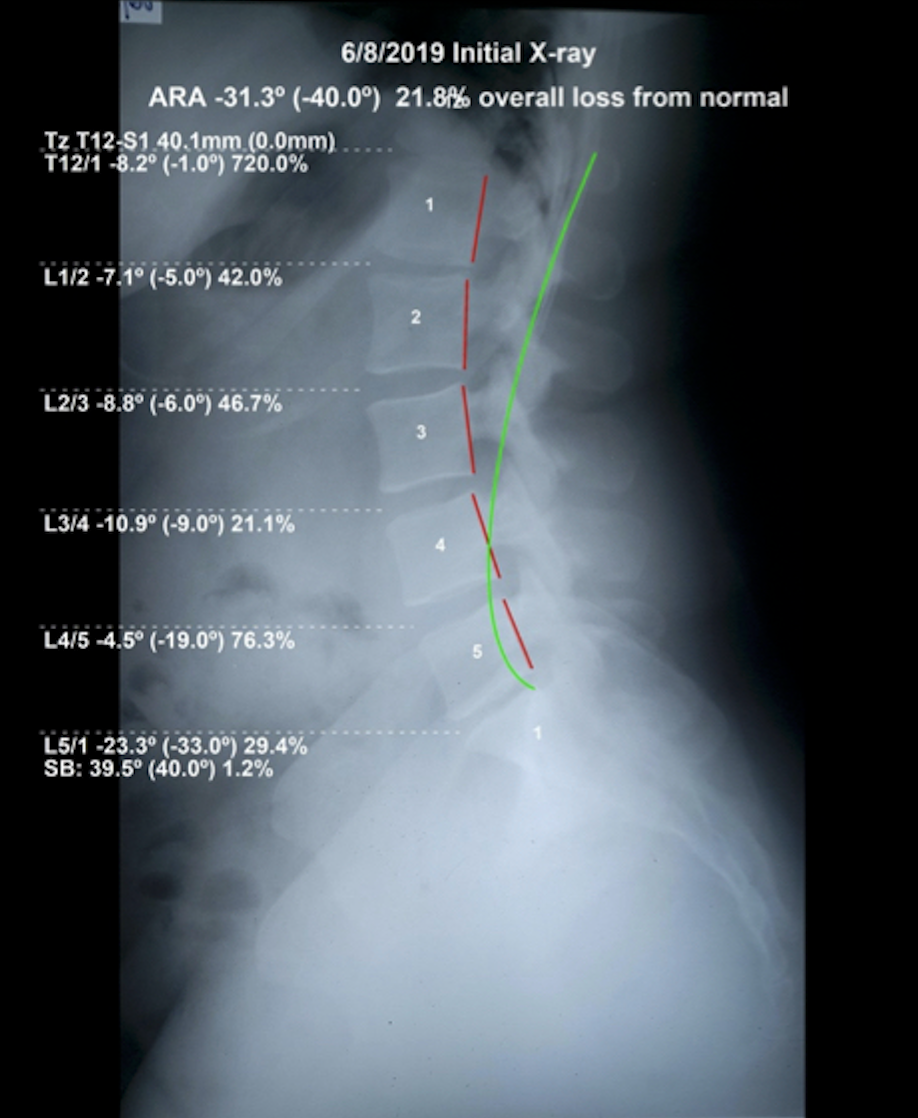
What We Found — Initial X-Ray (June 8, 2019)
Lumbar curve (ARA): -31.3° — normal is -40.0°. That's 21.8% overall loss from normal.
What it means: Her lower back curve was flat compared to where it should be. The vertebrae were loaded wrong, nerve roots were under pressure, and the pain down her legs was the result.
Six Months of Correction — Then Some
We put her on a corrective care plan targeting the specific vertebrae driving the problem. Six months of consistent adjustments, working to restore the lumbar curve and get the pressure off the nerves.
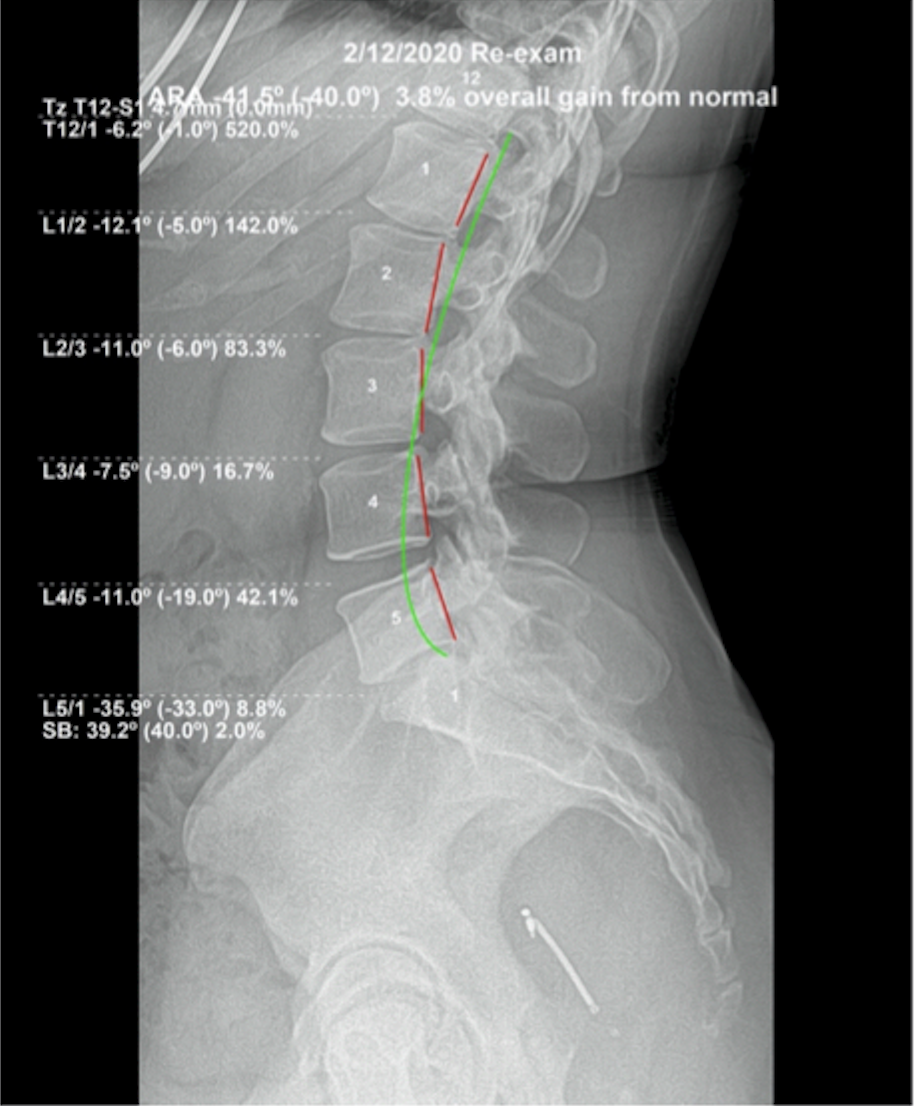
At re-evaluation, her lumbar lordosis had moved from -31.3° to -41.5°. Normal is -40.0°. She didn't just get back to normal — she went past it. 125% overall spinal correction. The curve that had been grinding on her nervous system for years was not only restored but actually exceeded the target.
Where She Ended Up — Re-evaluation (Feb 12, 2020)
Lumbar curve (ARA): -41.5° — surpassing the normal target of -40.0°.
Overall improvement: 125% correction. From 21.8% below normal to a slight gain beyond normal.
Next step: Continuing corrective care to finalize correction and ensure long-term stability.
What She Noticed
The radiation into her legs — gone. The chronic low back pain that had been her constant companion on shift — significantly improved. But like most patients going through structural correction, the changes went beyond where it hurt.
More energy. Less stiffness getting through her day. Better sleep at night. Sharper mentally. And the one that mattered most for her job: she could work longer without exhausting herself. For someone in the service industry, where your livelihood depends on being able to stay on your feet and stay sharp, that's everything.
She came in for back pain. She got her quality of life back. Because the spine isn't just a structural issue — it's the pathway the nervous system uses to run the entire body. Fix the structure, and the whole system runs better.
On Your Feet All Day and Your Back Has Been Talking to You?
If your job keeps you standing and moving, and your low back has been a problem — don't wait for the radiation to start. Come in and find out what your spine actually looks like. The X-ray tells the real story, not the symptoms.
Schedule a Structural AssessmentOr call us at (561) 795-3156
The Pattern Worth Recognizing
Three months in a row now, we've featured cases from physically demanding work backgrounds — a mechanic, a man with a lifetime of labor, and now a service industry worker. The details are different. The underlying pattern is the same.
Hard physical work doesn't break spines. It exposes them. When the alignment is off and you keep loading it, the stress concentrates where the spine is weakest. Years pass. The accumulation reaches a threshold. Pain shows up — sometimes local, sometimes radiating, sometimes both.
The fix is the same regardless of how it got there: find the subluxation, correct it, restore the alignment, and let the nervous system do what it was built to do. For people across Royal Palm Beach, Wellington, Lake Worth, and the Palm Beach area doing physical work every day — subluxation is not a rare finding. It is almost always there. And it is almost always correctable.
You don't have to keep working through it.
Why This Pattern Matters
The lumbar curve is the load-bearing arc that makes upright physical work possible. When it's depleted — as hers was, 21.8% below normal — the spine doesn't distribute force the way it was designed to. Every hour standing, walking, or carrying weight on a misaligned lumbar spine concentrates stress at the wrong points. The nerve roots traveling down into the legs exit through that same region. When the structure is off and the pressure builds, radiation into the legs is the spine's way of telling you it has been loading wrong for a long time.
The 125% correction result is worth understanding: her curve didn't just return to normal — it surpassed it. That's Innate Intelligence at work. Remove the interference that has been blocking proper alignment, give the body the corrective input it needs, and the body drives toward function beyond what was required. The lumbar spine that had been grinding on her nervous system for years recovered further than the target. The capacity to correct was always there. It needed the structural interference removed first.
What to Look For
Service industry workers rarely connect low back problems to their spine's alignment — they connect them to the job. That framing delays care. The early signs are subtler than radiation: persistent stiffness on one side of the low back, a sense of fatigue in the lumbar region that exceeds what the work should produce, or a habit of shifting your weight to one hip during a long shift. Leg symptoms — heaviness, tingling, aching that travels below the knee — come later, after the nerve roots have been under sustained pressure.
If your job keeps you on your feet and your low back has become a variable you manage rather than something that doesn't bother you, the lateral lumbar X-ray will show what the curve actually looks like. Symptoms tell you something is wrong. The film tells you what.
Have you ever had your spine checked for subluxation?