
Doing Everything Right — and Still Hurting
A 31-year-old man was referred to us by an existing practice member. He had a physically demanding job — the kind of work that keeps your body moving all day — and he worked out regularly on top of it. He was not sedentary. He was not neglecting his health. He was, by his own assessment and by any reasonable standard, doing the things you're supposed to do.
Which made the chronic, severe back discomfort all the more confusing to him. He couldn't understand why, despite all the right habits, his body kept yelling at him.
The answer showed up on the X-ray.
The Foundation Was Crooked
Here is the thing about exercise and physical labor: both load the spine. Every rep, every heavy lift, every demanding physical day sends force through the vertebral column. When the spine is properly aligned, that force distributes evenly — the load is shared across the structure the way it was designed to be shared, and the work makes the body stronger.
When the spine is misaligned — when the vertebrae are subluxated and the whole column is off-axis — that same load concentrates on the segments that are already stressed by being out of position. Every workout, every physical demand at work, every day of activity is pounding the same crooked structure over and over. The effort isn't building the body up. It's grinding it down.
Imagine trying to build a strong, straight wall on a foundation that's several degrees off level. Every brick you add makes the lean worse. The harder you work, the more you stress the flaw in the base. That was his spine.
Cervical Spine AP — Before & After
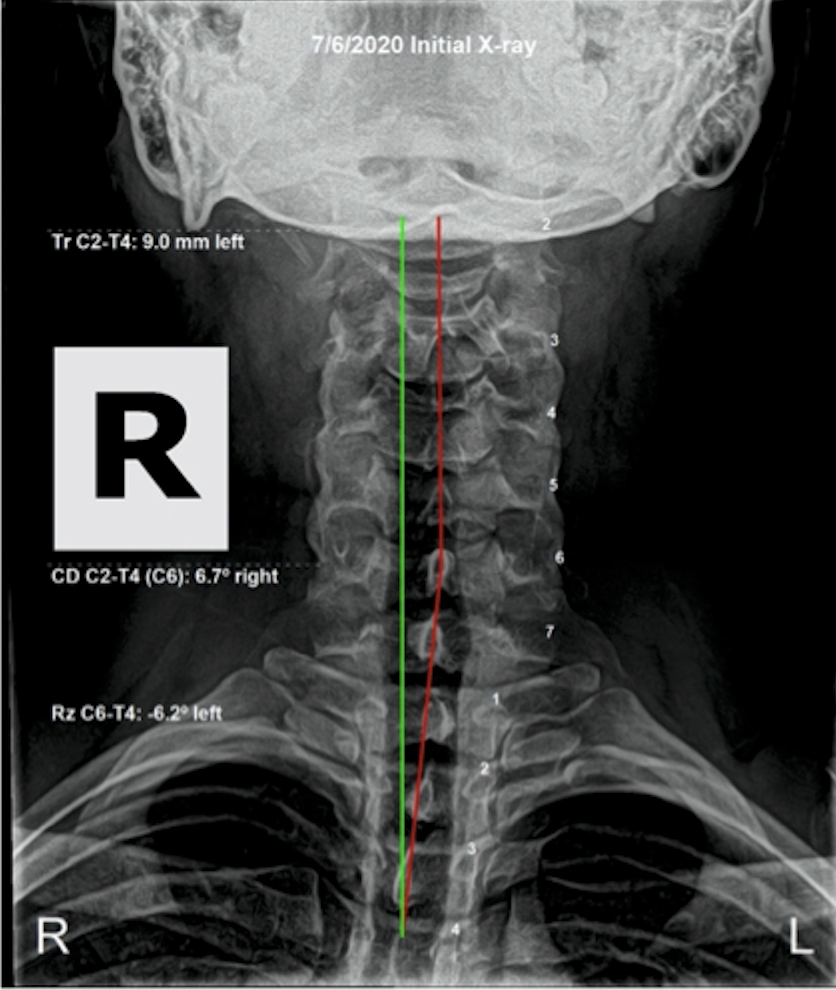
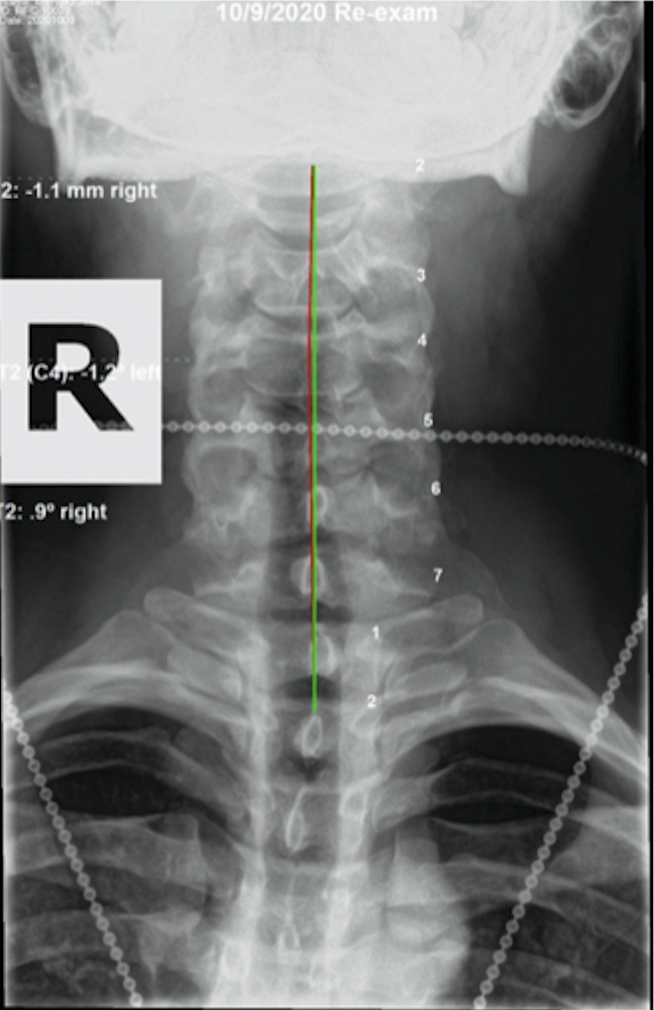
What the X-Ray Found — Initial Evaluation
Lateral translation (Tr C2–T4): 5.0mm left — significant shift off the midline axis.
Coronal displacement (CD C2–T4 C8): 6.7° right — measurable angular deviation throughout the cervical and upper thoracic region.
Rotational subluxation (Rz C6–T4): 4.3° left — rotational misalignment compounding the lateral shift.
Summary: The alignment was way off. All of the physical demands being placed on this spine — work and gym combined — were loading a misaligned structure rather than a properly aligned one.
Three Months of Corrective Care
We designed a 3-month corrective care plan specific to his subluxation pattern. Adjustments targeted the precise misalignments measured on the X-rays — translation, angular deviation, and rotation addressed systematically over the correction period. Not general mobilization. Structural correction based on specific measurements.
At re-evaluation, the numbers told the story clearly. What had been 5.0mm of lateral translation and 6.7° of displacement had corrected to -1.1mm and 0.9° — essentially at the midline. Near full correction of the cervical subluxation in one course of care.
Re-evaluation Results
C2 lateral position: -1.1mm right — from 5.0mm off-axis to essentially corrected.
C2 spinous rotation: 0.9° right — from 6.7° angular displacement to near-neutral.
Assessment: Near full structural correction achieved within the 3-month correction program.
Faster Recovery. More Rest. Better Focus at Work.
The functional changes matched the structural ones. He was resting more completely — sleep that actually restored him. He was recovering faster from workouts — the body's ability to repair after physical exertion improved as the nervous system interference was reduced. His focus and energy at work improved, even though his job hadn't changed and his workload hadn't lightened.
Once the alignment was corrected, everything he was already doing started working for him instead of against him. The gym didn't need to change. The job didn't need to change. The foundation needed to change — and once it did, his effort actually built something instead of tearing it down.
He understood that. Which is why, after completing the first 3-month correction plan and seeing what it produced, he decided to continue with an additional 3-month plan to push the structural correction further.
Active, Working Hard, and Still Hurting?
Effort can't fix a misaligned foundation. If you're doing all the right things and your body is still not responding the way it should — workouts, demanding work, staying active — there may be a structural problem driving the dysfunction that effort alone can't correct. A subluxation-based evaluation shows you what's actually there.
Schedule a Structural AssessmentOr call us at (561) 795-3156
Fitness and Alignment Are Not the Same Thing
This case is worth understanding carefully because it challenges something a lot of active people assume: that being physically fit means your spine is fine. It doesn't. Fitness and spinal alignment are entirely separate things. You can be strong and misaligned at the same time — and the stronger you are, the more force you're applying to whatever structural flaw exists in your foundation.
The cervical subluxation in this case was producing chronic discomfort that no amount of exercise, stretching, or physical effort was going to resolve — because the problem wasn't muscular. It was structural. Bones out of position, nerve interference present, the whole spinal column compensating around a misalignment at the top. Correcting the structure was the only thing that was going to fix it.
I am not the healer. I move the bone. When the bone is in the right place and the nerve is free of interference, the body does the rest — and it does it well. This patient's body knew exactly how to recover, perform, and rest once the structural obstruction was removed.
For anyone in Royal Palm Beach, Wellington, Lake Worth, Palm Beach Gardens, or across the Palm Beach area who stays active and wonders why the discomfort won't go away — start with a structural evaluation. Find out if the foundation is the problem.
Why This Pattern Matters
The measurements in this case are worth understanding: 5.0mm of lateral translation, 6.7° of angular displacement, 4.3° of rotational subluxation. That is not a subtle finding. That is a spine visibly off-axis on every measurement plane — and every rep he lifted, every demanding shift he worked, every physical demand of his active life was loading that misaligned structure rather than a properly aligned one. Fitness amplified the problem. The stronger he got, the more force he applied to a foundation that was already failing.
Near full correction in three months — from 5.0mm off-axis to -1.1mm, from 6.7° of displacement to 0.9° — shows what precision analysis makes possible. Not trial and error. Not general mobilization until something changes. Specific subluxation measurements, specific corrective inputs, specific targets. Innate Intelligence did the rest: faster recovery, more restorative sleep, better focus. The body already knew how to perform. It needed the structural interference cleared first.
What to Look For
The clearest sign in this pattern is the mismatch between effort and result. An active person who trains consistently, eats well, and takes care of their body — and still cannot get the chronic discomfort to resolve — is usually dealing with a structural problem that no amount of fitness effort will correct. Other signs: workout recovery that takes longer than it should, sleep that leaves you still tired despite physical exhaustion, and a persistent muscular tightness that returns to exactly the same place regardless of how much you stretch.
Those are not fitness problems. They are the spine's compensation signals telling you the foundation is loaded wrong. The cervical AP X-ray will show the lateral translation and displacement. If the structure is off, no amount of effort on top of it is going to fix it.
Have you ever had your spine checked for subluxation?