

He Had Been “Getting Adjusted” for Years
This 56-year-old man came to Rochet Family Chiropractic having already been under chiropractic care at another office. That detail matters because it is a distinction many people do not think to make. He had been receiving maintenance adjustments — ongoing care meant to manage accumulated spinal stress. What he had not been receiving, for over a year, was structured corrective care designed to produce measurable, X-ray-verified structural change in his vertebral subluxation.
Over time, he began noticing what he could not ignore: an increasing loss of flexibility and a general decline in his overall sense of wellbeing. These were not dramatic symptoms. They were the quiet accumulation of a nervous system operating under unaddressed interference. He decided to find out what was actually going on with his spine and sought out a structural evaluation.
What We Found — and What the First Plan Taught Us
Clinical Findings — Initial Examination
Patient: 56-year-old male
Prior care: Maintenance chiropractic care at another office; no structured corrective care in over one year
Presenting concerns: Progressive loss of flexibility, declining overall wellbeing
X-ray type: AP upper cervical
First plan result: Irregular attendance due to work responsibilities; X-ray results not congruent with care type
Second plan result: Full commitment to prescribed frequency; X-ray results and QOL outcomes both improved significantly
His first three-month corrective plan at our office was frequently interrupted by work responsibilities. Life happens, and I understand that. But this case illustrates something the X-ray makes undeniable: corrective care requires consistent, prescribed-frequency adjustments to produce structural change. When adjustments are sporadic, the spine does not maintain the corrective momentum built between visits. His first re-evaluation X-ray reflected that. The structural improvement was not what three months of corrective care should produce — because three months of corrective care was not what he actually received.
Atlas (C1) AP — Before & After
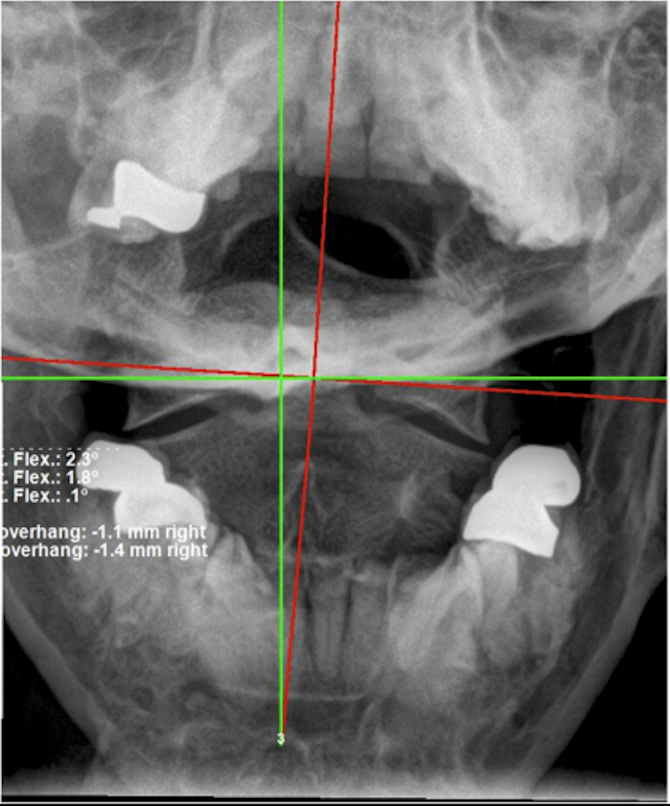
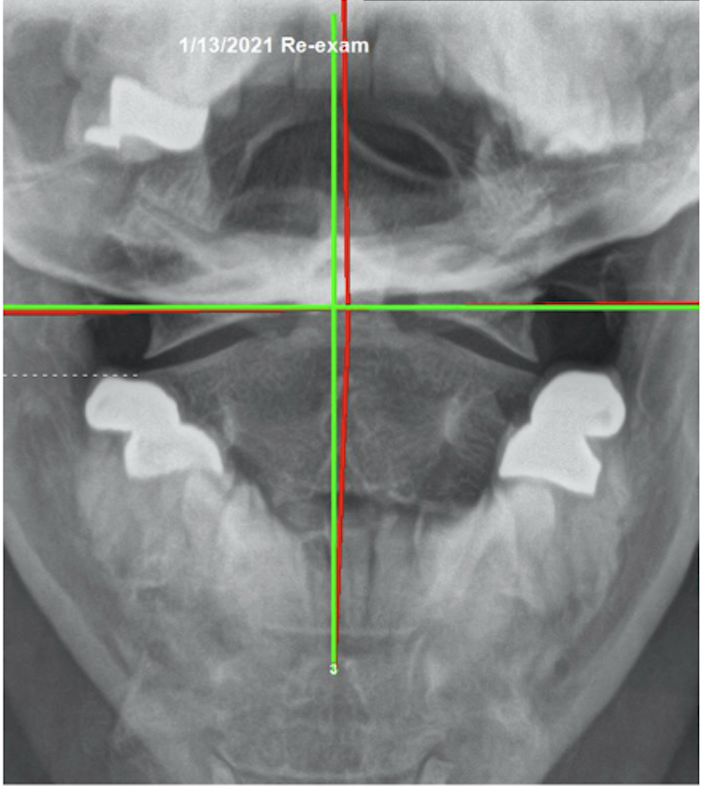
When He Committed — Everything Changed
On his second plan, he committed. He kept his appointments. He honored the prescribed frequency. The outcome was congruent with that commitment — the re-evaluation X-ray taken January 13, 2021 showed measurable improvement in atlas position. More importantly, his quality of life outcomes reflected the structural change: improved flexibility, increased activities of daily living, and a general sense of wellbeing he had not experienced in some time.
This is the part of corrective care that most people do not fully understand going in: the care plan is not a suggestion. The frequency of adjustments is calculated to maintain corrective momentum. Every missed visit is not simply a missed adjustment — it is an interruption in a structured process that depends on cumulative application. The results on the X-ray are an honest record of what the patient actually invested, not what they intended to invest.
He came in knowing something was declining. He left the second plan knowing what consistent, structurally-directed care actually produces. Innate Intelligence, when given the opportunity through a subluxation-free spine, does exactly what the body was designed to do.
Why This Pattern Matters
The distinction between maintenance and corrective chiropractic care is one of the most important things a patient can understand — and one of the least explained. Maintenance care addresses accumulated spinal stress. It keeps things manageable. What it does not do is produce the specific, documented, X-ray-measurable structural change that corrective care is designed to achieve. These are not interchangeable terms for the same thing.
What this case demonstrates is that the same patient receiving two different approaches gets two different results. The first plan produced limited structural change because the prescribed frequency was not honored. The second plan, with full attendance, produced documented improvement on the re-evaluation film. The variable was commitment to the care plan. Everything else was the same.
This matters because many people spend years receiving adjustments that feel helpful — and may genuinely reduce accumulated tension — while their underlying subluxation complex continues unaddressed. Maintenance care delays the effects of sustained subluxation. Corrective care, applied with structural precision and patient commitment, can actually reverse them. That difference accumulates over years, and it eventually shows up on an X-ray whether you have been measuring it or not.
There is a harder truth embedded in this case: the first plan's outcome was not a failure of the chiropractic. It was a failure of compliance. The correction protocol was sound. The frequency was appropriate. The patient simply did not attend at the prescribed rate. The body cannot complete a structural correction process on a fractional schedule. This is not a judgment — life is demanding and appointments are missed. But the X-ray is an honest record of what the spine actually received. Structural results require structural investment.
This also raises a question every chiropractic patient should ask: is my current care plan designed to produce a measurable structural change, or to maintain what currently exists? Both are valid clinical goals — but they are not the same goal. Knowing which one you are on determines whether you should expect a before-and-after X-ray comparison, and what that comparison should show.
The compliance distinction in this case is worth stating plainly because it is the variable most frequently misidentified as the cause of poor outcomes in chiropractic care. When a patient attends inconsistently and achieves minimal structural change, the natural conclusion is that chiropractic did not work. The more accurate conclusion is that the corrective protocol was not honored. A specific adjustment sequence designed to produce a defined structural change within a defined time window cannot produce that change if the prescribed visits are skipped. The result reflects attendance, not the limits of what correction can achieve.
The reversal in this case — a patient who had received prior care without objective structural improvement, committing to a second plan with full attendance and achieving documented change on re-evaluation X-ray — demonstrates that a prior failure of care is not a permanent ceiling. What failed previously was not the spine's capacity to correct. What failed was the attendance frequency required to produce the correction. When the attendance changed, the outcome changed.
What to Look For
If you have been under chiropractic care but your chiropractor has never taken or reviewed a comparative X-ray — one that measures your spine before and after a plan — you have not received verified corrective care. Corrective care is measured objectively. The structural change either shows on the film or it doesn't.
Other indicators: if your adjustment is always in the same spots in the same sequence, that is a sign of a maintenance protocol, not a specific corrective protocol guided by what the spine shows that day. Corrective care adjusts only where the analysis indicates subluxation is present — which changes as the spine improves.
If your care plan has no defined re-evaluation point, no comparative X-ray planned, and no structural goals, ask for a structural assessment. Finding out where your spine actually stands is always worth doing.
One final signal: if you have felt better after care and stopped, then returned months or years later with the same or worse structural picture — that is the pattern this case documents. Feeling better is not the same as structural correction being complete. The subluxation can still be present when the symptoms that brought you in have diminished. Have you ever had your spine checked for subluxation?
Maintenance Is Not Correction. Know the Difference.
If you have been seeing a chiropractor but never had X-ray-verified structural correction, you may be managing your spine without actually changing it. There is a meaningful difference between maintenance care and corrective care — and that difference shows up on film. Come in for a structural evaluation and find out where your spine actually stands.
Schedule a Structural EvaluationOr call us at (561) 795-3156
Related: He felt better and stopped. Four years later he couldn’t play with his kids. — another case that shows what happens when corrective care is interrupted too soon.