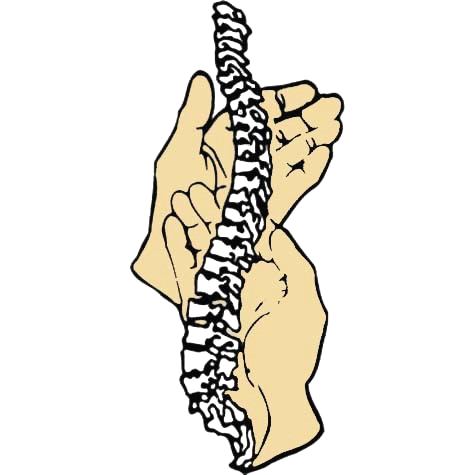

"Not managing how you feel — that's a side effect. Correcting what's interfering with how your body is expressing function. How your body is expressing life." — Dr. Romar Rochet
Your nervous system runs everything
Billions of signals leave your brain every second, travel down through your spinal cord, and branch out through your spine to every tissue, organ, and cell. Heart rate, digestion, immune response — all of it, around the clock, without you thinking about it once. That's Innate Intelligence — the God-given order your body runs on. No permission needed. It just works. Until something gets in the way.
What a subluxation actually does
Your spine has 24 movable bones. Because they move, they can shift. When a vertebra drifts out of its normal position, it presses on the nerve root at that level. That pressure distorts the signal your brain is sending to your body. Think of a garden hose being crimped — water still flows, but something is reducing it. Or a dimmer switch: the circuit is connected, the light is on, but it's running dim. The shift doesn't need to be large. A small loss of normal position or motion is enough. Those nerves are that delicate.
How subluxations develop — the three T's
Falls, accidents, sports injuries — and the birth process, which is one of the most overlooked. The forces involved in delivery are real mechanical forces on a real spine.
What you eat, drink, inhale, or absorb changes the chemical environment your nerves operate in. When that environment is burdened, the spine carries it.
Emotional stress doesn't stay in the mind — it settles into the body. The tension from chronic worry or sustained pressure shows up in the muscles and the spine.
The three compound. Months, sometimes years of accumulated stress — and the spine gradually loses its normal position and motion. By the time something is noticeably wrong, a lot has usually already built up.
Only 4 to 6 percent of your nerves register pain. The other 94 to 96 percent run organ function, immune response, circulation, and coordination — without producing any sensation you'd notice. You can have a subluxation, real nerve interference, and feel nothing at all. Pain isn't the beginning of the problem. It's the body getting loud about something that's been going on.
How we correct it
When we identify a subluxation, we correct it with a specific chiropractic adjustment delivered to the exact vertebra that has shifted. The adjustment restores normal position, normal motion, and normal nerve flow. When the vertebra moves back toward where it belongs, the pressure on that nerve root drops. The signal between your brain and your body starts to clear. Feeling better isn't the goal — it's what happens when the body is functioning better.
Want the full clinical detail — detection, X-ray analysis, spinal regions, and what correction looks like over time?
Read the complete guide →How subluxation is detected and corrected at RFC
Finding a subluxation isn't guesswork. At RFC, the analysis begins the same way every time: postural evaluation (how the body holds itself in gravity), motion palpation (how each spinal segment moves through its range), and X-ray. X-ray is not optional in this office. It's the only way to see what the spine is actually doing in three dimensions. The views we take are specific — we're looking at alignment, disc space, joint integrity, and the pattern of displacement across the affected levels.
From that analysis comes the correction. Where is the subluxation? How significant is it? What does that specific vertebra need? Not every subluxation requires the same adjustment. Not every visit requires an adjustment at all. What every patient gets is an analysis first — because adjusting without knowing is not subluxation-based care. The adjustment is always determined by what the spine shows, not by how the patient feels.