A Man Who Had Nowhere Else to Turn
This 37-year-old man was visiting Florida from another country — a country where chiropractic care is not available. He is an avid bodybuilder. A long history of spinal injuries had accumulated over years of training, with the most severe being a herniated disc at L5, the lowest level of the lumbar spine. He arrived at our office unable to move following what he described as a “bad lift” — a moment where the accumulated stress on his already-compromised spine became impossible to compensate for any longer.
Communication required Google Translate. His visiting status meant a long-term corrective plan was not possible. We adapted. We designed an abbreviated care plan within the three-month window available to us, focused on producing the maximum structural correction in the minimum available time. We performed specific chiropractic adjustments to correct the vertebral subluxation patterns found on his lateral lumbar X-ray, supplemented with McKenzie disc therapy to support disc restoration. Then we let Innate Intelligence do the work.
What the X-Rays Showed — Before and After
Clinical Findings — Lateral Lumbar X-Ray Analysis
Patient: 37-year-old male international visitor; avid bodybuilder
Presenting: Unable to move due to acute back pain after bad lift; long history of spinal injuries
Most severe finding: L5 disc herniation
X-ray type: Lateral lumbar
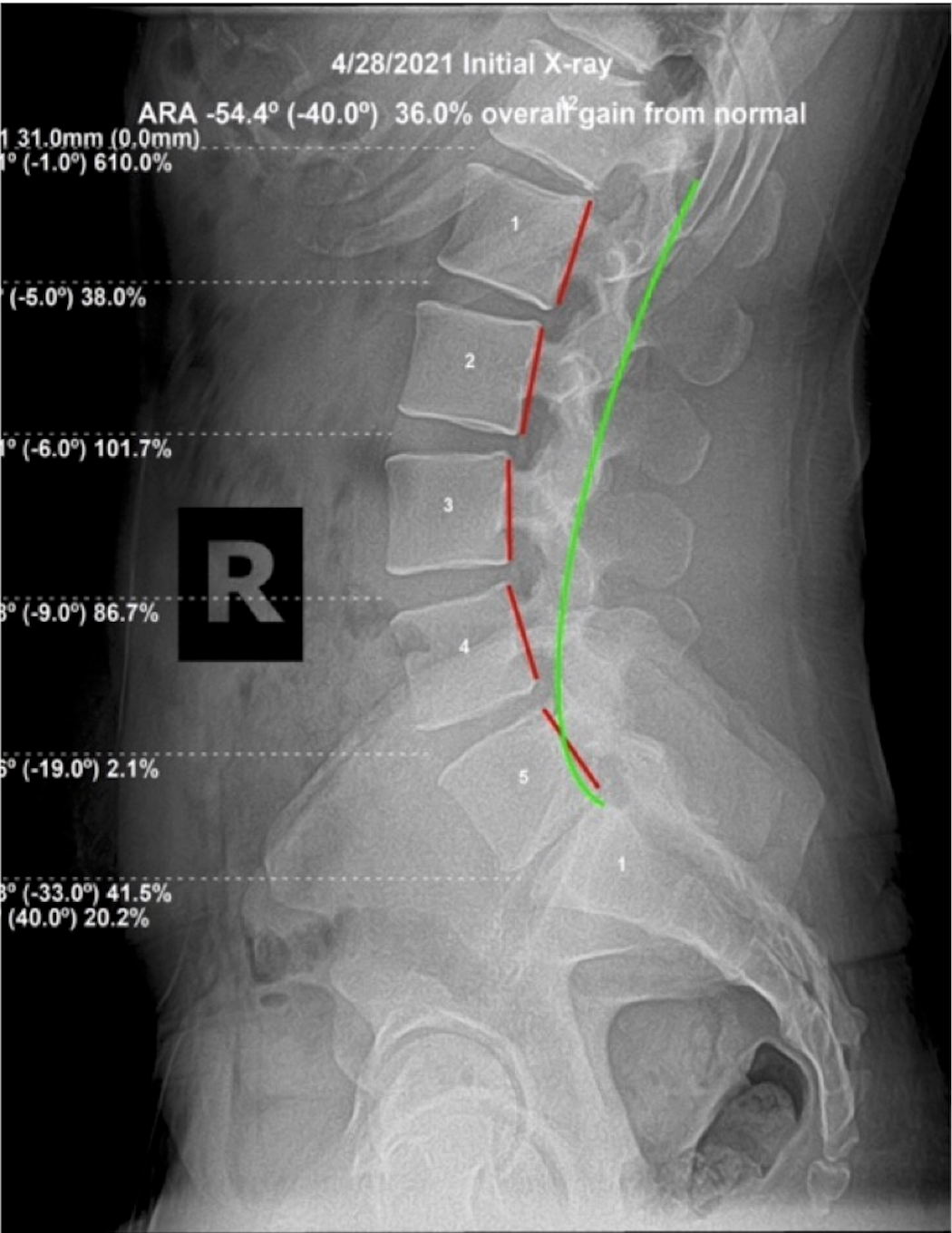
Initial ARA (Apr 28, 2021): −64.6° (normal −40.0°) — 36.8% overall loss from normal
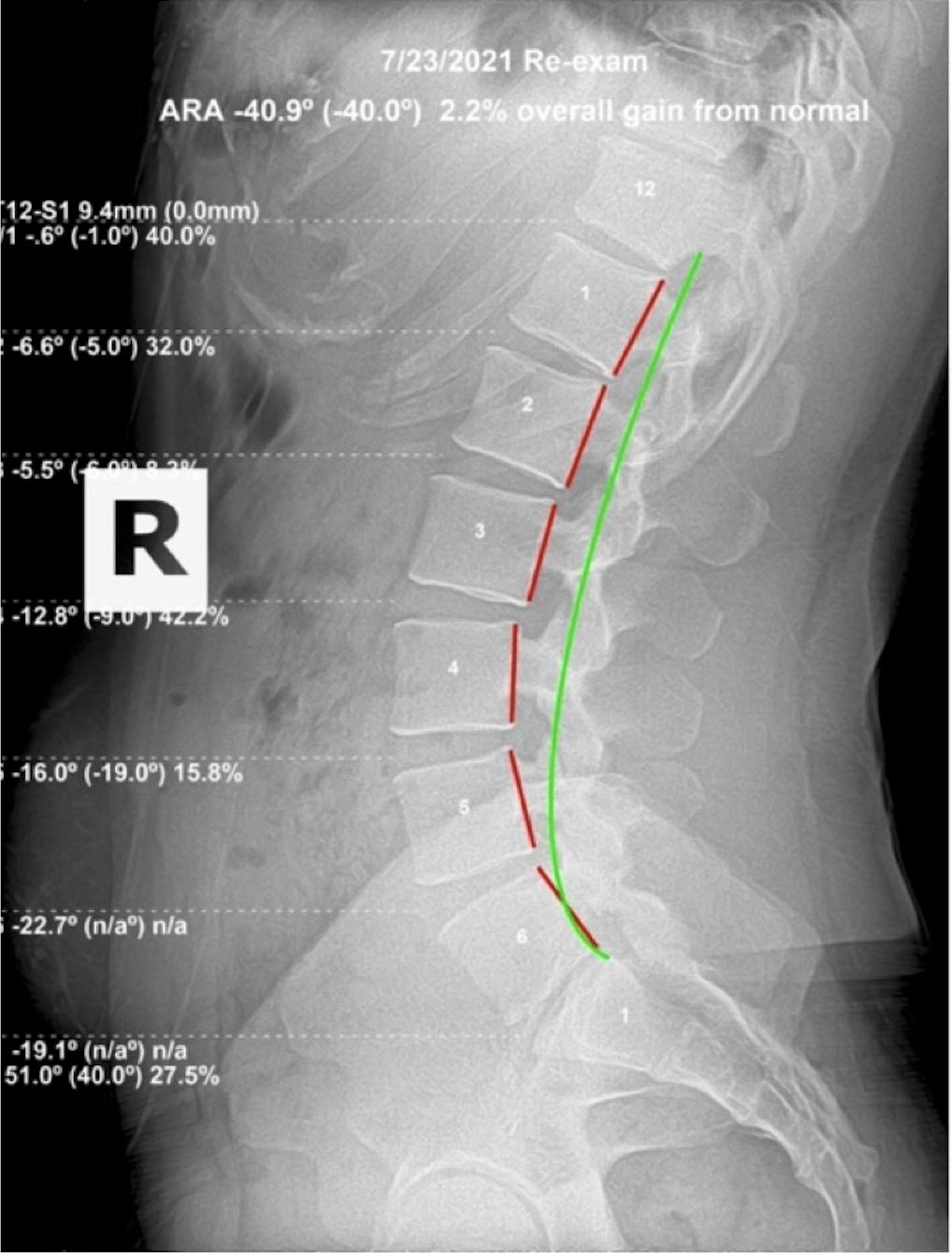
Re-evaluation ARA (Jul 21, 2021): −40.0° (normal −40.0°) — 2.3% gain from normal
Duration: 3 months corrective + 1 month maintenance
Outcome: Full ADL restoration; better QOL than before injury; no surgery, no medications, no physical therapy
His initial lateral lumbar X-ray, taken April 28, 2021, showed an ARA of −64.6 degrees against a normal of −40.0 degrees. This is a reversed lumbar curve — rather than curving forward (lordosis) as the healthy lumbar spine should, his lumbar spine was curving backward. This severe kyphotic reversal compresses the anterior disc space, accelerates L5 degeneration, and significantly compromises the nerve roots exiting the lumbar spine. It is among the most mechanically compromised lumbar presentations in our case records.
Lumbar Lateral — Before & After
Three Months. Life-Changing Results.
The re-evaluation lateral lumbar X-ray, taken July 21, 2021 after three months of corrective care and one month of maintenance, told the story clearly. ARA: −40.0 degrees. Normal is −40.0 degrees. A 2.3 percent gain from normal. In three months. In a 37-year-old bodybuilder with a reversed lumbar curve, an L5 disc herniation, and a lifetime of accumulated spinal injury. We performed specific chiropractic adjustments to correct his lumbar subluxation. His spine went through a near-perfect correction. His Innate Intelligence did the rest.
He returned to his full activities of daily living. He did so with a better quality of life than he had before the injury. He accomplished this without surgery, without medications, and without physical therapy. He came from a country with no chiropractors, found his way to a Royal Palm Beach office where we could not even communicate without a translation app, stayed the course for three months, and went home with a spine that was structurally close to what it was designed to be. That is what these principles produce when applied correctly. That is what the body is designed to do when the interference is removed.
Why This Pattern Matters
L5 disc herniations almost never begin at the disc. They begin at the curve. The lumbar spine distributes mechanical load across the disc face when the lordotic curve is intact. When the curve reverses — when the spine that should arc forward instead curves backward — the anterior disc space compresses and the posterior annular fibers carry load they were never designed for. The herniation follows. It is a structural problem that produces a tissue event.
Treating the tissue without correcting the structure is why disc injuries recur. Surgery targets the disc, not the curve. Injections suppress the signal, not the load. This case showed what happens when the structure itself is addressed. In three months, a lumbar ARA that was 36.8 percent outside normal returned to normal — without surgery, injections, or therapy directed at the disc. The body corrected the disc when the interference was removed and the curve was restored. Innate Intelligence does not need us to fix the disc. It needs us to free the structure so it can fix the disc itself.
The speed of correction in this case deserves specific attention. This was a 37-year-old body with a reversed lumbar curve and a documented L5 disc herniation. He presented unable to move normally. Three months later, the ARA measured at normal. That rate of structural change is possible because Innate Intelligence does not require years to act when given the right conditions. It requires consistency, specificity, and the removal of structural interference. Given those conditions, the body moves quickly.
The international dimension of this case is also notable. He traveled from a country with no chiropractic care. He and his care team communicated through a translation app. He stayed the course for three months of intensive correction and went home with documented structural restoration. The principles of subluxation-based correction are not language-dependent or geography-dependent. They are biological. The spine responds to specific structural correction the same way everywhere. The only variable is whether the correction is applied.
The abbreviated timeline of this case also contains a clinical lesson about the relationship between frequency and structural change. When the care window is short, the adjustment frequency within that window needs to be high to produce the same structural change that a longer, lower-frequency plan would achieve. The biology does not change. The protocol compresses the cumulative effect of more visits into fewer months. This patient received a higher frequency of specific adjustments in three months than a standard six-month plan would produce at lower frequency. The X-ray outcome reflected that intensity.
The international element of this case is not incidental. He sought structural correction in Royal Palm Beach because it was unavailable in his home country. The structural principles applied here are not locally developed — they are internationally applicable. The same ARA methodology, the same subluxation analysis, the same specific adjustment approach that corrected his lumbar spine would correct the same pattern in any country with the equipment and the training. The outcome is biological, not geographic. Innate Intelligence does not require a passport.
What to Look For
A reversed lumbar curve is rarely obvious from the outside. The person with significant kyphotic reversal typically describes an inability to stand fully upright for long periods, persistent tightness or spasm that doesn't resolve with stretching, and a pattern where bending forward feels more manageable than standing straight. The disc itself may or may not produce consistent pain. The spine compensates until it reaches its limit — then an ordinary lift becomes a crisis.
For bodybuilders and athletes in high-load activities, years of loaded spinal flexion without structural monitoring accelerates curve reversal. Recurring acute episodes of low back pain following heavy training are not muscle strains. They are the spine crossing its compensatory threshold. A lateral lumbar X-ray will show the curve as it actually is. Any athlete training through persistent low back tension should have one before the next incident.
Disc herniation with a reversed lumbar curve is also worth evaluating specifically in anyone who has had an MRI showing disc involvement but has not yet had a standing lateral lumbar X-ray with ARA measurement. The MRI is a supine imaging study — it shows the disc, but not the curve position under load. Two patients with identical MRI findings can have very different structural pictures on the standing X-ray. The distinction matters for determining what correction is available and what the protocol requires. The MRI is not the full structural picture. The standing lateral X-ray is. Have you ever had your spine checked for subluxation?
A Disc Injury Is a Structural Problem. Address It at the Structure.
If you have been told your disc herniation requires surgery, or if you have been managing it with medications and physical therapy without structural improvement, come in for a lateral lumbar X-ray analysis. The ARA measurement will show you exactly where your lumbar curve stands — and what is structurally correctable.
Schedule a Structural EvaluationOr call us at (561) 795-3156