
What Daily Screen Use Was Doing to Her Spine
This 34-year-old woman came to Rochet Family Chiropractic with a presentation that has become increasingly common: the consequences of years of daily screen use on the cervical spine. She was not aware of the structural damage accumulating while she worked, scrolled, and typed with her head tilted forward and down. That posture — sustained for hours each day — is a repetitive motion injury to the cervical spine. The X-ray makes it visible.
Her clinical picture included migraine headaches occurring almost constantly — not occasionally, almost daily. Suppressed energy levels. Mental fog. Fatigue. Occasional paresthesia (pins, needles, tingling, and numbness) in her hands. She is a mother to a young daughter. Each of these limitations had obvious quality of life consequences for her capacity to be fully present and functional in her most important role. She came in having managed these issues without a structural answer. The lateral cervical X-ray provided that answer immediately.
What the X-Ray Confirmed
Clinical Findings — Lateral Cervical X-Ray Analysis
Patient: 34-year-old female, mother; daily screen use as identified repetitive stressor
Presenting: Near-daily migraine headaches; suppressed energy; mental fog; fatigue; paresthesia in hands
X-ray type: Lateral cervical
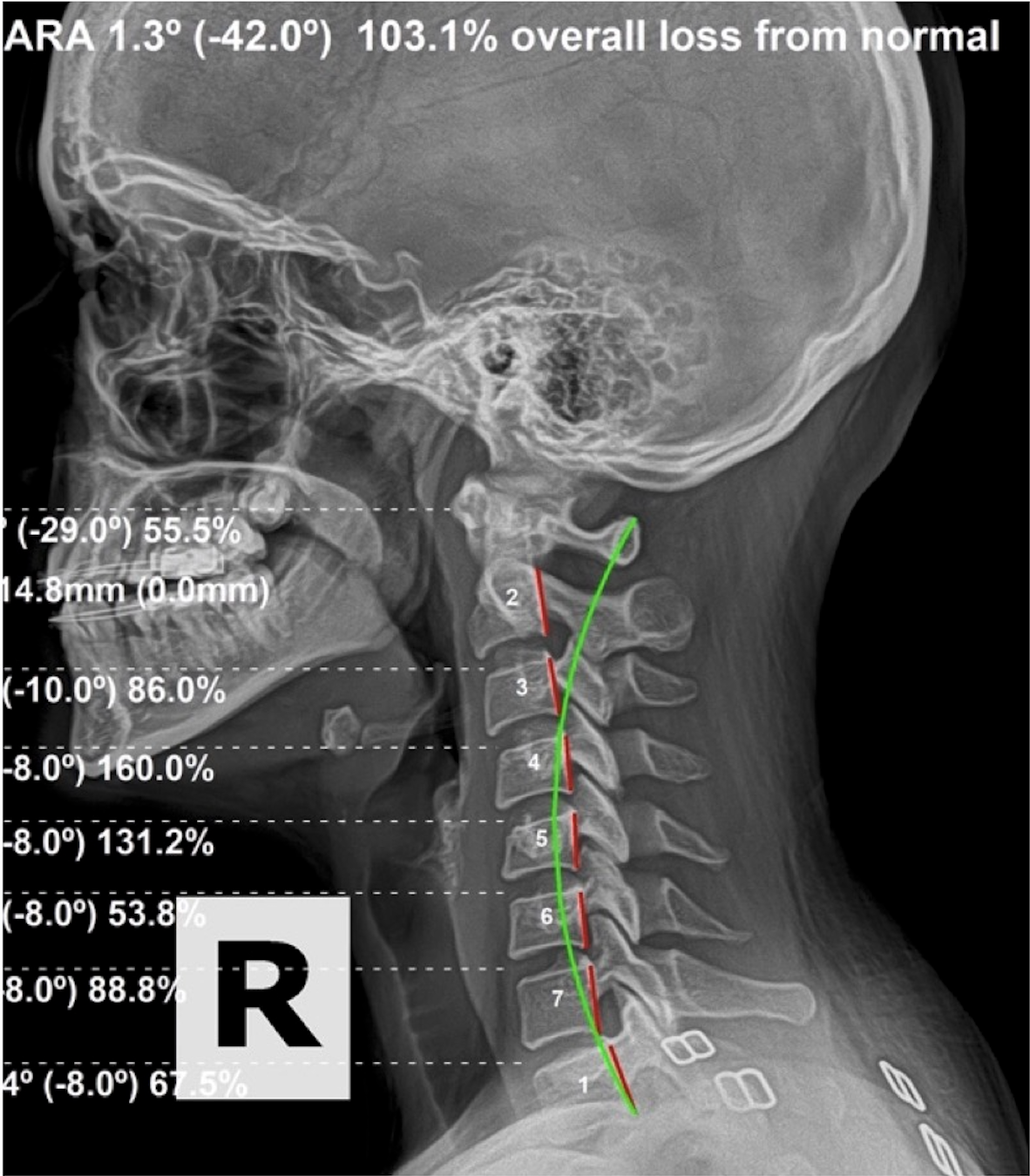
Initial ARA: 1.3° (normal −42.0°) — 103.1% overall loss from normal
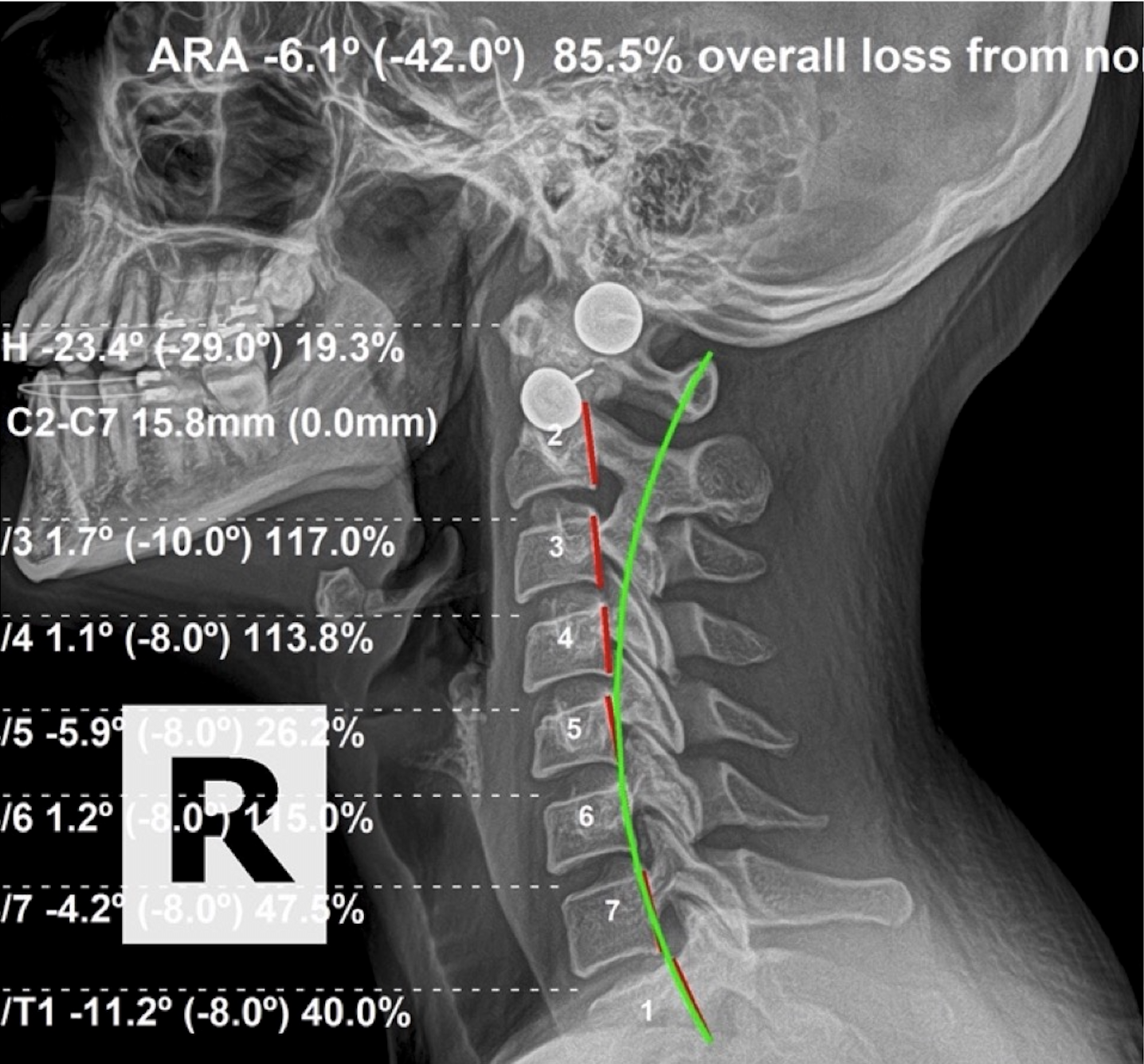
Re-evaluation ARA: −6.1° (normal −42.0°) — 85.5% overall loss from normal
Improvement: 17% cervical curve restoration in 6 months
Duration: 6 months corrective care
Post-care plan: Continuing on Protective Care to maintain and advance structural gains
The initial lateral cervical X-ray showed an ARA of 1.3 degrees against a normal of −42.0 degrees — a 103.1 percent overall loss from normal. Her cervical spine had not simply lost its lordotic curve. It had reversed past neutral into extension. Her head position on the initial X-ray was directed downward — consistent with the forward head posture produced by years of screen use. This was not an acute injury. This was a slow structural change written one hour of screen time at a time, left uncorrected until her nervous system could not compensate further.
Cervical Lateral — Before & After
What Six Months of Subluxation Correction Produced
We performed specific chiropractic adjustments to correct her cervical subluxation. Her Innate Intelligence went through the process of correcting the spinal alignment as the interference was progressively removed. From the first few adjustments, her headaches began responding. After six months, her headaches had resolved completely. We do not treat migraines. We correct subluxation. The headaches resolved because the nervous system interference that was contributing to them was addressed at its structural source.
Her other quality of life factors improved significantly as well. Her energy returned. Her mental clarity improved. The paresthesia in her hands diminished. As a mother, her capacity to be fully present for her daughter — the ADL that mattered most — was restored. The re-evaluation ARA of −6.1 degrees represents a 17 percent improvement in cervical curve from an initial position of 103.1 percent loss from normal. She is continuing on a Protective Care plan to maintain that structural gain and continue the restoration process. Her health future is measurably different from what it was before she walked in.
Why This Pattern Matters
Screen-time cervical subluxation accumulates invisibly until the nervous system runs out of compensatory capacity. What appears at the end — near-daily migraines, hand paresthesia, cognitive suppression — looks neurological. It is structural. When the cervical lordosis is lost, the brainstem and upper cervical nerve roots bear the mechanical load of a head displaced forward from its center of gravity. The migraine, the tingling hands, the mental fog are not independent problems. They are one structural problem expressing itself through the nervous system in multiple channels at once.
The 103.1 percent loss from normal documented here means the cervical spine wasn't simply out of alignment — it had reversed past neutral. Every subsequent hour of screen use compounded that position. The body had been managing it for years before symptoms became unmanageable. The 17 percent ARA improvement in six months from a reversed starting point demonstrates that the structure responds to correction even at this stage. Innate Intelligence does not require you to catch the problem early. It requires you to start.
The parenting dimension of this case is also worth naming directly. She identified her most important ADL as being fully present for her daughter. That is not a clinical metric in the traditional sense — but it is the life expression that sustained cervical interference was preventing. When the structural source of that interference was corrected, the capacity for her most valued function returned. Chiropractic does not restore ADLs directly. It restores the nervous system infrastructure that makes every ADL possible at full expression.
The continuation to a Protective Care plan is structurally correct. Screen use is a daily occupational reality. The cervical spine will continue to be loaded by that posture indefinitely. Protective care maintains the structural gains of the corrective phase against ongoing postural pressure. Without it, the cervical curve reverts. The screen use continues. The structural compromise rebuilds. Protective care is not optional maintenance — it is the rational response to a postural stressor that does not stop when the correction plan ends.
The 103.1 percent loss from normal also has a specific clinical interpretation that distinguishes structural damage from posture: the cervical spine had reversed 3.1 percent past the point of zero lordosis. This is not poor posture correctable by ergonomic adjustments. It is documented structural reversal measured in degrees on a standardized X-ray. Postural exercises, stretching, and workstation changes address behavior, not structure. The ARA measures the structural state of the spine. Behavioral changes slow future accumulation. They do not correct the displacement that has already occurred.
The multi-system expression of this patient's cervical subluxation — migraine, paresthesia, cognitive suppression, fatigue, energy loss — also demonstrates why cervical subluxation is not primarily a neck problem. Each of those expressions is a neurological output of a brainstem and cervical nerve root under structural load. The patient came in for the headaches. The paresthesia and cognitive fog resolved alongside them — not because they were treated separately, but because the structural source producing all of them was the same. One correction. Multiple simultaneous improvements.
What to Look For
Early screen-time cervical subluxation is not dramatic. Occasional tension at the base of the skull. Eyes that fatigue faster than they used to. A dullness in the late afternoon that extra sleep doesn't fix. A neck that cracks or pops more than it used to. These are pre-crisis signs. By the time migraines and hand tingling appear, the curve has typically been compromised for years.
Anyone spending four or more hours per day on screens — phone, laptop, or workstation — should have a lateral cervical X-ray. Not because symptoms are present, but because the posture is structural and the damage is cumulative. The ARA measurement will show the curve position as it actually exists. What you can't feel is still being measured in degrees.
For parents and caregivers who identify being fully present for family as a primary function — as this patient did — the structural evaluation for cervical subluxation deserves the same priority as any other health screening. Screen-time accumulation is a silent structural stressor. It does not produce a symptom that signals urgency until the cumulative damage is significant. The patient who waits for near-daily migraines to prompt the evaluation has already reached the end of the spine's compensatory capacity. The patient who evaluates while symptoms are still intermittent catches the structure earlier, corrects faster, and preserves more. Have you ever had your spine checked for subluxation?
Your Phone Is Shaping Your Cervical Spine. That Can Be Corrected.
If you spend hours each day looking at screens and have been experiencing headaches, fatigue, mental fog, neck stiffness, or tingling in your hands, your cervical spine may be telling you something important. A lateral cervical X-ray and ARA analysis will show exactly what daily screen use has been doing to your spinal structure — and what can be done about it.
Schedule a Structural EvaluationOr call us at (561) 795-3156