
How She Arrived
This month I want to walk through the case of a 33-year-old woman who came to see me here in Royal Palm Beach with severe low back pain. She is an equestrian instructor, so her livelihood depends on something most people never have to think about: how her body communicates with the horse underneath her. A rider's seat — the position of the pelvis and low back — is the language she uses to signal the animal. When her pelvis and low back were out of position, that language broke down, and she started compensating through her posture. That compensation created a second layer of muscular and structural imbalance on top of the original problem.
She came to me as a referral from one of the many health care professionals we work with. The bodywork he was doing for her — massage and active stretching — was helping her feel better in the moment, but it was not producing lasting correction. He recognized that his work had reached its limit and sent her to me for a structural evaluation.
What Her Films Showed
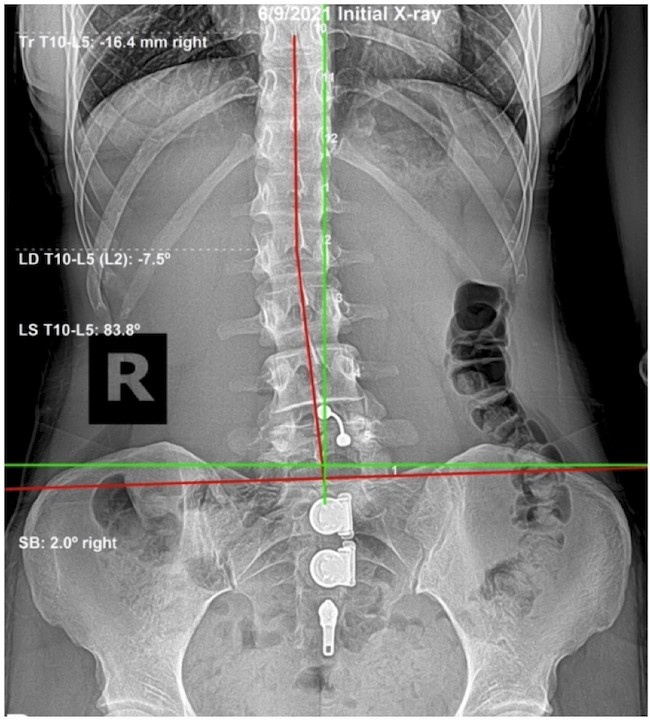
Her initial films, taken June 9, 2021, showed significant subluxation through her lumbar spine and pelvis. One of the measurements was a lateral translation of the lumbar spine of 16.4mm to the right, which is how far the spine had shifted sideways off the body's center line. From there her care was straightforward: specific chiropractic adjustments to correct the subluxations, over a six-month corrective plan.
Quality of life is the real measure of this care. Subluxations interfere with how the nervous system runs the body, and correcting them allows the body to function the way it was designed to. The X-rays are there to confirm that her structure changed, and that change coincided with the improvements she felt and the activities that came back to her.
Clinical Findings — Initial Examination
Patient: 33-year-old female, equestrian instructor, referred by a bodywork health partner
Presenting complaint: Severe low back pain affecting her ability to instruct and ride
X-ray type: AP lumbar and pelvis
Initial X-ray: June 9, 2021 — lateral translation (T10-L5) of 16.4mm right
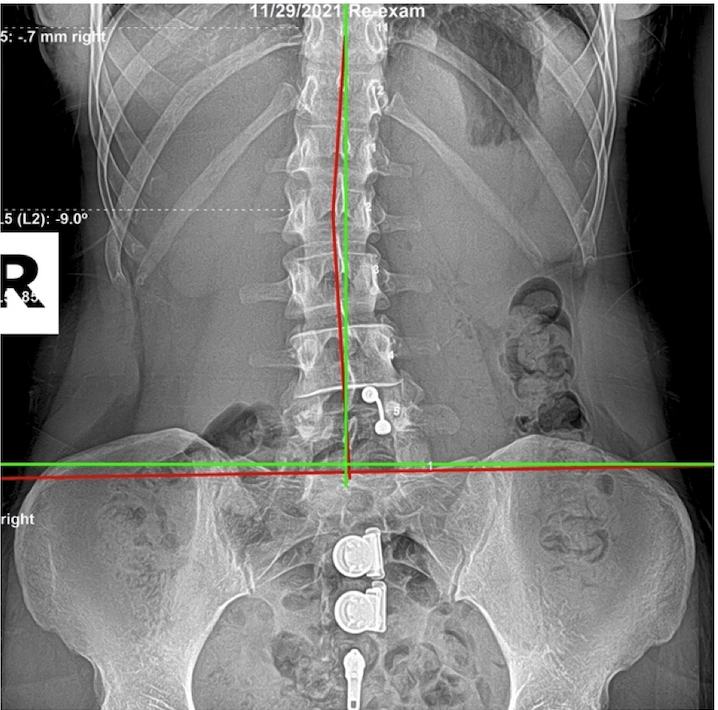
Re-evaluation X-ray: November 29, 2021 — lateral translation (T10-L5) reduced to 0.7mm right
Care span: Approximately 6 months of corrective care between films
Outcome: Graduated to a reduced, maintenance-level visit frequency
Lumbar & Pelvic AP — Before & After
Why Massage and Stretching Couldn't Correct It
Massage and active stretching are valuable. They help circulation and muscle tension, and they improve how you move in the short term. They cannot, however, move a lumbar spine that has translated more than sixteen millimeters to one side. That is a bony, structural position, and correcting it takes a specific chiropractic adjustment applied over time. The provider who sent her recognized that his work would not change her structure, and he referred her for a structural evaluation.
Six Months Later
Over the six months, her quality of life came back. She is instructing and riding again with no pain or discomfort, and her seat communication with the horse has improved — the skill her entire profession depends on.
Her re-evaluation films on November 29, 2021 showed her lateral translation reduced from 16.4mm to 0.7mm, confirming that her structure changed alongside how she felt. Her spine is not yet in its full ideal alignment, so she has continued on a lighter maintenance schedule to keep building on the correction.
What I See in Riders and One-Sided Athletes
This pattern is common in anyone whose activity loads one side of the body harder than the other — riders, golfers, tennis players, and people who sit and rotate the same direction all day. The early signs are usually small ones: one hip sitting higher than the other, weight settling onto the same leg when you stand, one boot wearing down faster than its mate, a movement that used to feel even now feeling off. By the time it limits what you do, the shift has usually been building for years. These patterns build quietly, and most people carry them for a long time before they think to have their spine checked.
She came to me because someone who understood her body sent her to the right place. I corrected the subluxations her films revealed, and her body responded the way it is designed to.
Your Foundation Affects Everything Built On Top Of It
If low back pain is limiting what you can do, your spine and pelvis need a structural evaluation. Come in for an X-ray analysis and find out what your own films show.
Schedule a Structural EvaluationOr call us at (561) 795-3156
Related: She was referred for sciatica. The pelvis was the key there, too.