How He Arrived
This month I want to feature a 57-year-old man who initially came to us for increasing low back pain and problems with his left hip. Some of his activities of daily living include being an organist for a church, as well as cycling. Both of those activities apply a great deal of stress to the hips. A cyclist spends hours folded forward over the bars, and the organ bench keeps him seated and still for long stretches as well. Years of that kind of loading add up in the spine and hips. He knew he had a degenerative condition in his hip, and he also knew that he didn't want to entertain surgery as a remedy.
What a Degenerative Hip Means for an Active Life
He came in already knowing two things: he had a degenerative condition in his hip, and he did not want surgery if he could avoid it. Although degeneration is a normal process with use, excessive degeneration due to injury, trauma, or biomechanical misalignment is not normal. When a joint wears down faster than it should, part of what drives it is the abnormal stress of a misaligned structure, and that is something we can work on.
His goal was to keep playing the organ, keep cycling, and keep living without pain running his life. Chiropractic does not rebuild a worn joint, but correcting the subluxations takes abnormal stress off the structure and gives the nervous system a better chance to run the body well. He is still playing, still riding, and still making his own decisions about his hip on his own timeline.
The Plan — A Royal Palm Beach Low Back and Hip Case
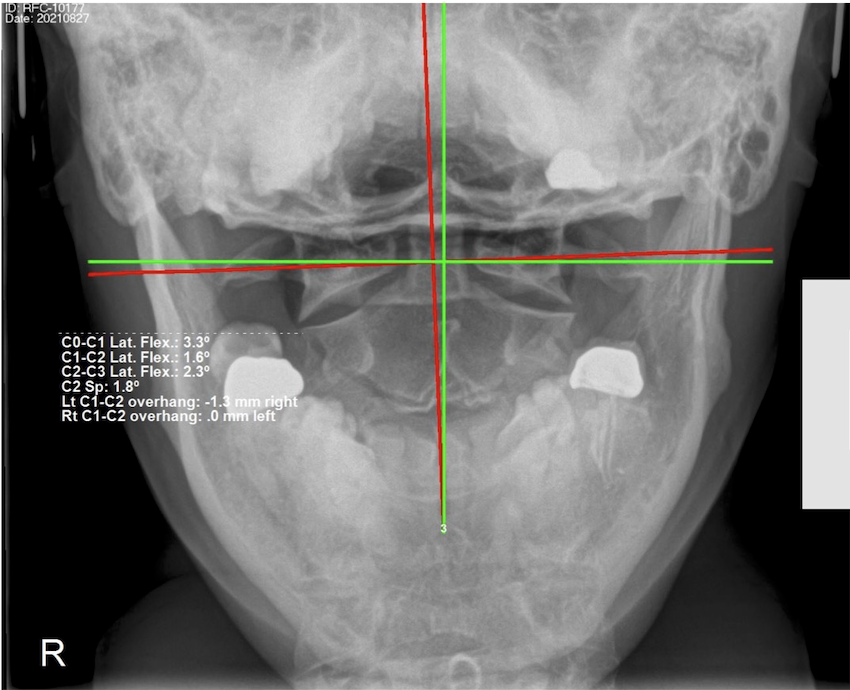
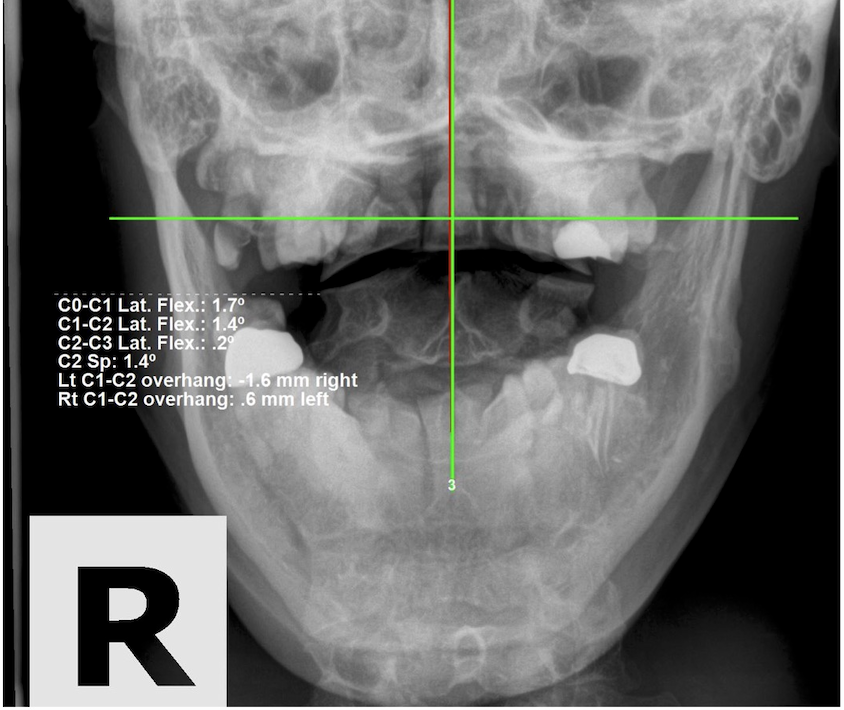
Our initial care recommendation was for a six-month correction program. His upper cervical films — the anterior-posterior open-mouth (APOM) view that shows the Atlas and axis — documented the Atlas subluxation and head tilt we set out to correct.
Clinical Findings — Initial Examination
Patient: 57-year-old male, church organist and cyclist
Presenting complaints: Increasing low back pain and left hip problems
Known history: Degenerative condition in the left hip; wanted to avoid surgery
X-ray type: APOM (anterior-posterior open-mouth) upper cervical
Primary structural finding: Atlas (C1) subluxation with head-tilt (C0-C1 lateral flexion 3.3°)
Care plan: Six-month correction program, extended by another three-month cycle
Upper Cervical APOM — Initial & Re-Evaluation
The Atlas Sits at the Foundation
The Atlas is the very top vertebra of the spine, the ring of bone the skull rests on. It carries the weight of the head and sits closest to the brain stem, where the nervous system begins its path down through the body. Because of where it sits, the Atlas has a great deal of influence over both the alignment of the spine below it and the function of the nervous system. On his APOM film, his Atlas was tilted, with a head tilt measured at 3.3 degrees. By his re-evaluation, that had come down to 1.7 degrees.
A tilted Atlas means the head is not sitting level on top of the spine, and the body compensates for that below. Bringing the head back toward level takes stress off that pattern of compensation. That is the correction his re-evaluation film captured, and it is the foundation the rest of his care is built on.
Six Months In
In that time, he has realized improvements in sleep, posture, and energy. He continues to participate in his activities of daily living with improving dexterity and range of motion. Although we did not realize any visible changes to his left hip joint, he has been able to maintain his range of motion without pain.
His x-rays show a marked improvement in alignment, as well as giving indications that further correction is on its way. His Atlas (C1) correction is a foundational component of the rest of the improvements throughout the spine we have seen, as C1 is the gatekeeper to both spinal correction and neurological function. He has decided to continue for another three-month cycle of correction in order to solidify his spinal correction, as well as maintain functional improvement in his low back and hips.
All of his functional improvements are based on his Innate intelligence being able to regulate his system better — the same way it can happen for you.
I am not the healer. I move the bone; God does the healing. You are a self-healing organism, and when you are subluxation free, not only does your spine heal, but your body expresses life the way you were created to do.
Low Back and Hip Pain Deserve a Full Structural Look
If low back or hip pain is limiting what you do, come in for a complete structural evaluation. A full X-ray analysis looks at your whole spine and shows where correction is needed.
Schedule a Structural EvaluationOr call us at (561) 795-3156
Have you ever had your spine checked for subluxation?
Related: Another Atlas case: upper cervical correction and whole-body change.