
When Years on the Job Finally Show Up in the Back
A 34-year-old mechanic came to us with low back pain that had crossed the line from annoying to impossible to ignore. He had a history of injuries and years of work on the job — the kind where you're under vehicles, twisting to reach something, holding awkward positions for too long, lifting more than you should in a space that doesn't give you room to do it right.
Every mechanic knows this. You don't blow your back out doing one thing. It's the thousand things over the years that add up. Each one by itself is manageable. Together, over time, they start to tilt and shift the bones in your spine and hips until the whole structure is out of alignment.
Think of it like a vehicle frame that's been in a few minor accidents and never fully straightened out. Each one was "not that bad." But after enough of them, the frame is crooked — and everything bolted to it is running at an angle it was never designed to handle. That's what his pelvis looked like on X-ray. Out of level. And his entire lower back had been compensating for it for years.
What the X-Rays Showed
The X-ray gave us an exact picture. His pelvis — the bone at the very base of his spine, the one everything else sits on top of — was severely out of level. When that base is tilted, every vertebra above it has to compensate. His lower back had been doing that for years. Every step, every shift of weight, every hour standing on the shop floor was running through a crooked foundation.
This is why the pain doesn't go away on its own. You can stretch, you can rest, you can tape it up — but if the underlying alignment is off, the stress keeps coming. The bones are misaligned (that's what a subluxation is — a spinal bone out of its proper position, putting pressure on the nerves). Until you fix the alignment, you're just managing a problem that isn't going anywhere.
Lumbar Spine AP — Before & After
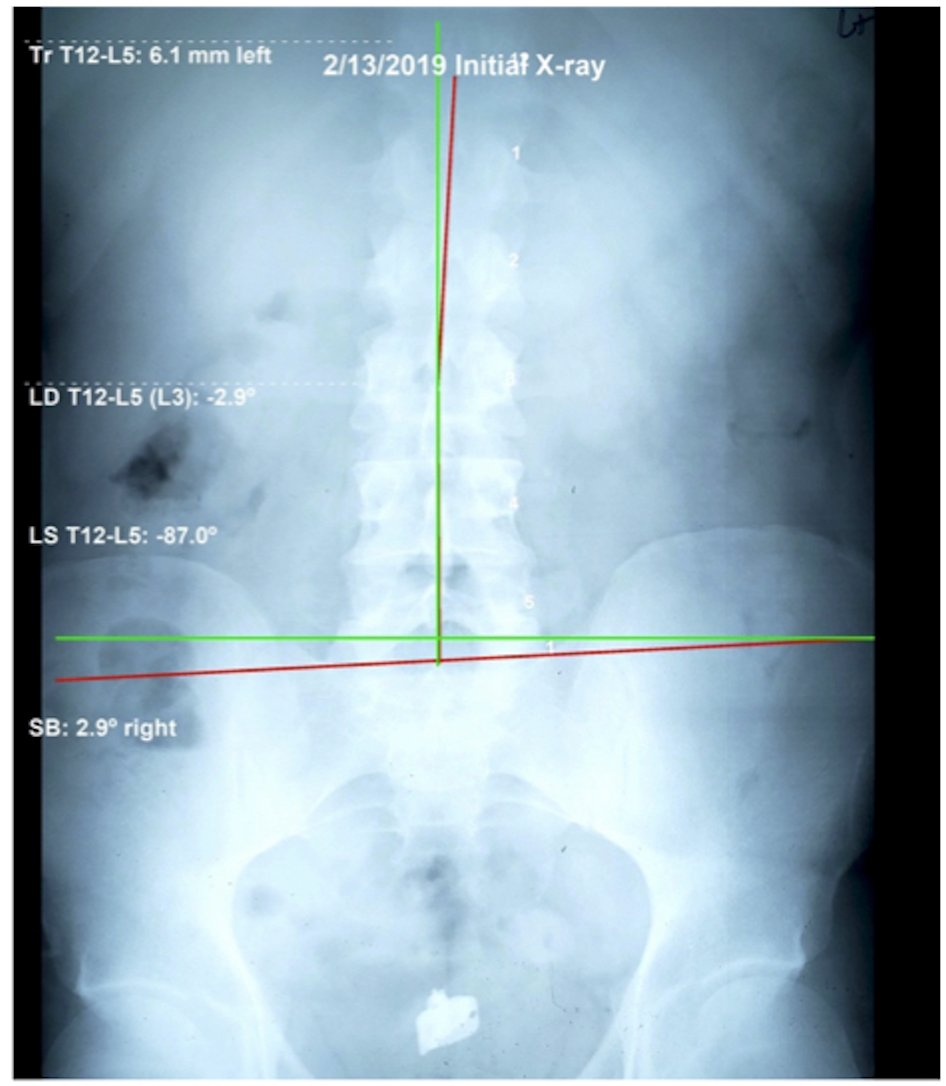
What We Found — Initial X-Ray (Feb 13, 2019)
Lower back / pelvis: Severely out of alignment. The base of the spine — the sacrum, the bone your whole lower back sits on — was tilted 2.9° off level. Everything above it had been compensating.
Bottom line: Years of physical work had pushed his foundation out of position, and the misaligned bones were putting constant pressure on the nerves in his lower back.
Getting It Straightened Out
We put him on a 6-month correction plan — specific adjustments to get the misaligned bones back where they belong and take the pressure off the nerves. No guessing, no generic treatment. We knew exactly which bones were out and exactly how to move them.
He made solid progress. His back was feeling better, he was moving better at work, and his day-to-day life was improving. He decided to push for another 3 months to get the correction as complete as possible before we backed off to a maintenance schedule.
Nine months total. Same commitment he'd put into fixing someone else's vehicle — except this time it was his own body on the lift.
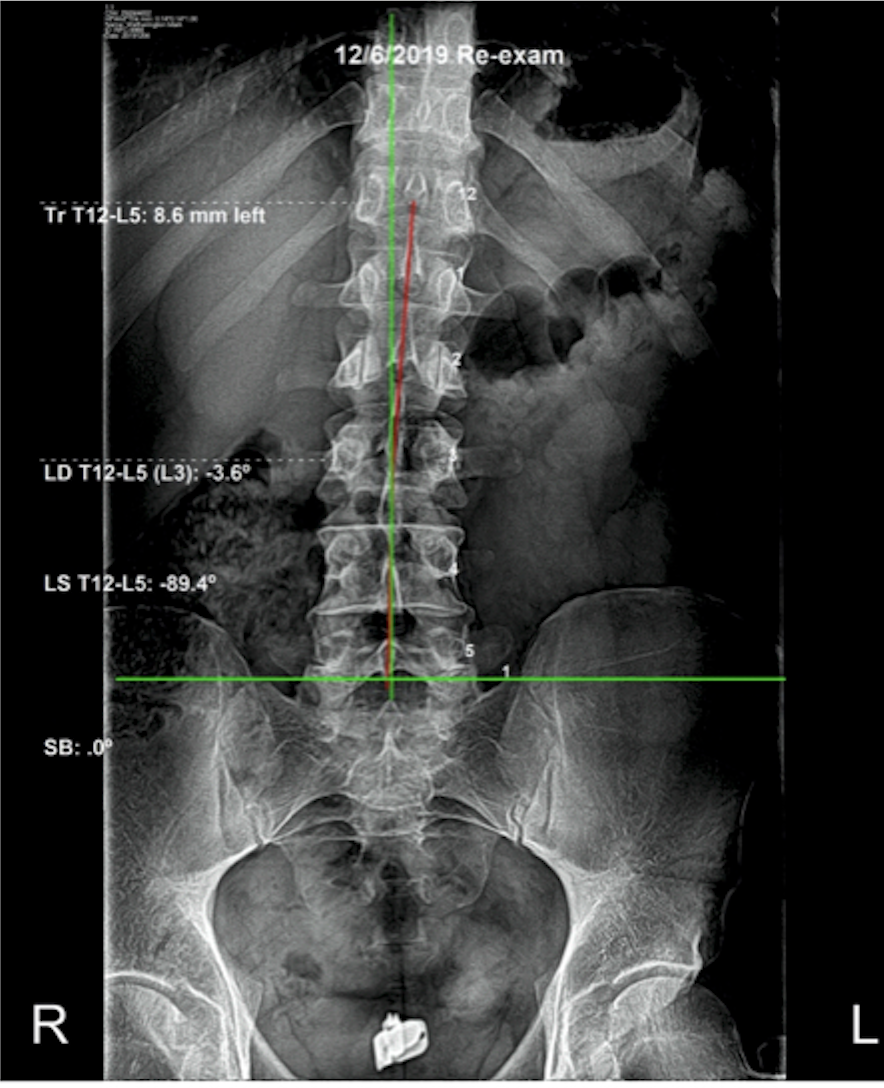
Where He Ended Up — Re-evaluation (Dec 6, 2019)
Lower back / pelvis: Base of the spine leveled from 2.9° off to approximately 0.2° — essentially level. The foundation was back where it needed to be.
Outcome: Moved to a maintenance schedule. Back pain no longer running his life. Quality of life improved across the board.
What "Maintenance" Actually Means
When we move a patient to maintenance, it means the correction is holding. The bones are back in place and staying there between visits. We're not fixing a problem anymore — we're keeping the alignment where it should be so it doesn't drift back.
For him, that meant the back pain that had been his constant companion was gone. He could do his job. He could get through a full day on his feet without dreading it. The things that had quietly gotten worse over the years — sleep, energy, just feeling like himself — came back.
We didn't treat the back pain. We fixed what was causing it. Once the alignment was corrected and the pressure was off the nerves, his body handled the rest on its own.
Got Old Injuries You've Been Working Around?
If years on the job have been adding up in your back — or you've got old injuries you never fully dealt with — it doesn't fix itself. Come in and let us take a look at what's actually going on. We'll show you exactly what the X-ray says and what it takes to correct it.
Schedule a Structural AssessmentOr call us at (561) 795-3156
Why Tradespeople Can't Afford to Ignore This
Nobody in the trades blows their back out doing one thing. It's the years of bending, reaching, lifting in bad positions, taking the hit and pushing through it. Every time you do that without getting the alignment checked, you're adding to a problem that compounds quietly until it doesn't.
For guys working in Royal Palm Beach, Wellington, and across the Palm Beach area — construction, mechanics, plumbing, electrical, landscaping — this is one of the most common things we see. The body is incredibly good at adapting and compensating. But it has a limit. And when it reaches that limit, the pain that shows up is the result of years of damage, not just what happened last week.
The good news: the spine responds to correction no matter how long the problem has been there. It takes longer when it's been building for years — but the direction is the same. Get it aligned, keep it aligned, and the body does what it's built to do.
The Simple Version
Your spine is the highway between your brain and every part of your body. When bones are out of position — what we call a subluxation — that highway has a roadblock in it. Your body can't communicate properly, can't heal properly, can't function at full capacity. You feel it as pain. But the pain is just the signal. The misalignment is the problem.
Fix the alignment, clear the roadblock, and the body does the rest. Your body works better when everything is lined up the way it's supposed to be. That's true for a vehicle. It's true for you too.
Whatever got your spine to where it is — years of trade work, old injuries, just life — the correction is available. It starts with actually looking at what's there.
Why This Pattern Matters
The pelvis is the structural foundation the entire lumbar spine sits on. When the sacral base is off-level — as his was, 2.9 degrees — every vertebra above it compensates. L5 tilts to accommodate. L4 responds to L5. The compensation works upward. By the time a tradesperson feels it daily, the pattern has been building for years through lifting, bending, and holding positions that load an already-tilted foundation.
The sacral base measurement tells the precise story: 2.9 degrees off-level to 0.2 degrees in nine months. The pain was the signal, not the problem. The misaligned foundation was the problem. Once the pelvis leveled and held, the body handled what it was always designed to handle. Innate Intelligence doesn't need help. It needs the interference removed. In this case, the interference was the tilted foundation his entire lower back had been compensating for, for years.
What to Look For
Pelvic subluxation doesn't always announce itself as acute pain. Earlier signs are subtler: one hip that sits consistently higher than the other, a sense that one leg is slightly longer, low back tension that is noticeably worse on one side, or a standing posture that has quietly shifted to favor one hip. Tradespeople often develop a habitual lean or a way of positioning during work that compensates without them realizing it.
If you've been managing back symptoms by adjusting how you work — favoring one side, avoiding certain movements, compensating with your stance — that adaptation is the sign. The AP lumbar X-ray will show the sacral base level and tell you exactly what the foundation looks like.
Have you ever had your spine checked for subluxation?