A Family Already in Care — and a Child Who Needed More
This family had been receiving maintenance adjustments at Rochet Family Chiropractic for some time. The parents were familiar with subluxation correction and trusted the process. But the father noticed something developing in his 10-year-old son that concerned him: facial tics, and they were increasing in frequency. He asked whether chiropractic care could help. We decided to do some investigation.
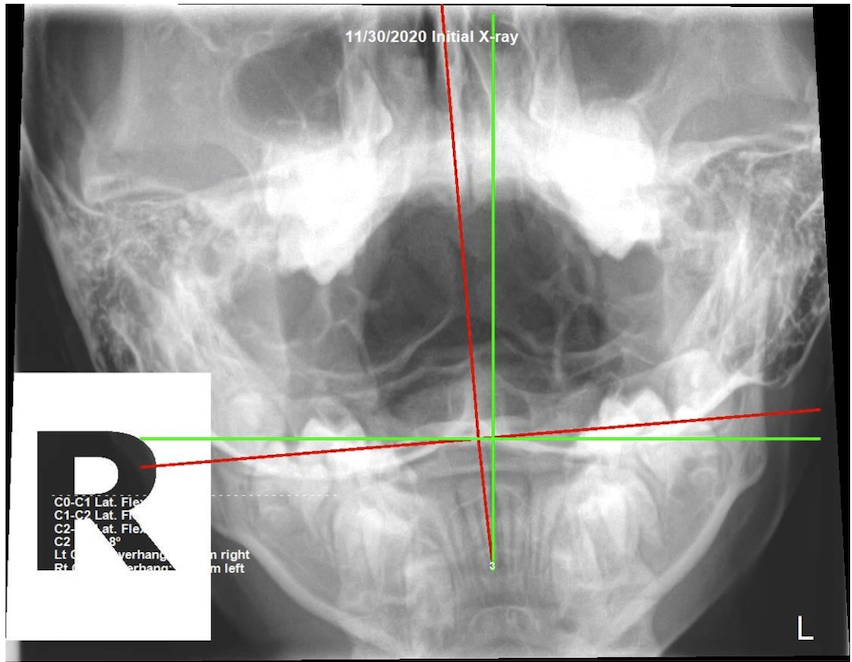
What we found on the upper cervical X-ray was not subtle. His Atlas (C1) and the overall alignment of his head were severely subluxated. The Atlas has a direct effect on the nerves that supply the head, and beyond that, it encircles the brainstem — the control center for the entire autonomic nervous system. Subluxation of C1 in this young man was preventing his nervous system from dealing with stress properly. The facial tics were the expression of that inability.
What the Examination Revealed
Clinical Findings — Initial AP Upper Cervical Examination
Patient: 10-year-old male; family under maintenance care at RFC
Presenting observation: Facial tics, increasing in frequency; father initiated evaluation
X-ray type: AP upper cervical
Initial: Oct 30, 2020 — Atlas (C1) and head alignment severely subluxated
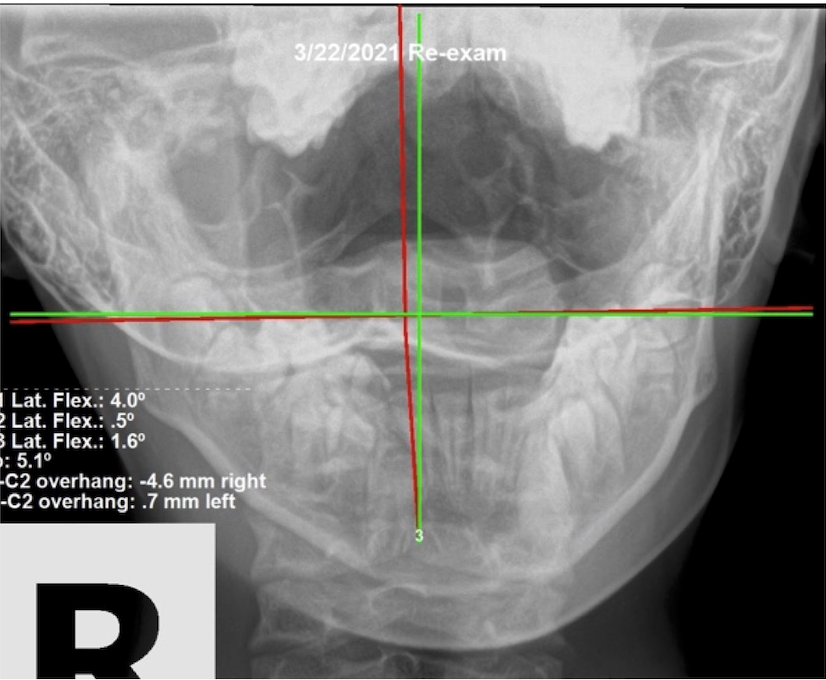
Re-evaluation: Mar 22, 2021 — improved C1 and C2 alignment confirmed
Neurological mechanism: C1 subluxation impairing nervous system stress regulation, manifesting as facial tics
Family commitment: Entire family committed to long-term corrective plan alongside the child
The Atlas (C1) has whole-body effects when subluxated. Subluxation of the first cervical vertebra does not merely affect the neck. It affects everything the brainstem regulates — and the brainstem regulates everything. In this child’s case, the interference at C1 was expressed through the nervous system’s inability to modulate its own stress response. Facial tics are one way that neurological dysregulation can manifest when the upper cervical spine is structurally compromised and the brainstem cannot regulate normally.
Atlas (C1) AP — Before & After
What Happened When the Atlas Was Corrected
As we progressed through the corrective care plan, the facial tics subsided. We do not treat facial tics. We corrected atlas subluxation. The body, through Innate Intelligence, restored the nervous system’s ability to regulate stress normally when the structural interference at C1 was removed. The X-ray taken March 22, 2021 confirmed the structural correction that was occurring.
The entire family had committed to long-term corrective care alongside the child — and all of them benefited from what could be called a “spinal refresher.” Every family member experienced improvements in mobility, sleep, mental clarity, and a decrease in general discomfort and pain. This is what subluxation-based chiropractic care does for a whole family when they commit together. The nervous system does not discriminate by age. Interference is interference. Correction is correction. The body was designed to heal when the interference is removed — and it does so at 10 just as it does at 60.
Why This Pattern Matters
The pediatric case makes visible something adults often don't consider: children accumulate subluxation just as adults do, and the effects appear in the nervous system first. The birth process creates C1 subluxation in many newborns. Falls during early childhood, sports, and the constant physical activity of growing up compound it. Most of this accumulates without pain. The nervous system adapts and compensates. But the interference is there, and it affects the quality of every function the brainstem governs.
Facial tics are a neurological expression of dysregulation — the nervous system's inability to modulate its own stress response. In adults, similar dysregulation might present as anxiety, insomnia, or blood pressure instability. In a 10-year-old, it expressed as facial tics. The mechanism is the same: brainstem interference from atlas subluxation disrupting the autonomic regulation the nervous system depends on.
The fact that the entire family corrected together — and all of them improved in sleep, mobility, and mental clarity — is not coincidental. Innate Intelligence responds the same way at 10 as at 40. Remove the interference, and the body expresses what it was designed to express.
The worsening trajectory before correction is also clinically important. Facial tics that intensify over months are not a behavioral problem — they are a structural signal. The atlas subluxation identified on the October 30, 2020 AP X-ray had been developing before the tics became noticeable. By the time a neurological expression reaches the level of visible, worsening tics, the structural interference has typically been present long enough to have already affected sleep, concentration, and sensory processing in ways the family may not have attributed to a spinal source. Correction at this stage can still produce full resolution, as this case confirmed. Earlier identification changes the timeline significantly.
The family participation model also deserves emphasis. Parents who observe their child's health improving through structural correction develop a different understanding of what the spine governs than patients who come in for their own pain management. When an entire family corrects together and every member experiences measurable improvement, it reframes what chiropractic care is. Not pain relief — structural stewardship of the nervous system, at every age, for every family member.
The developmental window matters specifically because of how rapidly the nervous system organizes itself in early childhood. The first years of life are when the brain and spinal cord establish the foundational patterns for sensory integration, motor coordination, and autonomic regulation. Subluxation present during that window does not just create interference — it creates interference during the period when the nervous system is most actively patterning itself. Correction at 10, as in this case, still produced full resolution. Correction at 3 or 5 would have reached the nervous system during an even earlier and more formative stage.
One practical implication of the pediatric timeline is that children who receive a diagnosis of a behavioral or neurological nature — tic disorder, attention difficulty, sensory processing concerns — without a prior structural evaluation have an incomplete workup. The upper cervical spine has not been assessed as a contributing factor. That gap is not unusual in standard care pathways. It is filled only when a parent knows to request a structural evaluation, or when a chiropractor who identifies these patterns sees the child. This case did not reach structural evaluation through a medical referral. It reached it because a parent sought it.
What to Look For
In children, atlas subluxation is often invisible by the standard criteria parents use to assess health. No obvious injury, no neck pain, no dramatic event. The signs are subtler: sensory sensitivity, difficulty concentrating in school, sleep that seems light or unrestorative, recurring headaches the child struggles to describe. Emotional regulation that seems harder than it should be for the child's age.
None of these are conclusive on their own. But in a child with a history of falls, contact sports, or a difficult birth, they are sufficient reason to evaluate the upper cervical spine. The X-ray will show what the absence of obvious symptoms cannot tell you. Children should be checked as early as possible — the nervous system develops most rapidly in the first years of life, and subluxation during that window matters most.
The family correction model in this case is also a practical guide for parents navigating the process for the first time. When a parent of a child with neurological or behavioral concerns has undergone their own corrective care before bringing the child in, they arrive as an informed advocate. They have experienced the evaluation process, understand what the X-ray shows, and can communicate the expected care plan to the child without the anxiety of unfamiliarity. That parent-as-informed-advocate dynamic tends to improve both child compliance and family commitment to the full corrective protocol.
Have you ever had your child's spine checked for subluxation?
Your Children Deserve a Structural Evaluation Too.
Children accumulate subluxation through falls, sports, the birth process, and daily physical activity. They often have no symptoms in the traditional sense — but their nervous systems are affected just as an adult’s would be. If your child has neurological, developmental, or functional concerns, or if you simply want to know that their spine is structurally sound, bring them in for an evaluation.
Schedule a Family EvaluationOr call us at (561) 795-3156