By Dr. Romar Rochet, D.C. — 20+ years subluxation-based family chiropractic care. Every Correction Spotlight documents a real patient from this office.
Why I'm Sharing This One
Most months I show you a spine that has improved under care. This one is different. He is a new patient I have just started working with, and I am sharing his case as a warning. I chose it to bring awareness to what silent spinal degeneration does over a lifetime, because I do not want you to end up where he is.
How He Arrived
He is 78 years old, with a storied past and some hard traumas when he was younger. About nineteen years ago he had a hip replaced, and it is suspected the implant was not measured accurately. Since that surgery he has lived with chronic, worsening low back pain. The one thing that gave him some relief was an orthotic in his right shoe, with a sole twice as thick as the left. You can imagine the biomechanical stress that puts on a spine that is already under duress.
His low back is severely subluxated and in need of major correction. He has also had worsening neck pain and stiffness for more than ten years, along with lung and breathing problems. His neck has lost more than sixty percent of its normal alignment. The discs have worn down significantly, complicated by bone degeneration and osteoporosis. Constant pain and the loss of his mobility have taken a heavy toll on his quality of life.
His Initial Films — Cervical & Lumbar
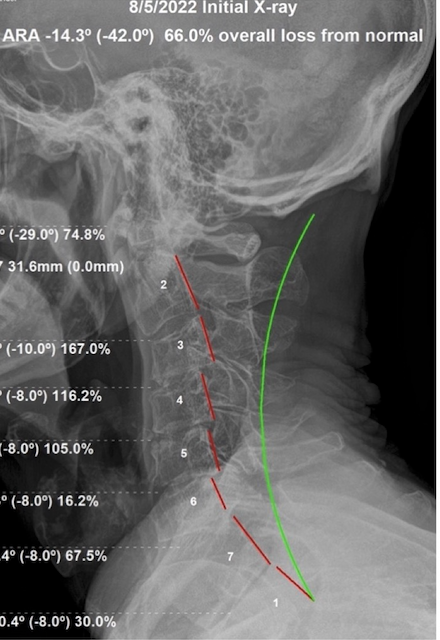
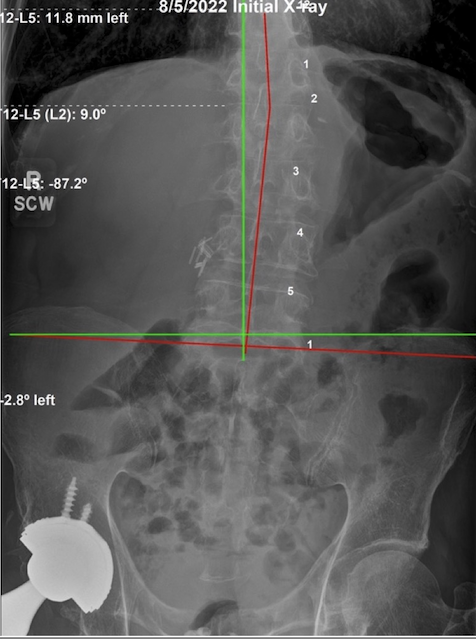
Both films were taken the same day, at his first visit. They show what decades of accumulated subluxation and stress do to a spine — across the neck and the low back at once.
Subluxation Is Destructive, and It Is Silent
Here is what I most want you to take from his case. The effect of subluxation on your spine is destructive, and it is asymptomatic for years. Symptoms are only produced after the dysfunction crosses a threshold, and by that time, the subluxation nerve interference is affecting systemic function — blood pressure, digestion, breathing, acid reflux, and more. By the time you feel it, it is already well underway.
The reason it stays hidden is that the body is remarkably good at compensating. It shifts weight, recruits other muscles, and works around the problem to keep you upright and moving. For years, that compensation masks what is happening underneath. But compensation has a ceiling. Once the spine can no longer work around the dysfunction, the symptoms arrive, and by then the structural damage — the disc wear, the bone changes, the lost alignment — has been building for a very long time.
This Is Correctable — If You Don't Wait
There is real urgency here. Waiting for symptoms before you have your spine checked may make the damage impossible to fully correct, and some of the effects may be irreversible. Waiting usually results in a spine that robs you of your quality of life and your ability to do the things that make life worth living. His is a correctable condition, if we get to it early enough. In his case, we are starting later than I would like, but we are starting, and I intend to help him.
Get checked often. Get adjusted when necessary. Stay healthy.
I am not the healer. I move the bone; God does the healing. You are a self-healing organism, and when you are subluxation free, not only does your spine heal, but your body expresses life the way you were created to do.
The Best Time to Check Your Spine Is Before It Hurts
You cannot feel subluxation while it is doing its damage, which is exactly why waiting for pain is the wrong strategy. Come in for a full structural X-ray analysis and find out what your spine is actually doing, while there is still the most to be done about it.
Schedule a Structural EvaluationOr call us at (561) 795-3156
Have you ever had your spine checked for subluxation?
Related: A severe, long-injured spine that improved more than expected.