By Dr. Romar Rochet, D.C. — 20+ years subluxation-based family chiropractic care, at this Royal Palm Beach office since 2007.
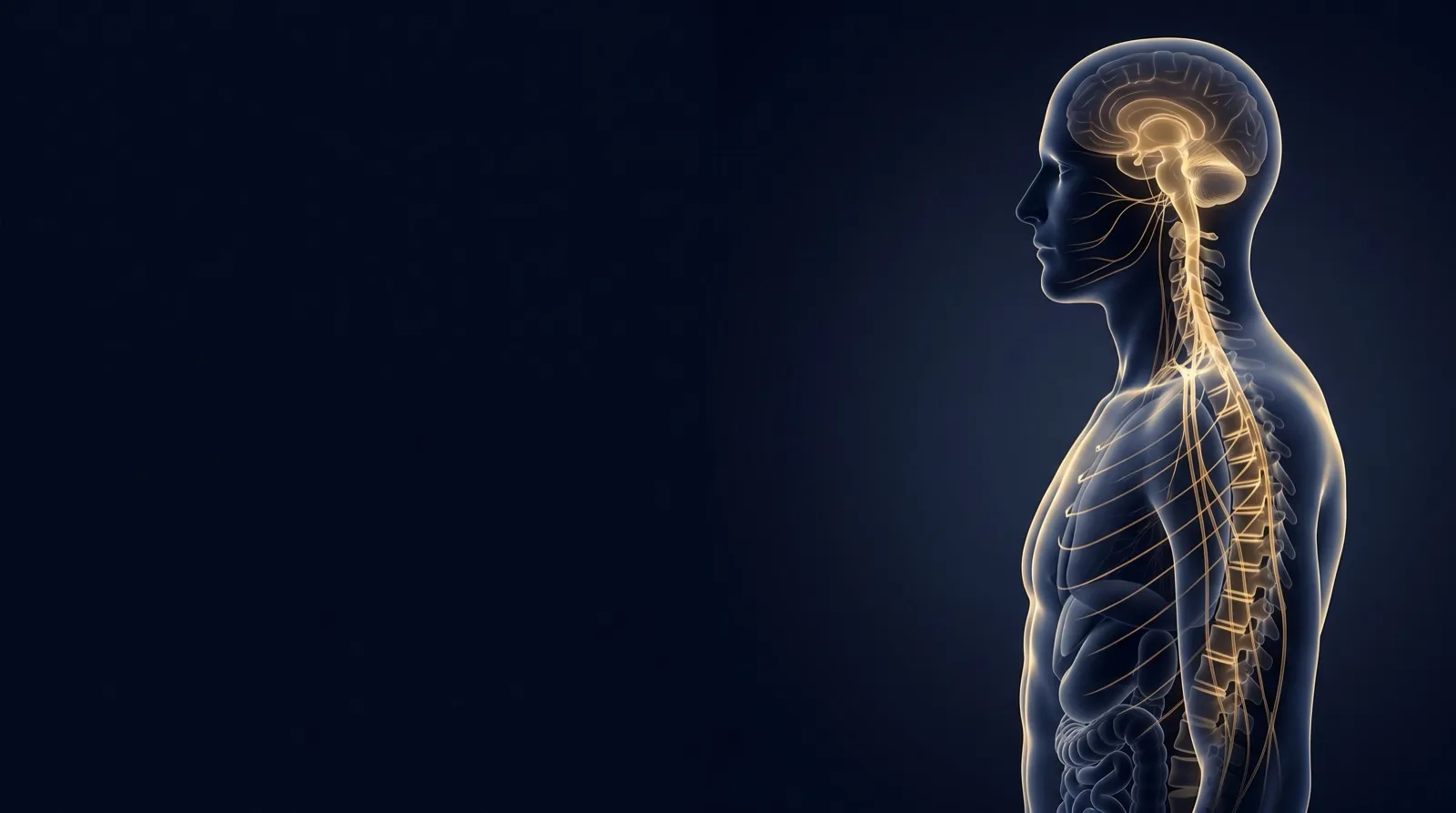
Your immune system does not run itself. It is coordinated by your nervous system, through nerve pathways that leave the brain, travel down the spinal cord, and branch out to the organs that defend you. A vertebral subluxation — a bone in your spine shifted out of its normal position — can interfere with those pathways. Correcting it is aimed at restoring that communication. That is the mechanism, and it is worth understanding plainly, without the overpromising this topic usually attracts.
How does the nervous system control the immune system?
This part is not chiropractic theory. It is mainstream neuroscience, and it has become much better understood in the last decade. Sensory and autonomic nerves signal directly to immune cells and to the organs that house them. Immune cells, in turn, carry receptors for the neurotransmitters and neuropeptides those nerves release — meaning the nervous system does not merely observe an immune response, it participates in shaping one. A 2022 review in Nature Reviews Neuroscience, from the immunology department at Harvard Medical School, lays out how distinct populations of sensory, sympathetic, parasympathetic, and enteric neurons regulate immune cells in barrier tissues and peripheral organs.
The organs on the receiving end of that signaling are the ones most people never think about. The thymus, where T lymphocytes mature. The bone marrow, which manufactures red and white blood cells. The spleen, which filters blood and produces immune cells. The lymph nodes and vessels (the drainage network running throughout your body), which trap pathogens and coordinate the response to them. Each of these is supplied by nerves. Each of them is downstream of a nervous system that has to be working properly for the whole arrangement to function the way it was designed to.
This is what I mean when I say the body carries an Innate Intelligence. Nobody has to instruct the spleen. Nobody consciously tells bone marrow to release white blood cells during an infection. That coordination was built in — God-given, running without your permission or attention — and it depends on a nervous system able to carry the message.
What does a subluxation have to do with immune function?
Your spine has two jobs. It holds you upright, and it protects the spinal cord — the main line between your brain and everything the brain governs. Those two jobs are related, because the same bones that provide the protection can also become the problem when one of them shifts out of position.
That is a subluxation: a vertebra that has moved out of its normal position or lost its normal motion, in a way that interferes with the nerve pathways at that level. The upper cervical spine — the top of the neck, adjacent to the brainstem — is the region I watch most closely in this context, because the autonomic pathways that regulate organ function pass through it. When a vertebra there is out of position, it can interfere with the signal traveling through. Correcting it is aimed at clearing that interference.
There is a second route worth naming. Sustained stress on the nervous system keeps cortisol elevated, and cortisol dampens immune activity — that connection is well documented. Structural stress in the spine is one of the things that keeps a nervous system in that state. Reducing it is one of the reasons a spine free of subluxation matters beyond how you happen to feel that week.
What does the research actually show?
Here is where I will be more careful than most of what you will read on this subject.
The nerve-immune connection itself — the anatomy and the signaling — is solid, established science, and the Harvard review above is one of many places you can read it. What is far less settled is the specific question of what a chiropractic adjustment does to immune measurements.
The study most often cited on this is Brennan and colleagues, published in 1991, which found enhanced respiratory burst activity in phagocytic cells (the immune cells that engulf and destroy pathogens) following spinal manipulation. It is a real finding in a peer-reviewed journal. It is also a small study, now thirty-five years old, and it has never been replicated at the scale that would settle the question.
The more current picture comes from a 2024 systematic review updating this literature, covering fifteen trials and 737 participants. Its finding was measured: low-quality evidence that spinal manipulation may influence inflammatory markers such as interleukins and may affect cortisol levels immediately after the intervention — alongside very low-quality evidence that it does not influence several other markers the earlier work had suggested. The authors were explicit that more research is needed to establish what these changes mean clinically.
So the honest summary is this: the mechanism is real, the measurements are suggestive and incomplete, and nobody has demonstrated that adjustments prevent illness. Be careful of any office that tells you otherwise. I would rather you trust what I say about your spine because I did not oversell you on this page.
What I have seen in twenty years of practice
Research is one form of evidence. What a doctor documents over two decades in one office is another, and I will give it to you with its limits attached: these are individual cases, they are not predictions, and I will not tell you what your body will do before I have examined your spine.
A 38-year-old woman came to this office after watching what correction did for her son. She presented with headaches, environmental allergies, and chronic neck and back tension. Over six months of corrective care, her re-evaluation X-ray showed near-ideal cervical alignment — and her environmental allergies resolved completely, as did the headaches. I did not treat her allergies. I corrected the subluxations in her cervical spine, and her body did what it does when the interference is gone. Her case is documented in full here, films included.
Another patient, a referral, arrived with a cluster of complaints spanning several systems at once — sinus dysfunction, diminished hand and leg function, and cognitive fog — with X-rays showing substantial subluxation stress at the level of the brainstem. After six months of corrective care, the skull had realigned and her sinus function was among the things that improved. That case is written up here.
Neither of those women came in asking me to do something about her immune function. That is usually how this presents. People come in for the thing that hurts, and the other changes are what they mention months later, almost in passing, once their Quality of Life has quietly moved.
Does this mean chiropractic prevents illness?
No. I want to be direct about that, because the opposite claim is common in my profession and it does not hold up.
You will still catch what goes around your household. What I am describing is narrower and, I would argue, more important: whether the system that coordinates your defense is running without interference. A body carrying an uncorrected subluxation is working around something. A body free of it is not. I cannot tell you what that difference will be worth in your particular case, and any doctor who gives you a number is guessing.
What I will say is that waiting for pain is the wrong trigger. Only a small fraction of the nerves in your body register pain at all. The rest run organ function, coordination, and immune response without producing any sensation you would notice — which means a subluxation can sit there interfering for years while you feel perfectly fine. That is the reason I check spines before anything hurts, and the reason I check children.
Where this fits for your family
If you are in Royal Palm Beach, Wellington, or anywhere in Palm Beach County, this is a straightforward thing to find out about. I will look at your spine, tell you plainly whether a subluxation is present, and show you what I am seeing. If there is nothing to correct, I will tell you that too.
Have you ever had your spine checked for subluxation?
Udit S, Blake K, Chiu IM. "Somatosensory and autonomic neuronal regulation of the immune response." Nat Rev Neurosci. 2022;23(3):157–171. doi:10.1038/s41583-021-00555-4 ↗
Kovanur Sampath K, Treffel L, Thomson OP, Draper Rodi J, Fleischmann M, Tumilty S. "Changes in biochemical markers following a spinal manipulation — a systematic review update." J Man Manip Ther. 2024;32(1):28–50. doi:10.1080/10669817.2023.2252187 ↗
Brennan PC, Kokjohn K, Kaltinger CJ, et al. "Enhanced phagocytic cell respiratory burst induced by spinal manipulation." J Manipulative Physiol Ther. 1991;14(5):399–408. PubMed ↗