What a heavy backpack does to a developing spine
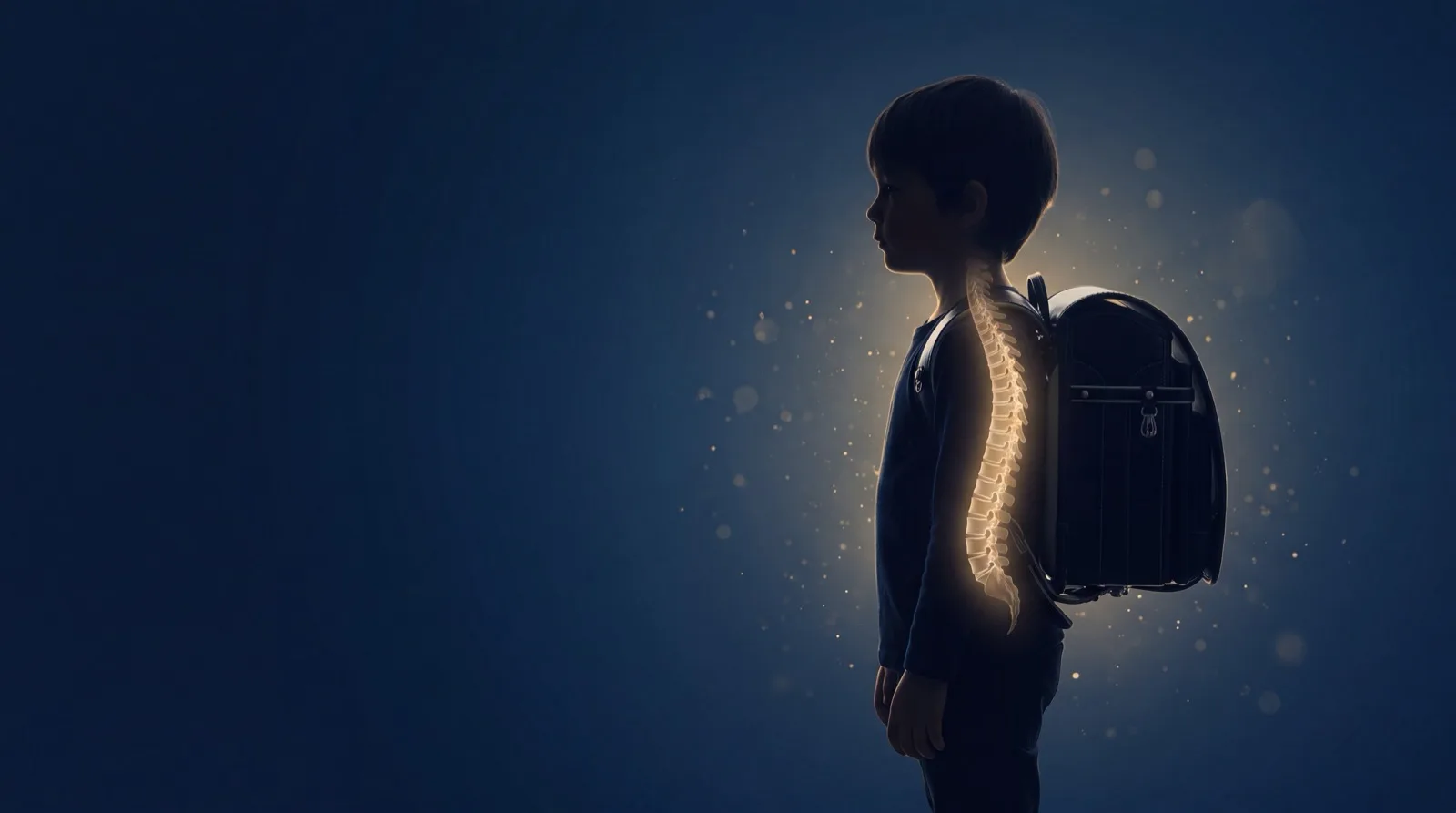
When a child shoulders a backpack, the load creates two forces simultaneously: vertical compression driving down through the spine, and a forward flexion moment pulling the torso and head forward and down. To compensate, the child must either lean backward from the hips — creating lumbar hyperextension — or forward from the shoulders, driving the head ahead of the body's center of gravity.
Both compensation patterns create asymmetric loading through the developing vertebral end plates — the cartilaginous growth centers at the top and bottom of each vertebra. In a structurally aligned spine, vertical load is distributed evenly across the full disc and end plate surface. In a spine that is compensating for backpack weight, that load concentrates on the anterior (front) portion of the vertebral bodies. Over months and years, this uneven loading pattern influences how those vertebrae develop.
The cervical and thoracic spine are particularly vulnerable. A heavy backpack encourages the head to migrate forward — increasing the functional weight the cervical spine must support. For every inch the head moves forward of its neutral position, the effective gravitational load on the cervical spine increases significantly. In a 10-year-old whose cervical vertebrae are still forming, that is not a trivial stress.
The concern is what five days a week, nine months a year, over six or more years of schooling does to a spine designed to grow under neutral structural load.
The 10% rule — and why a developing spine is more vulnerable
Backpack Load and Postural Compensation
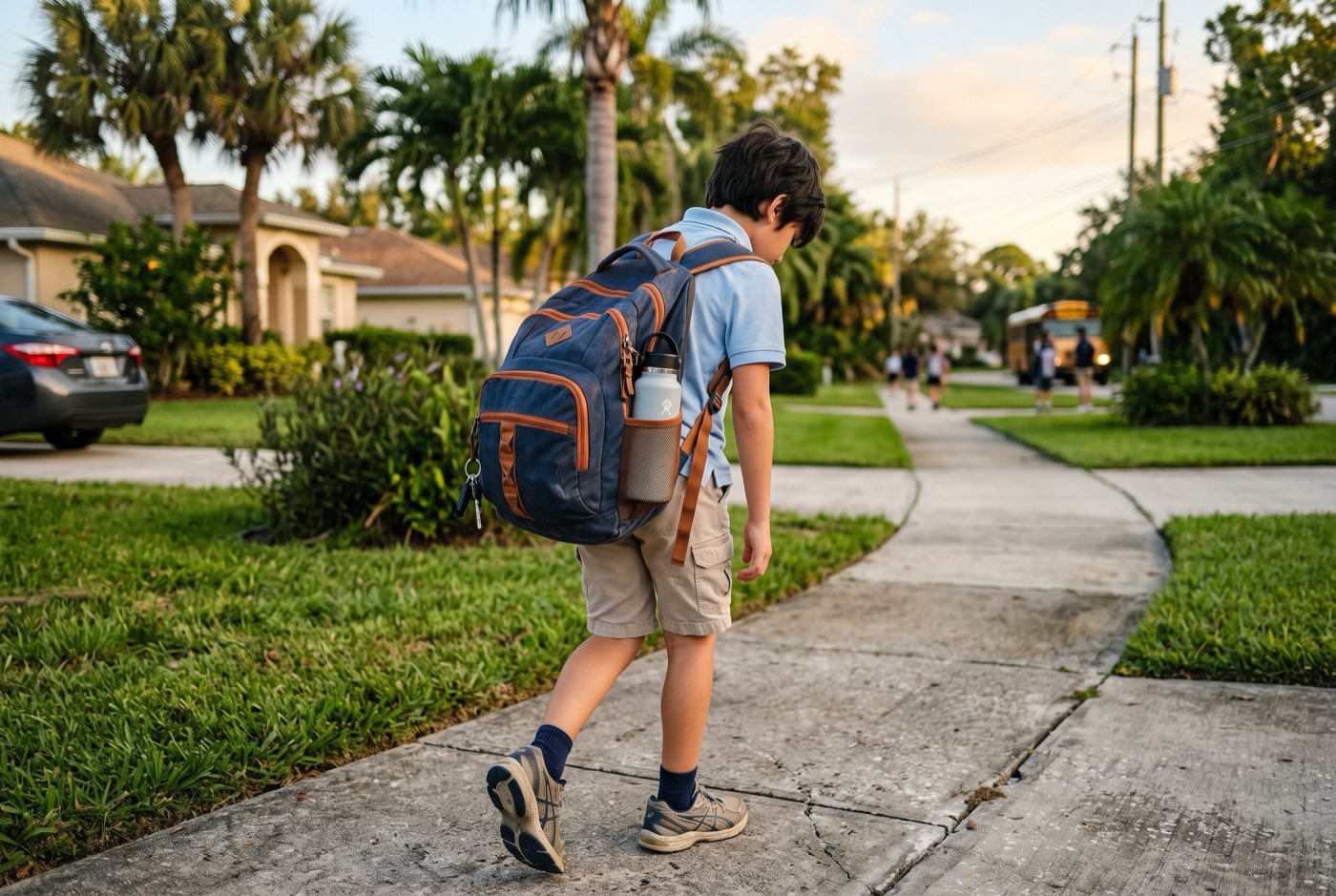
The forward lean and low-sagging pack: the postural compensation pattern a heavy backpack creates in a developing spine.
The 10% Body Weight Guideline
60 lb child (typical 8-year-old): Maximum backpack weight = 6 lbs
75 lb child (typical 10-year-old): Maximum backpack weight = 7.5 lbs
90 lb child (typical 12-year-old): Maximum backpack weight = 9 lbs
Average load measured in studies: 22% of body weight — more than double the guideline (Negrini & Carabalona, Spine, 2002)
The problem is total weight combined with duration (6–8 hours), frequency (5 days per week), and the developmental stage during which loading occurs.
The reason the 10% threshold matters more for children than adults comes down to developmental biology. An adult spine has finished forming — its vertebral shapes are set, its disc heights are established, its curves are fixed. A growing spine is none of those things. The Wolff's Law principle that governs bone remodeling — that bone adapts to the loads it regularly bears — applies actively and rapidly in a growing child. The spine a child develops is shaped in part by the structural loads it experiences during development.
Subluxation created by chronic backpack overload is not the same as subluxation from a fall or an acute injury. It develops gradually, through progressive vertebral compensation and the structural adaptations that follow. Because the compensation is gradual, and because children are remarkably good at adapting without producing symptoms, it often goes undetected until a structural evaluation reveals what is already established.
What subluxation looks like in school-age children
Pediatric subluxation does not present the way adult subluxation typically does. Children compensate differently — the nervous system at younger ages is more neuroplastic, more capable of routing around interference before expressing it as recognizable symptoms. That is Innate Intelligence doing what it was designed to do. It is also why waiting for symptoms before seeking structural evaluation misses the window when correction is most effective.
How pediatric subluxation compensation differs from adults:
Adults tend to express subluxation as localized pain or neurological symptoms (numbness, tingling, radiating discomfort). Children more often express it as postural adaptation — the spine and musculature reorganize around the subluxation rather than producing a pain signal.
What you can observe externally in a child carrying subluxation from backpack load or other structural stress: one shoulder sits measurably higher than the other at rest. The head tilts or rotates slightly off-center. When the child stands relaxed with feet together, the hips are not level. When they walk, one shoe shows a different wear pattern than the other — indicating uneven gait mechanics and rotational compensation through the pelvis and lumbar spine.
None of these signs are diagnostic on their own. But any of them — particularly when consistent and visible across different contexts — is a structural pattern worth evaluating. The external posture is the visible expression of what is happening architecturally in the spine.
Signs it is time to have your child's spine checked
These are the signals that warrant evaluation: structural patterns indicating the spine may be compensating in ways worth identifying and correcting.
- One shoulder consistently higher than the other at rest, with or without the backpack
- Visible head tilt or forward head carriage when standing relaxed
- A tendency to lean or shift weight to one side when standing still
- Uneven hip height when observed from behind
- One shoe wearing down faster than the other — particularly on the heel or outer edge
- Fatigue after school disproportionate to activity level
- Difficulty sitting still that does not improve with rest or breaks
- Complaints of "growing pains" localized to the lower or mid-back, outside of normal limb growth patterns
Children's bodies are resilient. What the signals mean is that there is structural information worth gathering — and the years when the spine is still developing are when acting on that information matters most.
What practical backpack changes actually help
Structural correction of subluxation is the clinical response. There are also practical changes that reduce the daily structural load on a growing spine. None of these replace evaluation — but they matter.
Weight reduction: Audit the backpack weekly. Textbooks that are not needed for the next day's work should not travel home. A 3-pound reduction in pack weight is structurally meaningful for a 60-pound child.
Both straps, always: Single-shoulder carrying concentrates the load laterally, creating immediate lateral spinal flexion and asymmetric loading. Both straps engaged, adjusted to keep the pack close to the torso, distributes load more symmetrically.
Hip belt use (when available): Backpacks with a hip belt transfer a significant portion of the load to the pelvis rather than the shoulders and spine. Most children's packs do not include these — but when available, they should be used.
Pack placement: The pack should rest against the mid-back, not hanging low toward the lumbar or below. Low-hanging packs dramatically increase the forward flexion moment on the lumbar spine.
These are load-reduction strategies. A spine that is already subluxated from months of overloading does not correct itself when the load decreases. Structural correction requires structural care.
Pediatric chiropractic care in Royal Palm Beach
At Rochet Family Chiropractic, children's spinal evaluations are adapted entirely for the patient's age and developmental stage. A complete structural evaluation is included with your child's initial new patient visit. When subluxation is identified, correction is specific and gentle — the techniques appropriate for a child's spine are fundamentally different in force and direction from those used in adult structural correction.
I have been in practice in Royal Palm Beach since 2007. Families bring their children here from Royal Palm Beach, West Palm Beach, Wellington, Palm Beach Gardens, and Lake Worth. What I want every parent of a school-age child to consider: the spine being built right now is the one they will carry into adulthood.
Have you ever had your child's spine checked for subluxation?
Schedule a Pediatric Structural Evaluation
Your child's spine is forming right now — during the same years they're carrying a backpack five days a week. Structural evaluation identifies subluxation before compensation patterns are established. Dr. Romar Rochet provides pediatric chiropractic care in Royal Palm Beach, FL.
Schedule Your Child's AssessmentTo understand more about how vertebral subluxation affects nervous system function at any age, including how early subluxation patterns established in childhood carry forward into adult health, read our foundational overview of subluxation and structural correction.
Frequently asked questions
How heavy is too heavy for a school backpack?
The standard guideline is 10% of body weight. A child weighing 60 pounds should carry no more than 6 pounds; a 90-pound child no more than 9 pounds. Published research measured students carrying an average of 22% of their body weight (Negrini & Carabalona, Spine, 2002) — more than double the 10% guideline.
Can a heavy backpack cause lasting spinal problems in children?
Heavy backpack load creates structural stress on a still-developing spine — one that is actively forming its curves, calcifying its vertebral end plates, and building the structural architecture it will carry for life. Chronic compressive and asymmetric load that creates vertebral subluxation during this developmental window has different long-term implications than the same load applied to a mature spine. The spine adapts to what it regularly bears.
What is pediatric subluxation?
Vertebral subluxation in children refers to misalignment of spinal vertebrae that disrupts nervous system function. It occurs in children and infants just as in adults, though the causes differ — the birth process, developmental milestones, falls, and chronic postural loads like heavy backpacks all contribute. Children often compensate for subluxation without producing noticeable symptoms, which is why structural evaluation is the clinically sound approach.
At what age should children have their spine checked?
There is no minimum age for a structural spinal evaluation. Many parents bring infants and toddlers to ensure proper alignment through the rapid developmental stages of early childhood. School-age children benefit from evaluation when they begin carrying backpacks, participating in organized sports, or when postural asymmetry becomes visible. The pediatric spine changes rapidly — early evaluation establishes a structural baseline.
What are signs that my child's spine needs to be checked?
Structural signals to watch for include: one shoulder consistently higher than the other, a visible head tilt or forward head carriage, a tendency to lean or shift to one side when standing, uneven hip height, one shoe wearing faster than the other, or fatigue after school that seems disproportionate to activity. These are structural patterns worth evaluating.
Is chiropractic care safe for children?
Pediatric chiropractic evaluation and structural correction uses techniques adapted entirely for the child's size, age, and developmental stage. The forces involved are gentle and specific — fundamentally different from adult spinal correction. Subluxation-based chiropractic for children focuses on structural evaluation and age-appropriate correction to support the nervous system during the critical years of spinal development.
Is there a pediatric chiropractor near me in Royal Palm Beach or West Palm Beach?
Rochet Family Chiropractic at 650 Royal Palm Beach Blvd, Suite 7 provides pediatric structural evaluation and subluxation-based care for children of all ages throughout Royal Palm Beach, West Palm Beach, Wellington, Palm Beach Gardens, and Lake Worth. Dr. Romar Rochet has over 20 years of experience in family and pediatric chiropractic care. New patient appointments are available by calling (561) 795-3156.