
The pelvis carries more than weight during pregnancy
During pregnancy, the pelvis performs three distinct structural functions simultaneously. It transfers the increasing weight of the growing uterus down through the femurs and into the ground. It forms the birth canal — the bony passage the baby must navigate at delivery. And it maintains sacroiliac stability as the hormone relaxin progressively loosens the ligaments that hold the pelvic ring together.
The pelvic ring itself is formed by four structures: the sacrum in the posterior center, two iliac bones on either side, and the pubic symphysis joining the ilia at the front. In a structurally aligned pelvis, these four components distribute load evenly and maintain the geometry of the birth canal inlet, midpelvis, and outlet.
Relaxin, which rises through the first trimester and peaks around the second, is a necessary adaptation — the body preparing the pelvis for the expansion required at delivery. But increased ligament laxity also makes the sacrum and iliac bones more susceptible to subluxation. A pelvis already carrying minor misalignment before pregnancy can shift further under the combined pressures of hormonal change, altered center of gravity, and increasing uterine weight. This is why structural evaluation early in pregnancy — before symptoms develop — matters.
Pelvic Structural Reference Points
Sacrum: Wedge-shaped bone at the base of the spine, formed by five fused vertebrae. Articulates with both iliac bones at the sacroiliac (SI) joints.
Ilium (×2): The large "wings" of the pelvis. Anterior or posterior iliac rotation is a common subluxation pattern.
Pubic symphysis: The cartilaginous joint at the front of the pelvis; softens during pregnancy to allow pelvic expansion.
Sacroiliac joints: The two joints connecting the sacrum to each ilium; primary site of pelvic subluxation.
What pelvic subluxation means — and why it differs from "back pain"
Back pain during pregnancy is a symptom — the body's signal that structural or neurological stress has exceeded its ability to compensate silently. Pelvic subluxation is the structural condition that often underlies that signal (Damen et al., Acta Obstet Gynecol Scand, 2001): the misalignment of bony pelvic structures and the resulting disruption to nerve transmission.
When the sacrum rotates laterally or lists to one side, or when one ilium is anteriorly rotated while the other tilts back, the geometry of the entire pelvis changes. This is a structural condition with measurable mechanical consequences.
What makes lumbosacral subluxation particularly significant during pregnancy is the nervous system connection. The nerve supply to the uterus is lumbosacral: the sympathetic supply arising at the T10–L1 levels is dominant for uterine muscle tone, while the sacral nerve roots — S2, S3, and S4 — passing through the sacral foramina (openings in the sacrum) govern pelvic floor function and bladder and bowel regulation. When the lumbosacral spine is subluxated, that nerve supply can be mechanically compromised. That nerve interference affects how the pelvis functions — including how the uterine muscles respond during labor.
It is also possible — and common — to have significant pelvic subluxation without notable back pain. The God-given intelligence of the body compensates for structural disruption long before symptoms appear. Waiting for pain before seeking structural evaluation misses the point.
How pelvic alignment affects fetal positioning
Pelvic Anatomy — Alignment and Birth Canal
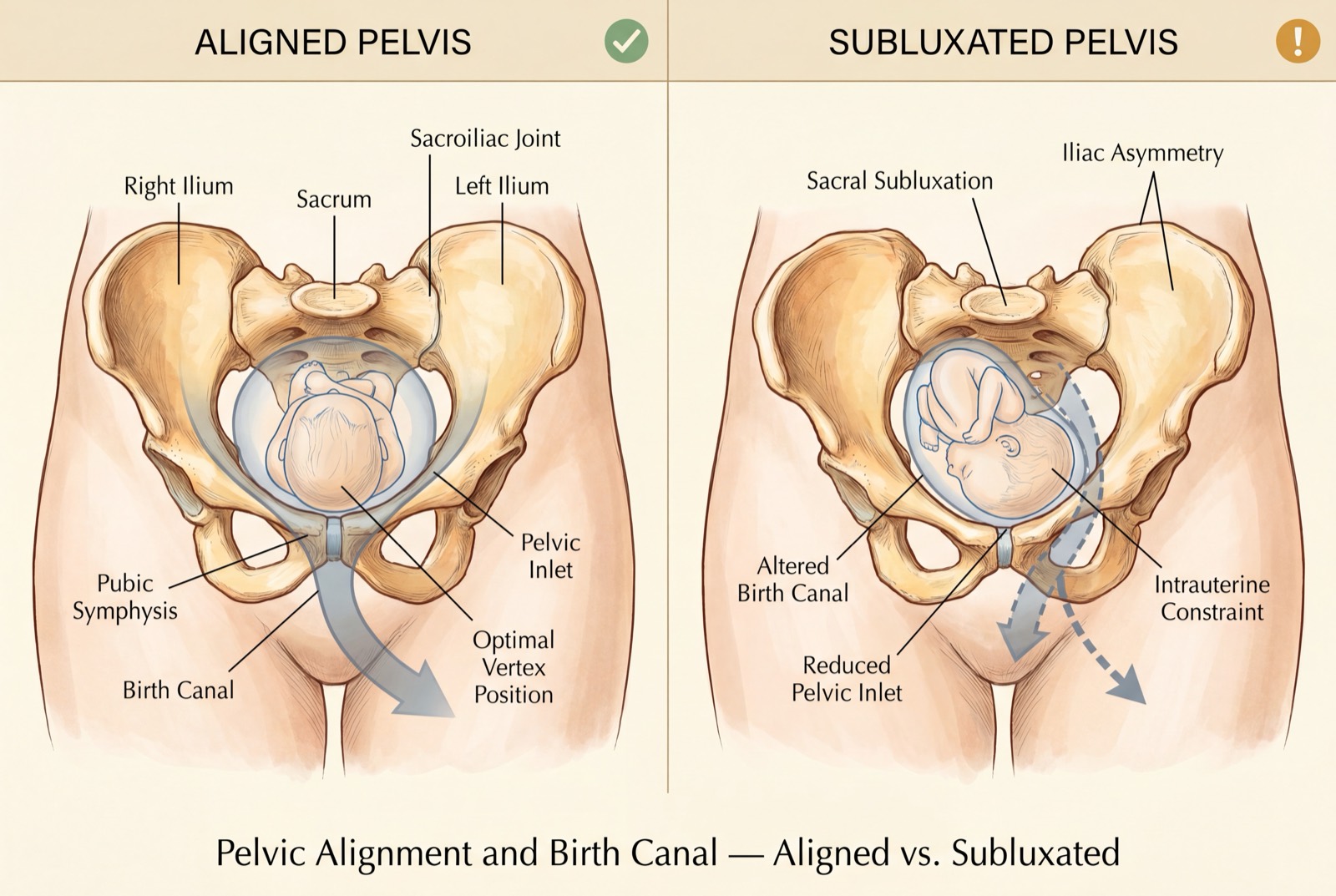
Left: Structurally aligned pelvis — symmetrical birth canal, optimal fetal positioning. Right: Subluxated pelvis — sacral rotation, iliac asymmetry, altered birth canal geometry.
A baby moves toward vertex presentation — head down, ideally in an occiput anterior position — through a combination of gravity, amniotic fluid dynamics, and uterine muscle tone. The last of those three is directly influenced by the lumbosacral nerve supply to the uterus. When the lumbosacral spine is subluxated, the nerves supplying the uterine musculature are under mechanical stress. Uterine muscle tone becomes asymmetric.
That asymmetry matters because the uterus is suspended by ligaments — primarily the round ligaments (one on each side), the broad ligament, and the uterosacral ligaments. When the pelvis is structurally symmetrical, these ligaments are balanced in tension on both sides of the uterus. When the pelvis is subluxated — one ilium rotated anterior, the sacrum listing laterally — those ligaments pull unevenly. The result is intrauterine constraint: the uterus becomes functionally uneven, narrower on one side, and the available space for fetal movement is reduced.
Intrauterine constraint doesn't prevent delivery. It does make it harder for a baby to find and hold optimal position.
Birth canal mechanics: what structural symmetry actually means at delivery
The birth canal has three distinct reference points, each defined by the relationship between the sacrum, iliac bones, and pubic symphysis.
Pelvic Inlet: The superior opening of the birth canal. Normal anteroposterior diameter: approximately 11 cm. Sacral subluxation with posterior rotation reduces this AP diameter by crowding the sacral promontory (the front edge of the sacrum) toward the pubic bones.
Midpelvis: The narrowest portion of the canal, at the level of the ischial spines. Lateral iliac subluxation creates asymmetric midpelvis dimensions — wider on one side, narrower on the other — requiring the baby to navigate an off-center passage.
Pelvic Outlet: The inferior opening. Defined by the coccyx posteriorly, ischial tuberosities laterally, and the pubic arch anteriorly. Sacral subluxation affects the coccyx position, which can reduce the available posterior outlet space.
A subluxated sacrum that reduces pelvic inlet AP diameter (front to back) by even a centimeter creates a structurally different delivery environment than an aligned one. A midpelvis that is asymmetric requires the baby to rotate through an uneven space. Structural symmetry — a pelvis where the sacrum sits in neutral and both ilia are even — is the foundation that optimal birth mechanics requires.
What subluxation-based chiropractic care offers during pregnancy
The goal of subluxation-based chiropractic care during pregnancy is structural restoration during a period of maximum pelvic demand. A complete pelvic structural evaluation for expecting mothers is included with your initial new patient visit — identifying whether the pelvis is functioning as designed or compensating around a subluxation.
When subluxation is found, correction is specific, gentle, and adapted for pregnancy. The techniques appropriate for a 32-week pregnant patient differ significantly from standard adult correction. This is specific structural work directed at the identified misalignment.
Earlier evaluation is structurally more advantageous. In the first trimester, before relaxin-driven ligament laxity peaks, the pelvis is more correctable — the structures haven't had months of load bearing in a misaligned position. Care through the second and third trimesters then supports ongoing structural integrity as the body changes rapidly and pelvic demand increases week by week.
What I tell every expecting mother who asks about this: your body was designed — fearfully and wonderfully — to carry and deliver life. Innate Intelligence is at work throughout the entire pregnancy. My job is to remove what's interfering with that intelligence expressing itself fully. A subluxated pelvis is interference. Correcting it is how we honor the design.
Expecting mothers in Royal Palm Beach, West Palm Beach, and Wellington
Rochet Family Chiropractic serves expecting mothers throughout Royal Palm Beach, West Palm Beach, Wellington, Palm Beach Gardens, and Lake Worth. Pelvic structural evaluation during pregnancy is available as a standalone visit or as part of ongoing subluxation-based care.
If you are pregnant — at any stage — and have never had your pelvic alignment evaluated: the pelvis can carry significant subluxation long before pain appears. What a structural evaluation tells you is whether that foundation is what your baby needs it to be.
Have you ever had your spine checked for subluxation?
Expecting Mothers: Schedule a Pelvic Structural Assessment
Your pelvis is doing more during pregnancy than at any other stage of life. Structural evaluation is what ensures it is functioning the way it was designed to. Dr. Romar Rochet provides subluxation-based prenatal chiropractic care in Royal Palm Beach, FL.
Schedule Your AssessmentFor more on how vertebral subluxation affects the nervous system beyond the spine, and what structural correction can restore, read our foundational article on subluxation and nervous system function.
Frequently asked questions
Is chiropractic care safe during pregnancy?
Subluxation-based structural chiropractic care can be appropriate throughout pregnancy. Evaluation focuses on the alignment of the sacrum, iliac bones, and sacroiliac joints — structures under significant demand during pregnancy. Techniques used for pregnant patients are specific, gentle, and modified for the changes of pregnancy. As with any care during pregnancy, the evaluation informs the approach.
How does pelvic misalignment affect fetal positioning?
Pelvic subluxation — particularly sacral misalignment or anterior iliac rotation — creates asymmetric tension in the uterine ligaments, especially the round and broad ligaments. This ligament tension asymmetry creates intrauterine constraint: the uterus becomes functionally uneven, making it harder for the baby to rotate into and hold optimal vertex presentation. A structurally symmetrical pelvis provides a more neutral uterine environment.
What is pelvic subluxation during pregnancy?
Pelvic subluxation refers to misalignment of the sacrum, one or both iliac bones, or the sacroiliac joints that disrupts structural symmetry and nervous system function. During pregnancy, relaxin loosens pelvic ligaments — a necessary adaptation — but this also increases susceptibility to subluxation. Lumbosacral subluxation is particularly significant because the nerve supply to the uterus is lumbosacral — the sympathetic supply (T10–L1) is dominant for uterine muscle tone, while the sacral roots (S2–S4) govern pelvic floor, bladder, and bowel function.
When during pregnancy should I see a chiropractor?
Earlier evaluation is structurally more advantageous. The first trimester, before ligament laxity peaks, is the optimal time to establish a pelvic structural baseline and address any pre-existing subluxation. Care through the second and third trimesters supports structural integrity as the body changes rapidly and pelvic demand increases. A pregnancy chiropractor in Royal Palm Beach can evaluate your pelvic alignment at any stage.
How does pelvic subluxation affect the birth canal?
The birth canal is defined by three bony landmarks: the pelvic inlet, midpelvis, and pelvic outlet — all formed by the relationship between the sacrum, iliac bones, and pubic symphysis. Sacral subluxation with posterior rotation narrows the anteroposterior diameter of the pelvic inlet. Lateral iliac subluxation creates asymmetric midpelvis dimensions. These are structural changes that alter the pathway a baby must navigate during delivery.
What is the difference between pregnancy back pain and pelvic subluxation?
Back pain during pregnancy is a symptom — a signal the body produces when structural or neurological stress exceeds its ability to compensate silently. Pelvic subluxation is the structural condition that often underlies that signal (Damen et al., Acta Obstet Gynecol Scand, 2001). It is possible — and common — to have significant pelvic subluxation without notable back pain. Structural evaluation identifies subluxation regardless of symptom presence.
Is there a pregnancy chiropractor near me in Royal Palm Beach or West Palm Beach?
Rochet Family Chiropractic at 650 Royal Palm Beach Blvd, Suite 7 serves expecting mothers throughout Royal Palm Beach, West Palm Beach, Wellington, Palm Beach Gardens, and Lake Worth. Dr. Romar Rochet provides subluxation-based structural evaluation and care specific to the demands of pregnancy. New patient appointments are available by calling (561) 795-3156.