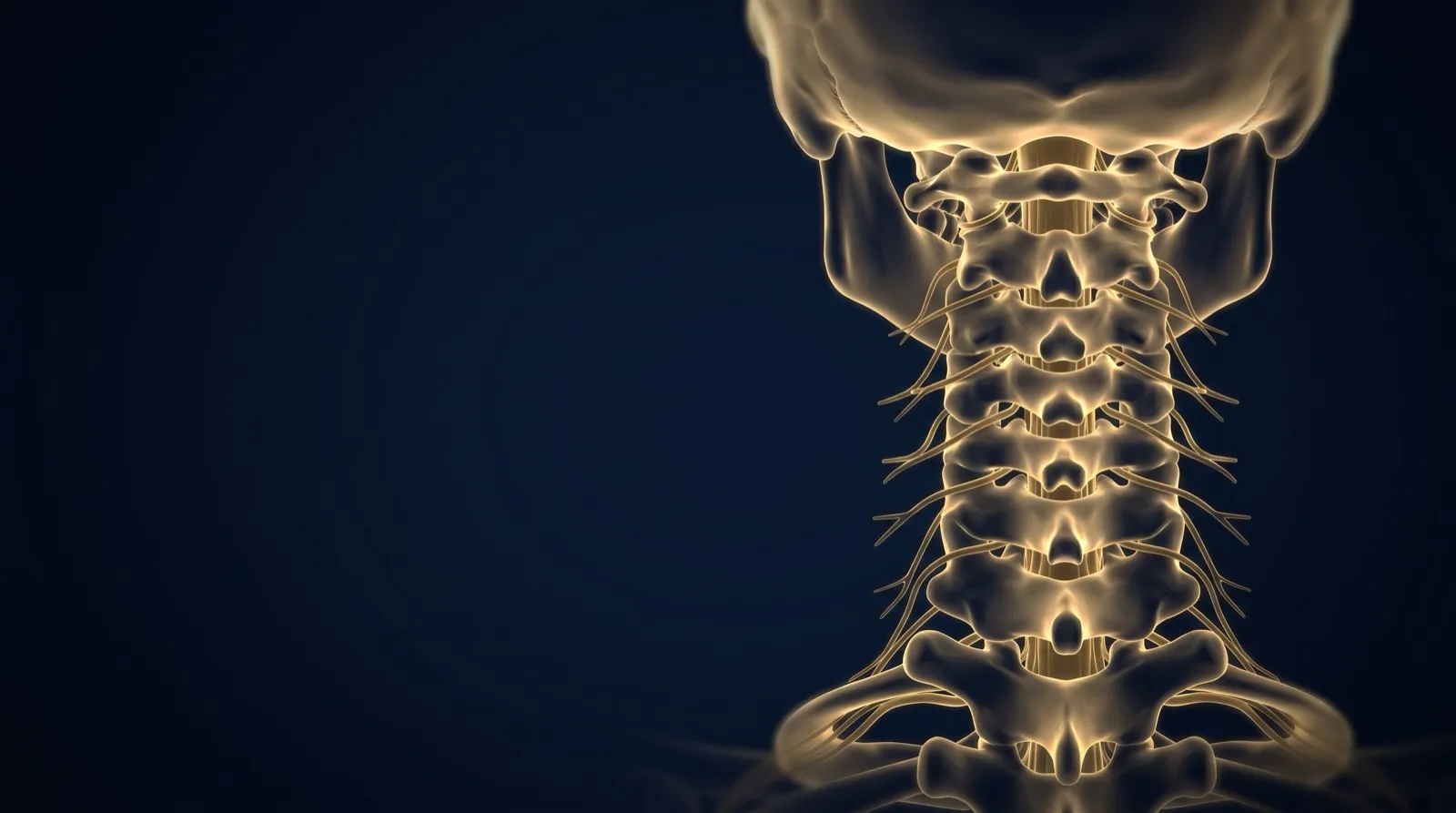
Atlas subluxation is a vertebral subluxation of C1, the atlas, the first bone of the spine. The atlas sits directly under the skull, around the place where the brain stem becomes the spinal cord. When the atlas has misaligned, often together with C2 (the axis) beneath it, it interferes with the nerve flow between the brain and the body.
Atlas and axis subluxation is a frequent finding in our Spinal Correction Spotlight cases. People came in for headaches, neck pain, vertigo, low back and hip pain, and in one case a 10-year-old boy's facial tics. In each of the thirteen cases at the bottom of this page, the films showed subluxation at the top of the neck, at the atlas, the axis, or both.
C1 and C2: the top of the spine
How the two bones work
The atlas is a ring of bone with no disc above it. It carries the weight of the skull, and the opening at its center holds the place where the brain stem becomes the spinal cord. The axis (C2) sits below it. A post of bone on the axis, called the dens, rises into the front of the atlas ring, and the atlas turns around it each time you turn your head. A large share of the rotation in your neck happens at this one joint.

The atlas (C1) seen from above. The odontoid process (dens) of the axis (C2) sits inside the front of the atlas ring, held by the transverse ligament. The atlas turns around it when you turn your head. Sobotta, Atlas and Text-book of Human Anatomy, 1909. Public domain.
Because of where it sits, a subluxation at this level can affect far more than the neck.
“These 2 bones have a direct influence on the brain stem, and subsequently, every function of the body.”
Dr. Romar Rochet, The Weekly Adjustment, January 2021
“C1 is the gatekeeper to both spinal correction as well as neurological function.”
Dr. Romar Rochet, The Weekly Adjustment, March 2022
What patients came in with
The reasons given at the first visit
These are the reasons people gave for coming in, in the atlas cases documented below:
- Headaches and migraines
- Neck and upper back pain
- Vertigo
- Low back pain and hip trouble
- Anxiety attacks and acid reflux
- Interrupted sleep and a reduced ability to exercise
- Slow digestion and disruptive menstrual cycles
- Facial tics that were increasing
Low back pain brought several of them in. In one of those cases, Dr. Rochet wrote:
“He originally came to us with low back pain, but his greatest subluxation was his atlas. More than 80% of his adjustments were to his Atlas, which has had a global effect on his overall wellbeing and ADL’s (activities of daily living).”
Dr. Romar Rochet, The Weekly Adjustment, January 2021
An atlas subluxation can be present for years before anything is felt. Pain is feedback, and it often arrives late.
Atlas subluxation after birth
Where it can start
For many people, the first physical stress on the atlas comes at birth. Delivery places pulling and twisting forces on a baby's head and neck, even in an uncomplicated birth. When Dr. Rochet lists the physical stresses that cause subluxation, he names “the birth process, which is a huge one.”
Medical research has studied these forces for decades. In 1969, the pathologist Abraham Towbin published his findings on latent (hidden) spinal cord and brain stem injury in newborn infants.1 Pediatric spine research explains why the upper neck is the level at risk: a young child's head is large compared to the body, the neck muscles are still developing, the soft tissues are more elastic, and the joints of the upper neck sit at a flatter angle. For these reasons, spinal injuries in very young children occur more often in the upper cervical spine.2 An assisted delivery adds more force. Simulation research has measured the pressure and traction that forceps and vacuum devices place on the head and neck,3 and rotational forceps delivery is associated with upper cervical spinal cord injury in newborns.4 Those are the most severe cases. They show where the forces of delivery concentrate.
What parents notice
A baby cannot tell you that the atlas has misaligned. Parents see it in other ways. In a Dutch study of 307 infants with upper cervical dysfunction, the most common reasons parents brought them in were a preferred head position, restlessness, and an abnormal head position.5 The International Chiropractic Pediatric Association (ICPA) describes how the traction of most births, vaginal or cesarean, can misalign the top bone of the neck, interfere with the nervous system, and affect a baby's comfort, sleep, digestion, immune system, coordination, and breastfeeding.6 In 1987, the German physician G. Gutmann described blocked nerve impulses at the atlas in infants and young children, with effects that ranged from motor development to lower resistance to ear, nose, and throat infections.7
The foundation for what follows
An atlas subluxation from delivery can stay in place through infancy and childhood, while the brain, the spine, and the nervous system grow faster than at any other time in life. The interference sits at the top of the nervous system for all of those years. That is how an atlas subluxation at birth can become the foundation for future dysfunction.
Checking a baby's spine is gentle work. A 2019 systematic review of manual therapy in children found that adverse events were uncommonly reported, and the ones reported were transient and mild to moderate.8 This is why the spine should be checked for subluxation early. Children of every age, newborns included, can have their spines checked at our office. More on newborn subluxation and children's chiropractic.
Correction takes time
No single care plan fits everyone
How long correction takes depends on how long the subluxation has been there and how far the spine has progressed. Healing takes time. The worse the start, the longer it takes.
Correction moves some measurements before others. In one 27-year-old woman's case, her neck curve measured worse at re-evaluation while her atlas position and head rotation corrected.
“It is actually common for one aspect of the spine to “get worse” even as another improves.”
Dr. Romar Rochet, The Weekly Adjustment, May 2023
In the case of a 46-year-old entrepreneur, Dr. Rochet wrote:
“An Atlas (C1) correction of this magnitude, as well as seeing how that correction resulted in such QOL improvements, is a powerful, positive influence on the ability of her Innate Intelligence to manifest health and proper function in her body.”
Dr. Romar Rochet, The Weekly Adjustment, June 2022
One man felt better after a few adjustments and stopped care. Four years later he came back unable to play with his kids, and his films showed a severe atlas subluxation with more subluxations below it.
Your initial new patient visit includes spinal X-rays. They show where your atlas sits today, and follow-up films show how it has changed.
Atlas subluxation case studies
Thirteen Spinal Correction Spotlight cases
Neck pain, upper and low back pain, anxiety attacks, and chronic acid reflux. Atlas and axis severely out of position. Read the case
Physically active, long hours at a computer, neck pain. Upper cervical subluxation. Read the case
Low back and neck trouble, vertigo, and frequent headaches while already under care at another chiropractic office. Upper cervical subluxation. Read the case
Headaches, neck and upper back tension, vertigo, pins and needles into the arms and hands, and menstrual changes. Atlas subluxation. Read the case
Felt better, stopped care, and came back four years later unable to play with his kids. Severe atlas subluxation. Read the case
Came in for low back pain. His greatest subluxation was his atlas, with the axis below it. Read the case
Migraines and neck pain, with slow digestion and disruptive menstrual cycles. Atlas and head alignment severely subluxated. Read the case
His father noticed his facial tics increasing. Atlas and head alignment severely subluxated. Read the case
Church organist and cyclist with increasing low back pain and a left hip problem. Atlas subluxation and head tilt. Read the case
Entrepreneur at a computer most of the day, with severe neck pain, upper back pain, and headaches. Atlas subluxation with head tilt. Read the case
Severe neck and low back pain with constant headaches, on a laptop up to eight hours a day. Severe left head rotation and atlas subluxation. Read the case
Neck and low back pain, frequent headaches, interrupted sleep, and less exercise. Atlas subluxation and a reversed neck curve. Read the case
Tradesman still working in his trade, referred by a long-term maintenance client. Severe atlas subluxation with multilevel disc degeneration. Read the case
Research cited on this page
- Towbin A. Latent spinal cord and brain stem injury in newborn infants. Dev Med Child Neurol. 1969;11(1):54–68. doi:10.1111/j.1469-8749.1969.tb01395.x
- d’Amato C. Pediatric spinal trauma: injuries in very young children. Clin Orthop Relat Res. 2005;(432):34–40. PubMed 15738801
- O’Brien SM, et al. Pressure and traction on a model fetal head and neck associated with the use of forceps, Kiwi ventouse and the BD Odon Device in operative vaginal birth: a simulation study. BJOG. 2017;124 Suppl 4:19–25. doi:10.1111/1471-0528.14760
- Mills JF, et al. Upper cervical spinal cord injury in neonates: the use of magnetic resonance imaging. J Pediatr. 2001;138(1):105–8. doi:10.1067/mpd.2001.109195
- Saedt ERIC, et al. Common manual therapy practices in the Netherlands for infants with upper cervical dysfunction: a prospective cohort study. J Manipulative Physiol Ther. 2018;41(1):52–61. doi:10.1016/j.jmpt.2017.08.003
- Shtulman I. Birth, baby, and breastfeeding. Pathways to Family Wellness, Issue 64. International Chiropractic Pediatric Association. icpa4kids.com
- Gutmann G. Manuelle Medizin. 1987. As summarized in Webster L. Chiropractic today for a better world tomorrow. Pathways to Family Wellness, Issue 69. International Chiropractic Pediatric Association. icpa4kids.com
- Parnell Prevost C, et al. Manual therapy for the pediatric population: a systematic review. BMC Complement Altern Med. 2019;19(1):60. doi:10.1186/s12906-019-2447-2
Have you ever had your spine checked for subluxation? Your initial new patient visit includes spinal X-rays. Call (561) 795-3156.
I love and appreciate you all.